
UC researchers examine ethics of evolving AI
UC researchers examine ethics of evolving AI
Spectrum News examines ethical questions surrounding artificial intelligence
Spectrum News highlighted work by researchers at the University of Cincinnati to explore ethical questions raised by artificial intelligence.
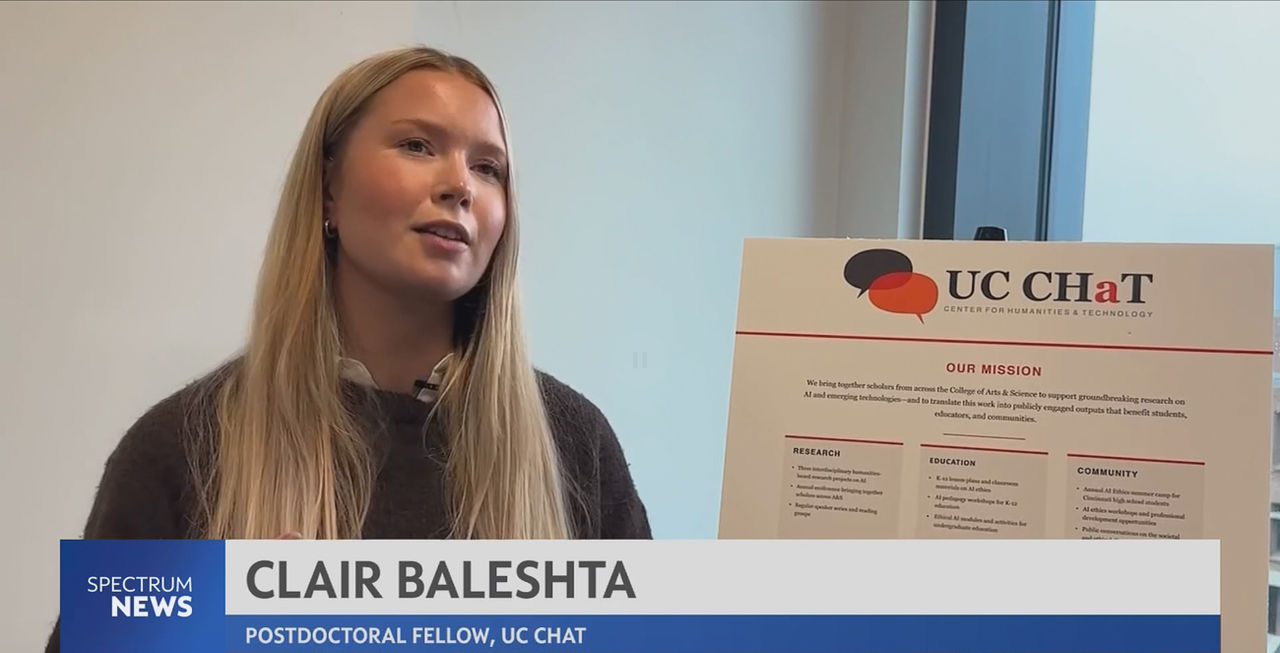
UC's Center for Humanities and Technology is looking at a number of issues surrounding AI, including harm, trust and fairness, postdoctoral fellow Clair Baleshta said.
She is studying AI ethics in UC's College of Arts and Sciences.
“We're focusing on questions about trust in AI, harm in AI,“ Baleshta told Spectrum News.
The UC center launched last year to conduct humanities research on AI and emerging technologies and connects its work to community partners to help them think critically about how they use AI.
AI agents are becoming ubiquitous across business, healthcare and education.
“There are real questions about what would it mean to trust a system that is very alien to us but nonetheless is playing an increasingly important role in all aspects of our life,“ said André Curtis-Trudel, assistant professor and director of the center.
UC's Digital Technology Solutions in December launched Ohio's first university AI platform, BearcatGPT, in stages to faculty and staff and then to students. Unlike other generative AI systems, BearcatGPT is private and secure.
Featured image at top: UC postdoctoral researcher Clair Baleshta talks to Spectrum News about her examination of the ethics around artificial intelligence. Photo/Spectrum News
Watch the Spectrum News report.
UC Assistant Professor Andre Curtis-Trudel is founding director of the Center for Humanities and Technology. Photo/Spectrum News
In a paper in Nature Human Behaviour, UC's Anthony Chemero explains the difference between AI thinking and human thinking: although AI can "lie and BS" like its maker, it is not embodied therefore doesn't have the same definition as intelligent.
The rise in AI generated fake news content is concerning, especially leading up to the 2024 presidential election. For now, there are still ways to identify fake news outlets and reporting, but the average reader needs to become more savvy, says UC's social media expert Jeffrey Blevins.
A University of Cincinnati project to protect sources of drinking water and identify valuable underground resources is part of a national initiative to harness artificial intelligence to speed scientific breakthroughs.
Related Stories
 AI News
Bill Gross bets AI can help mass
3 weeks ago
 AI News
Nigeria records 93% rise in AI micro
3 weeks ago
 AI News
The Italian gelato maker using AI to invent new flavours
3 weeks ago
 AI News
Closing the Gap Between Agentic CX Pilots and Production
3 weeks ago
 AI News
New Brunswick data centre debate highlights cross
3 weeks ago
 AI News
How to Structure an AI Agent Referral Fee Agreement Between Startups
3 weeks ago
 AI News
No, AI didn’t delete a Swedish reality TV series
3 weeks ago
 AI News
There is no AI in Armageddon. Artificial intelligence is a tool, not an apocalypse
3 weeks ago