
Undergrads gain hands
Undergrads gain hands-on machine learning experience in summer program
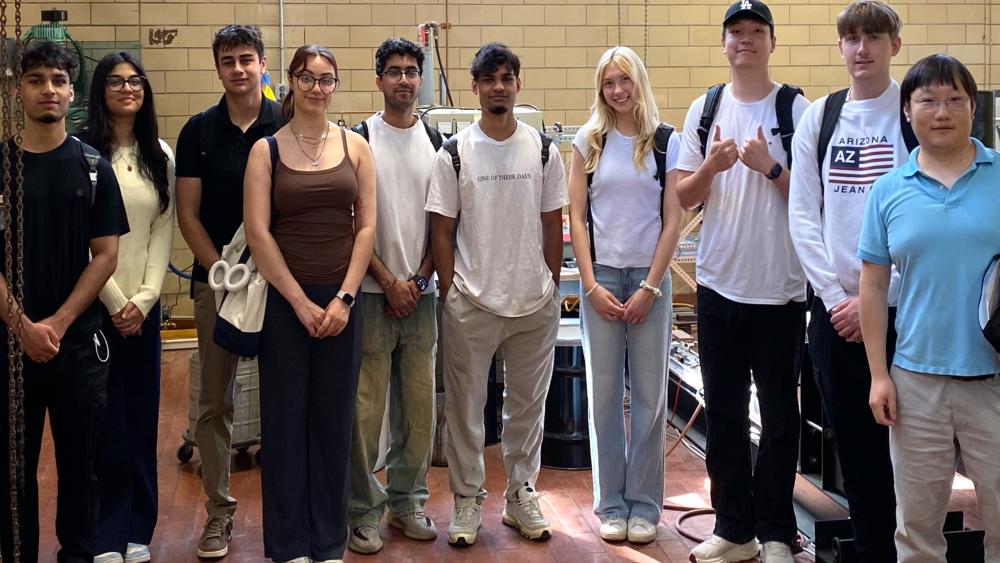
Students across engineering disciplines joined Hongtao Sun, to the far right, to gain hands-on training in machine learning. Credit: Provided by Hongtao Sun. All Rights Reserved.
UNIVERSITY PARK, Pa. — As Penn State embarks on a multi-year AI Transformation Initiative to expand enterprise artificial intelligence (AI) tools, provide AI upskilling for faculty and employees and teach students essential AI literacy skills, faculty are seeking innovative ways to give students hands-on opportunities in AI and machine learning. During two weeks in May, Hongtao Sun, assistant professor in the Harold and Inge Marcus Department of Industrial and Manufacturing Engineering, hosted 13 students for a two-week summer Research Experience for Undergraduates (REU) centered on AI-enabled research. The program was administered through Sun’s research lab, AI-Driven Materials Design and Manufacturing.
“I established this program to create opportunities for a broad range of undergraduates from varied backgrounds and levels of expertise to learn about hands-on machine learning research together,” Sun said.
Machine learning, a subfield of artificial intelligence that enables computers to identify patterns and make predictions from data, has strong applications across multiple fields and offers skills to benefit students as well as the future of science and technology, according to Sun.
The program grew from Sun’s previous experiences mentoring undergraduate students in his lab, including Steven Traczik, an industrial engineering undergraduate who first enrolled in one of Sun’s courses before joining the lab. Without prior experience in machine learning research, Traczik contributed to a project that used artificial intelligence to predict the mechanical behavior of advanced 3D-printed materials. By forecasting how deformation patterns evolve under mechanical loading, the research supports future applications in smart manufacturing, digital twins, structural monitoring and soft robotics. Traczik also co-authored a peer-reviewed paper published in ACS Applied Engineering Materials in May. Sun said the experience demonstrated that undergraduate students from diverse disciplines can make meaningful contributions to AI-enabled scientific research when provided with the right mentorship and hands-on research opportunities.
"Many people assume machine learning research is only accessible to students with extensive computer science backgrounds, but our experience has shown otherwise," Sun said. "Students from many different disciplines can successfully learn and apply machine learning tools. Because our research integrates artificial intelligence with hands-on experimental science and engineering, students can collect their own data, develop machine learning models and directly explore how AI can help analyze complex scientific and engineering problems."
The inaugural cohort featured 13 Penn State undergraduate students across multiple engineering majors, including industrial engineering, mechanical engineering and aerospace engineering. The two-week program combined hands-on exposure to engineering research with foundational training in artificial intelligence. During the first week, students participated in a series of laboratory visits and hands-on activities focused on energy storage and 4D printing. The second week featured a lecture series covering machine learning fundamentals, neural networks and data-driven research.
Aryan Ingle, senior in aerospace engineering, said he was attracted to Sun’s program because of its focus on innovation and interdisciplinary collaboration, and he appreciated Sun’s enthusiasm in their initial discussions.
“Dr. Sun was adamant in training students in basic AI math, programming and conceptual understanding,” Ingle said. “I learned the basic programming and math behind common classification and prediction models, neural networks and generative AI systems. This implementation of AI is massive in my area of study as the new space race begins.”
Sun also used the program to introduce students to the broader network of Penn State resources — including the Roar supercomputer, housed in the Institute of Computational and Data Sciences.
“We introduced students to the basic working environment for AI-related research, which included leveraging Penn State resources like the Roar supercomputer,” Sun said. “We introduced them to the Linux-based computing environment and showed them how these resources support modern AI and data-driven research.”
The program aligns closely with broader efforts within the Harold and Inge Marcus Department of Industrial and Manufacturing Engineering to prepare students for an increasingly AI-driven workforce, according to Ling Rothrock, interim head of the Harold and Inge Marcus Department of Industrial and Manufacturing Engineering.
“Artificial intelligence is becoming an essential tool across engineering and manufacturing,” Rothrock said. “We are committed to providing opportunities for students to develop AI literacy and practical skills through hands-on experiences. Programs like this help students understand how AI can be applied to real-world challenges and prepare them for careers in engineering, advanced manufacturing and emerging technology sectors.”
Sun said he hopes to continue the program in future years and expand opportunities for undergraduate students to participate in AI-enabled research projects. He also plans to help students pursue individual research experiences, either within his lab or in collaboration with faculty mentors in their respective disciplines.
“For the next iteration of the REU program, I would like to recruit students from a broader range of majors, including disciplines beyond engineering,” Sun said. “Machine learning is becoming an important tool across nearly every field, and I hope this program helps students develop the skills and confidence to apply AI to advance research in their own areas of interest.”
College of Engineering Media Relations
Related Stories
 AI News
Russia reports large
2 minutes ago
 AI News
Belgium reach World Cup knockouts as New Zealand exit tournament
2 minutes ago
 AI News
Joy, disappointment, protests: A view from Egypt
2 minutes ago
 AI News
Uruguayans distraught as defeat against Spain confirms World Cup exit
2 minutes ago
 AI News
The World Cup is undressing the myth of Trump’s American homogeneity
2 minutes ago
 AI News
'Modi right person to lead India at this critical juncture of world politics': Sharmistha Mukherjee backs...
3 minutes ago
 AI News
PM Modi is right person to lead India at this critical juncture of world politics: Sharmistha Mukherjee | India News
3 minutes ago
 AI News
Canada's first offshore wind farms move closer to reality as regulator clears bidders
3 minutes ago