
U.S., Canadian officials warn of anticipated surge in FIFA World Cup dupes
U.S., Canadian officials warn of anticipated surge in FIFA World Cup dupes
Counterfeit concerns put Canada's laws under pressure with tournament 1 week away
Security officials are anticipating a surge of counterfeit goods entering Canada and the U.S. for the FIFA World Cup, prompting a warning that Canadian laws don't go far enough to stop it.
Lawyer David Lipkus, who represents companies whose products are knocked off, says the system in Canada heavily relies on brands launching civil lawsuits instead of tougher border enforcement legislation.
"Our government needs to prioritize removing these goods from the marketplace similar to our counterparts in the United States and globally," Lipkus said.
The U.S. Embassy hosted a panel with Canadian and American border and intellectual property enforcement officials on Friday ahead of the FIFA World Cup. The officials spoke on the condition they not be named publicly. Provincial police, lawyers and sports industry representatives were in the room.
A Canada Border Services Agency (CBSA) official working in customs enforcement warned the World Cup is going to bring in new volumes of counterfeit products and it's using advanced data analysis and exploring AI to detect suspicious shipments.
An official with the U.S. Department of Homeland Security said when consumers buy dupes they could be funding other criminal activity that involve weapons and drugs.
"It's not just a counterfeit jersey. It's where the money is going, it's funding large-scale criminal organizations," the American official said.
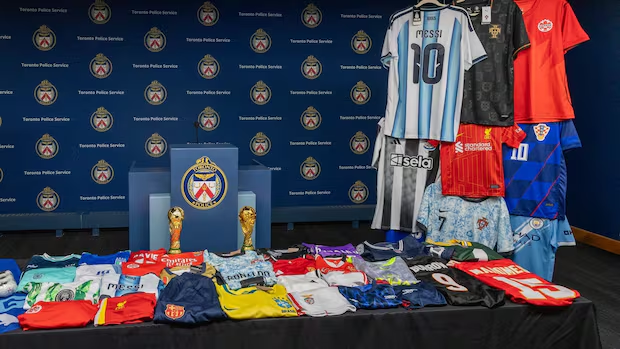
The panel warned consumers about the risk of buying counterfeit goods during the same week Toronto police announced its largest seizure of counterfeit soccer merchandise in the country's history. Police seized more than $3.5 million worth of allegedly counterfeit goods claiming to be from big-name brands including FIFA, Puma, Nike and Adidas.
Investigators said they started investigating after receiving a complaint from Lipkus's law firm that's part of the Canadian Anti-Counterfeiting Network.
Toronto police seize $3.5M worth of allegedly fake soccer merch ahead of FIFA World Cup
At the U.S. Embassy after the panel, Lipkus said the seizure shows the volume of counterfeit products already on the market and warned this was just one warehouse in one city.
He said he believes far more knock-offs are coming into the country because the laws aren't tough enough.
In the U.S., border officials have the power to seize, forfeit and destroy counterfeit goods on their own, he said.
But Lipkus said in Canada, the laws are "weaker" and border officials only have the authority to detain counterfeit goods for 10 days.
During those 10 days, the goods are only destroyed if an importer agrees or the brand being knocked off files a civil lawsuit. If the company doesn't sue during that time, CBSA is required to release the counterfeit goods into the country.
"That should be eye-opening to everyone," he said. "Because that is not enough."
Lipkus testified before the House of Commons and the Senate in 2015 calling for change, but said the problem has only gotten worse. That's in part, Lipkus said, because social media is marketing dupes directly to consumers.
Canada's trademark and copyright laws also only require websites to receive a notice they're infringing on copyright laws, he said.
Fact check: Fake FIFA World Cup websites
These are not victimless crimes, Lipkus said, and consumers should care.
"What if that jersey included toxicity in it?" said Lipkus of potential risks and ethical issues that come with purchasing these goods.
"What if that jersey included urine and feces traces because it was made in substandard conditions? What if the jersey was made by an eight-year-old child that was chained to a sewing machine? Would that change the perspective? What if you knew that money was going to a terrorist group?"
CBSA said it's doing its best to fulfill its mandate and is exploring using artificial intelligence to help detect irregular shipment patterns. The official said the tool identifies possible counterfeit goods so that officers can examine them.
The CBSA official said while it prioritizes national security at the border including firearm parts being shipped in, that doesn't mean it treats counterfeit goods at a lower level.
CBC News asked CBSA for comment about whether it has the legislative power it needs, but has not yet received a response.
Ashley Burke is a senior reporter with the CBC's Parliamentary Bureau in Ottawa. She was recognized with the Charles Lynch Award and was a finalist for the Michener Award for her exclusive reporting on the toxic workplace at Rideau Hall. She has also uncovered allegations of sexual misconduct in the Canadian military. You can reach her confidentially by email: ashley.burke@cbc.ca
Related Stories
 World
Manchester United weigh up stunning move for Real Betis and ex-Tottenham forward Troy Parrott
3 days ago
 World
Israeli police arrest 10 following weekend attacks by settlers on journalist and diplomats
3 days ago
 World
Trump says suspension of Russia sanctions is to keep peace negotiations going
3 days ago
 World
Ukrainian drones strike St. Petersburg oil facilities | NHK WORLD
3 days ago
 World
Victoria Falls stadium in Zimbabwe nears completion for CWC27
3 days ago
 World
‘The world will be amazed:’ Iran’s commanders prepare for further war
3 days ago
 World
Festival opens with musket salute in Sakai, Osaka
3 days ago
 World
Trump's new pitch for Republican candidates — they're really good
3 days ago