
U.S. Open powers up AI
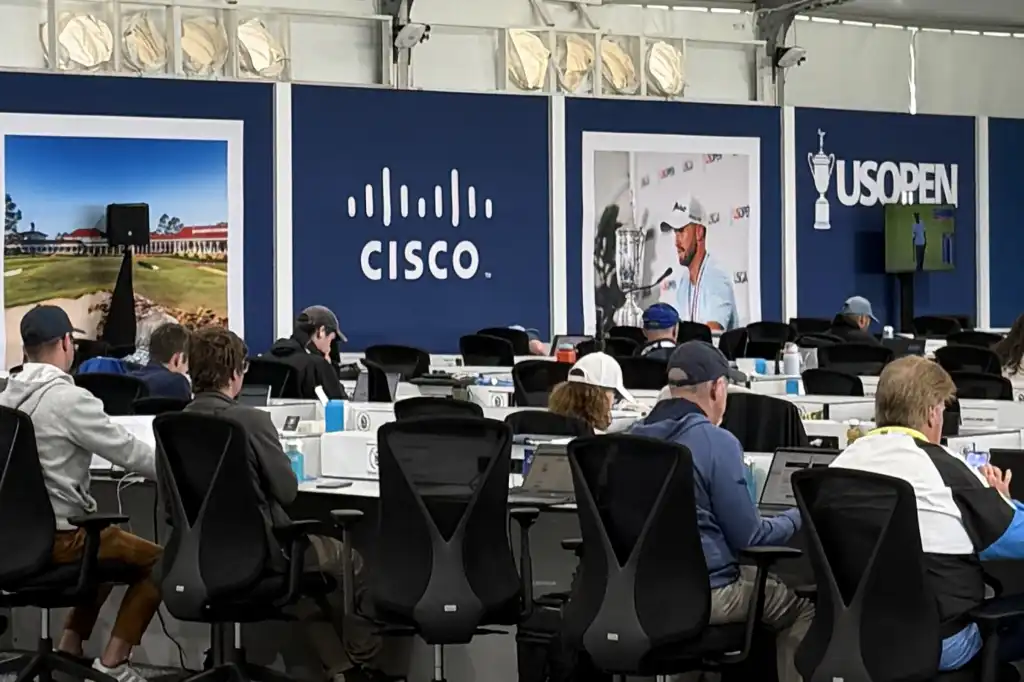
At the U.S. Open, Cisco and the USGA built a network that survives dust, rain, roving crowds, and cyberattacks — and the lessons for network engineers extend well beyond golf.
Cisco’s work with the USGA at the 2026 U.S. Open at Shinnecock Hills Golf Club was a live testbed for what AI-ready networking and security look like in the wild — not in a lab, not in a climate-controlled data center, but across 18 holes of constantly changing terrain, crowds, and threats. It’s also a blueprint that network engineers in other industries can borrow as they grapple with the convergence of connectivity, security, and AI apps.
Golf as a worst‑case network environment
From a distance, it’s tempting to lump golf in with stadium or arena networking. The reality on the ground is very different. Stadiums offer a fixed concrete bowl and predictable RF patterns. A U.S. Open venue is effectively rebuilt every year: temporary structures, new hospitality layouts, shifting fiber routes, and a crowd that never sits still.
Christian Rodriguez, senior manager, IT operations, from the USGA’s technology team, captured that reality when he explained why they tear down and rebuild from scratch: No two championships share the same layout, ISP entry points, or even the placement of critical compounds. They don’t simply clone last year’s configs; they design for the specific course, topology, and constraints of that site. That level of contextual design is expensive, but it’s also the only way to avoid brittle architectures that fall apart as soon as the environment changes.
Environmental conditions add another layer of complexity. Anthony Santora, managing director of IT for the USGA, describes the championship network as a data center without the usual comforts. There’s dust, rain, wind, and wide temperature swings instead of clean, controlled air. Hardware resides in trailers and weatherproof enclosures, not in racks behind raised floor tiles. For network engineers who spend most of their time on office campuses and in colos, that’s an important reminder: Critical infrastructure increasingly sits in places that look nothing like a traditional wiring closet.
User behavior is just as hostile. The U.S. Open has its own term — the “Tiger effect” (though one could argue it’s now the Scottie effect) — for what happens when tens of thousands of fans follow a single golfer. The hot spot moves with the group, and the RF design must cope with a dense, moving cluster of devices. That pattern should sound familiar to anyone who supports large conferences or festivals; it’s the same phenomenon, just under a different name.
Building an AI‑ready, fault‑tolerant course network
Cisco’s answer to this environment is a fully redundant, mobile core design. Instead of a single large core in a building, the network collapses into dual trailers that serve as cores on the go, typically anchored at the NBC broadcast compound and another central location. Each core hosts Cisco Secure Firewall appliances, FMCs, core Catalyst switches, DHCP, UPS, and generators, all in pairs. Rodriguez was matter-of-fact about the philosophy: “We do everything in pairs as much as we can.” If one fails, its twin picks up the load.
From those cores, the team builds a ring topology around the course, using diverse fiber paths — including trenching fiber through wooded areas — to avoid single points of failure. Mobile IDF kits in cooled cabinets serve as distribution points, delivering connectivity to weatherproof access switches and Wi-Fi access points around hospitality tents, grandstands, and entry gates. Everything on the backbone operates at Layer 3, with HSRP (Hot Standby Routing Protocol) and routing redundancy to ensure that a single switch failure doesn’t take out large swaths of the network.
The scale of a golf course deployment is massive as well, with about 500 access points and more than 100 switches, many of them the latest Wi‑Fi 7 and campus platforms. What matters is not the absolute numbers but the duty cycle. Every TV, every POS terminal, every credential pedestal, every media workstation, and every fan device share this converged fabric during a compressed, high‑risk period. Santora points out the business impact in simple terms: If merchandise goes down for even five minutes, lines explode and fans walk away. There’s no “we’ll patch it on the next maintenance window.”
On the RF side, the shift to Wi‑Fi 7 is more than a speed upgrade. Santora’s team has seen real-world performance improvements — hundreds of megabits down in the middle of a packed media center – but the more important change is resilience under high density. When you combine wider channels, better scheduling, and smarter management with a dense deployment, you get something that can withstand the Tiger Effect and the crush of content creators and broadcasters.
That last group is critical. Rob Neumann from Cisco notes that at these events, upload traffic now dominates download traffic. Influencers, media teams, and fans are publishing in near-real time, and cellular uplink simply can’t keep up. High-capacity Wi-Fi with solid backhaul isn’t a luxury; it’s the only way to avoid a miserable experience for the most vocal, visible part of the audience.
Security: Treat every device as untrusted
If the connectivity story feels familiar, the security posture at the U.S. Open is where this deployment begins to diverge from more generic “converged stadium” narratives. Santora has to contend with “thousands of untrusted devices” each championship week: fans, vendors, media, broadcasters, and staff, many of whom plug in or connect to networks the USGA doesn’t control outside the event. The USGA is well aware of the risks: outages or breaches could lead to data and financial losses, as well as reputational damage that would undermine the organization’s core mission, not just its IT metrics.
Cisco Secure Firewall, AnyConnect, Duo, and other components form the core security stack, but how they’re used is the differentiator. Fan Wi‑Fi runs with strict isolation: every client is segmented, so lateral movement is essentially off the table. Neumann explains it simply — each fan has an isolated path out — but under the covers, you get VLAN separation, policy enforcement, and inspection that treat fan traffic as untrusted end-to-end.
The rest of the network is equally segmented. There’s a separate network for ShotLink and everything “inside the ropes,” including scoring and betting feeds. Back-of-house traffic for staff, concessions, and retail runs on its own network. Remote POS systems are segmented again. Broadcast compounds and production systems have their own paths and policies. The result is a unified, converged physical fabric with tightly controlled logical overlays.
This is a pattern many enterprises discuss but struggle to implement: a single platform that carries many classes of traffic, each with its own risk profile, without collapsing into a flat, lateral-friendly network. The U.S. Open shows that it’s possible — but only if segmentation is treated as a core design principle, not an afterthought.
Observability and AI security in the loop
Security and availability at this scale demand observability. Here again, Santora’s team is in the middle of a transition many enterprises are grappling with: moving from reactive log-scraping to proactive, correlated telemetry.
Instead of manually combing through firewall and switch logs, the USGA and Cisco have built a pipeline into Splunk and Cisco’s observability tools. Neumann describes it as a single pane of glass across the network, but the more important point is what feeds that view: APs, switches, firewalls, cameras, and applications, all instrumented and reporting. When you combine that with full-stack observability, you can spot anomalies in real time, whether they’re performance issues or indicators of compromise.
That observability story extends to AI. One of the headline features of the renewed Cisco–USGA partnership is the AI-powered rules assistant: an application that lets golfers and fans ask complex rules questions in the USGA app and receive near-instant guidance. Under the hood, Santora’s team started with question–answer pairs and built a knowledge graph that now spans hundreds of topics and clusters. They also built an evaluation program that identifies outliers — questions the system struggles with — and feeds them back into human review.
Cisco AI Defense wraps the assistant with security controls. It’s not enough to get rules right; the system must resist prompt injection, data exfiltration, and other AI-specific threats that are increasingly appearing in the wild. The teams monitor usage, validate models, and protect applications at runtime against misuse or abuse. Perhaps most importantly, they keep a human override in place. If the system isn’t confident, it won’t answer; it escalates to rules experts rather than bluffing.
This is a model network engineers should watch as AI assistants and agents proliferate across other industries. The U.S. Open rules assistant isn’t treated as a toy or a sidecar; it’s a mission-critical application that resides within the same protected fabric as POS, scoring, and broadcast and is subject to the same observability and security rigor.
Lessons for network engineers beyond golf
Strip away the golf-specific details, and a set of lessons emerges:
Perhaps the most important takeaway is cultural rather than technical. Santora and his team position AI and automation as tools for scale, not as replacements for experts. The rules assistant accelerates responses and expands reach, but it still defers to human judgment when confidence is low. The network uses automation and observability to keep a complex environment running, but it still depends on experienced engineers, in trailers on-site, watching for issues and making decisions.
For network engineers in other industries, that’s a useful template: Build AI-ready, secure, observable networks that assume the worst about their environment, and pair them with human expertise that can adapt when reality inevitably diverges from the design.
Related Stories
 AI News
The CEO of the unicorn AI accounting startup, Rillet, says AI is changing who consulting firms hire
21 minutes ago
 AI News
7 ways AI can be used to enhance security operations
51 minutes ago
 AI News
Argentina Artificial Intelligence in Packaging
51 minutes ago
 AI News
Dr. Dre Says Artificial Intelligence Is Not a Threat to Creative Musicians
51 minutes ago
 AI News
Claude is down
51 minutes ago
 AI News
Omega Seiki Mobility Partners with Electra AI for Battery Health Intelligence
1 hour ago
 AI News
Artificial intelligence in action: how AI agents are transforming businesses, public administrations and strategic sectors
1 hour ago
 AI News
Alibaba’s US$10 billion share sale three times oversubscribed in Hong Kong
2 hours ago