
Vancouver 'RoboCop' is 1st Canadian ALS patient to receive Elon Musk's Neuralink brain implant
Vancouver 'RoboCop' is 1st Canadian ALS patient to receive Elon Musk's Neuralink brain implant
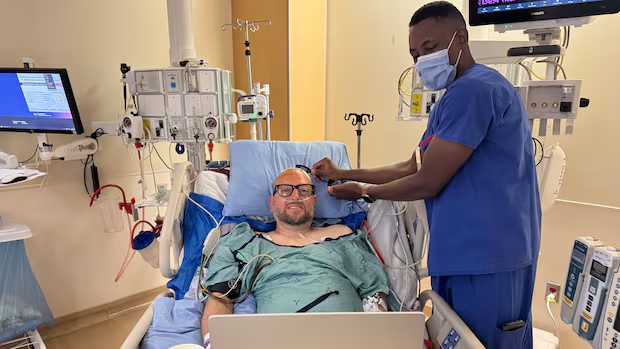
Lee Marten, a VPD sergeant, underwent surgery on May 20
Sitting in his wheelchair, hands at his side, 48-year-old Lee Marten looks at the computer screen in front of him and imagines moving the cursor across the screen. As quickly as he thinks it, the arrow shifts.
Marten, who is a sergeant with the Vancouver Police Department (VPD) currently on leave, uses the cursor to type letters on a digital keyboard — as fast as, or faster, than human fingers. Right away, the latest Toronto Blue Jays score pops up.
"I know it seems like science fiction," he said. "But here I am and it works."
On May 20, Marten became the third Canadian, and the first Canadian ALS patient, to receive a Neuralink brain implant as part of a clinical trial at Toronto Western Hospital.
He is just the 26th person in the world to undergo the procedure, which is being tested on people unable to move because of ALS or spinal injuries. The other two Canadian patients are quadriplegics.
Neuralink is owned by controversial trillionaire Elon Musk, and the hospital has faced criticism for participating in the trial.
But Marten sees the procedure as a chance to improve his quality of life and advance science in a way that could help others.
"Getting a terminal diagnosis, you don't have much to look forward to," he said.
"This is going to maybe improve my time that I have left, and allow me to be a kind of trailblazer for anyone else going through this."
Marten's symptoms began in April 2022. He was working on the bike patrol with the Vancouver Police Department when his left foot began to drop.
At first, he thought it was a cycling injury, but he kept losing his balance. A fall off the steps to his garage led to a broken leg.
Doctors attributed the symptoms to a benign brain tumour and Marten had surgery to remove it in March 2024.
But the mobility problems continued to worsen, and three years after he first felt unwell, the devastating diagnosis came. ALS was destroying the nerve cells in his brain and spinal cord. It is progressive and there is no cure.
"I was getting worse for so long," he said through tears. "It was hard."
Marten is no longer able to walk. He only has limited movement in his hands, which for now allows him to control his electric wheelchair.
Eventually, he will be unable to move, speak, or breathe on his own.
The disease's progression varies from patient to patient, but Marten said the hardest part about knowing he will die from ALS is that he won't be able to watch his children, Rys, 14, and Carys, 11, grow up.
Before working for the VPD, Marten worked as a sheriff and served for 14 years as a reservist in the Canadian Armed Forces.
Marten's wife, Lisa, began looking online for treatments that might improve or extend his life when an ad for Neuralink clinical trials popped up on her Facebook account.
"I signed him up," she said. "What do we have to lose?"
Marten was screened by the Neuralink team over Zoom and was selected for the procedure shortly afterward.
"People joke that I'm going to be RoboCop," he said, laughing, in an interview shortly before the procedure.
"I'm going to be a cyborg, right?"
The Martens' biggest hope for the surgery was that it would allow him to communicate with family through a computer after he is no longer able to physically speak.
Lisa said this will be helpful with medical decisions, including those around a potential medically-assisted death.
"We can get his true feelings on what he wants to do," she said.
1st Canadian clinical trial in Toronto
Toronto Western Hospital is the only facility outside the United States participating in the Neuralink clinical trial.
It involves implanting more than 1,000 electrodes, each thinner than a human hair, into the brain's motor cortex. Surgeons open the skull and prepare the site, but the electrodes are inserted by a two-metre-tall robot shipped to Toronto from San Francisco.
"The robot is crucial because it's much more accurate and precise than a human neurosurgeon could do," said Dr. Andres Lozano, who leads the neurosurgery team at Toronto Western.
The hospital has faced criticism for participating in the trial, including from an emergency physician who said that Canadian institutions should not work with companies owned by Musk, who was behind U.S. government cuts to global health. Neuralink has also been criticized for how it shares information.
Lozano said the trial went through a series of ethical screens, and passed all of them.
"We jumped at the opportunity to participate because we think the technology is very advanced and we think it really has an opportunity to help patients," he said, adding that it may be possible in the future for paralyzed patients to control movement of a wheelchair, or even a specialized exoskeleton, through Neuralink brain implants.
The first person to receive the device in 2024 has said publicly that it started slipping out of his brain weeks after the surgery, setting back his progress, but that he's since stabilized and that it has still been worthwhile.
Patients participating in the Canadian trial will be monitored for at least a year, with doctors watching for side effects that could include seizures, infections or strokes.
Elon Musk's Neuralink chip implanted in two Canadian patients | Hanomansing Tonight
The day of Marten's surgery started with stress when they learned his surgery would be different from those of previous Neuralink patients.
For the first time, surgeons would not peel back the dura, or protective layer around the brain. Instead, the robot would insert the chip through the dura.
Lozano called it a "tremendous advance in technology" that could make the operation simpler, and safer.
Elon Musk's Neuralink brain chip implanted into 2 quadriplegic Canadian patients as part of clinical trial
Why your brain could be the next frontier of data privacy
But the new plan made Lisa nervous.
"They didn't tell us until just before he went in that he was going to be the first person in the world to have the new procedure done," she said. "That's where it got a little scary."
Lee, on the other hand, was ready.
"I'm like, let's get 'er done."
The procedure took six hours and doctors say it was a success.
Marten woke up in the ICU with 27 staples in his scalp and a brutal headache. Painkillers helped, and he says about an hour after waking up, he was working with Neuralink engineers to try out the device.
"They told me I was the first out of all the participants [to] do that so soon after surgery," he said. "And I'm like, well, Canadians are just built tougher."
In the days following the procedure, the Martens explored Toronto — attending a Blue Jays game and visiting the Hockey Hall of Fame.
On a whim, Marten got a tattoo on his leg, featuring a drawing of a human brain, the Neuralink symbol, and his patient number — 26.
Since returning to Vancouver, he has "homework" that consists of doing exercises every couple of days so the Neuralink engineers can monitor how the device is working. It keeps him busy.
Marten has plans to make playlists for his kids, and play video games with them, even when he can no longer move or speak.
"This disease takes everything from you," he said. "But if you can fight back a little and adapt, you can contribute."
Lyndsay Duncombe is a senior reporter with CBC national news, based in Vancouver. She's been at CBC for more than two decades, with postings in Washington, D.C., Los Angeles, Winnipeg and in her home province of Saskatchewan.
With files from The Canadian Press
Related Stories
 Canada
New routes as buses taken under public control
25 minutes ago
 Canada
Man dies after tiger attack at wildlife park
26 minutes ago
 Canada
Riyadh airport attacked again and evacuated as explosions rock the Saudi capital
26 minutes ago
 Canada
The Lotto Max jackpot just reached a record
26 minutes ago
 Canada
9 dead after shooting in northern Pennsylvania, circumstances described as ‘deeply disturbing’
1 hour ago
 Canada
Men arrested over non
1 hour ago
 Canada
Nearly half of provinces, territories call on Canada to expand mining tax credit
1 hour ago
 Canada
Conversations That Matter: Ken Sim of ABC Vancouver
1 hour ago