
VivaTech showcases biotech, drones and AI breakthroughs
Around 15,000 startups from around Europe and beyond are showing off their wares at the VivaTech trade show in Paris until Saturday.
Here are just a few of the innovations being touted across the three floors of stands and displays: Berlin-based Blueprint Biomed is developing an artificial replacement for the grafts used in millions of patients every year to support bone healing.“With this, we don’t need to add any kind of autologous bone graft (from the patient’s own body),” chief executive Aaron Herrera told AFP. Grafts of the patient’s own bone can fail, requiring follow-up surgery, or result in complications, he highlighted.
Blueprint’s artificial structures, which can be created in many different shapes, are built on a 3D-printed scaffold of a biodegradable polyester called polycaprolactone, which supports a collagen structure.
Both substances are eliminated from the body within three months (collagen) to two years.The company is looking for $2.5 million as it heads towards human trials, hoping to implant its products into patients by 2028, Herrera said.
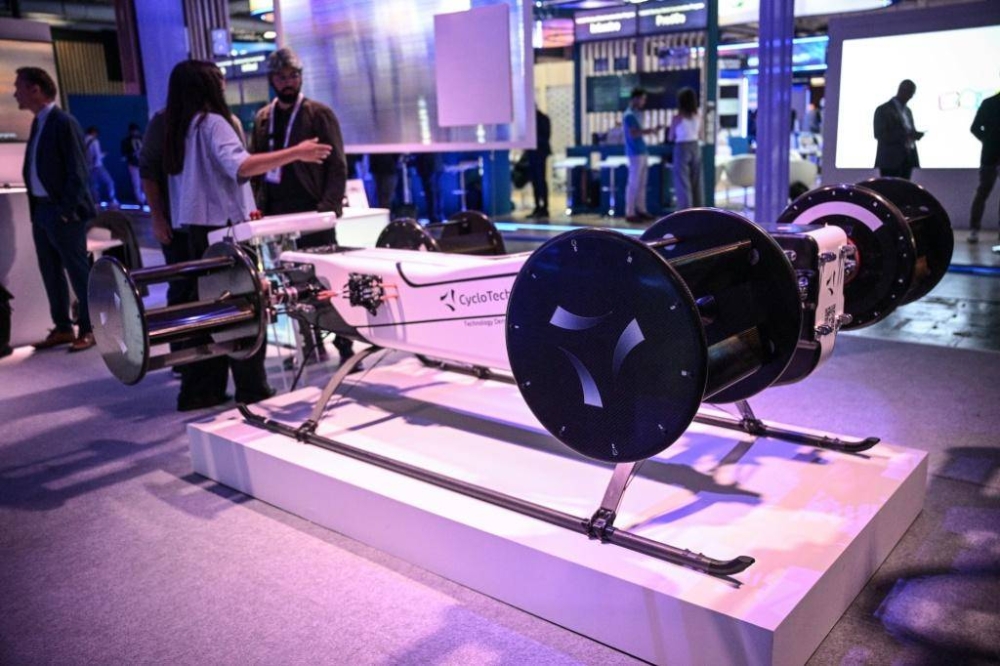
Agile quadcopter drones are already prized in applications from coordinated aerial displays to battlefields in Ukraine.But Austrian startup CycloTech says it can make aircraft even nimbler with its motors — shaped like an open cylinder with the sides made up of several wing-shaped blades.
“It can hover like a helicopter, fly forwards like an aircraft, but equally brake in midair or fly backwards,” marketing chief Andrea Marchsteiner told AFP. “It can move very flexibly in the air and land very precisely”.
Applications could range from deliveries in built-up areas to transporting people through the air, she said -- as well as military uses.
The 65-strong company, which has already raised 40 million euros ($46 million), is currently looking for more funding and partners who could integrate its motors into their flying machines.
French firm Whispeak started out as a tool to confirm customers’ identity by recognising their voice when they call a bank or other sensitive service.Founded long before the generative AI boom created the risk of calls using “deepfake” voices resembling real friends or family, the company is now working on filtering potentially fraudulent conversations.“With less than ten seconds of someone’s voice, you can imitate anyone, often for free,” chief executive Florent Van Calster told AFP.
After three years of work, including with Whispeak’s own AI tools, “we now have the best detector of audio deepfakes in the world,” he boasted, citing the team’s first place in multiple contests.
Related Stories
 AI News
Your AI Notetaker Would Like a Word
1 hour ago
 AI News
AI
2 hours ago
 AI News
A battle over ‘Italian brainrot’ could shape who owns AI art
2 hours ago
 AI News
What Battery Recycling Could Tell Us About AI’s Role in Experimentation
3 hours ago
 AI News
Outrage over Claude’s AI watermark is missing the most important point
3 hours ago
 AI News
Tech Mahindra expands ServiceNow partnership for enterprise AI adoption
4 hours ago
 AI News
Opinion: There are lies, damned lies and AI: why I despise ‘artificial intelligence’
4 hours ago
 AI News
AI leaves its mark: One in three web texts is now generated by chatbots
4 hours ago