
‘We are pawns’: Indian sea captain fears for other seafarers still stuck in Persian Gulf
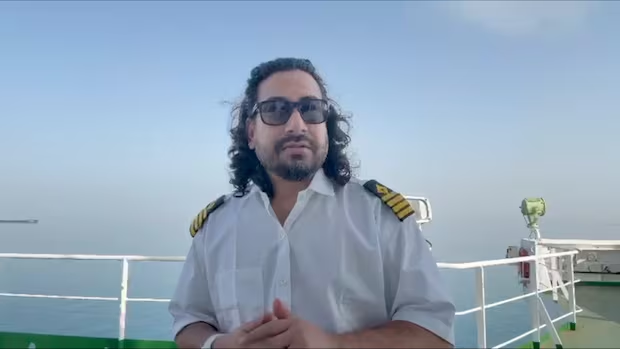
‘We are pawns’: Indian sea captain fears for other seafarers still stuck in Persian Gulf
Thousands of mariners on hundreds of ships remain stranded, UN agency says
As the U.S. and Israel-Iran war was raging, Capt. Raman Kapoor was stuck for 2½ months on an oil tanker in the Persian Gulf with 23 seafarers begging to go home.
"Our families were so scared, the entire crew was requesting for their relief, but we couldn't get out of that place," he told CBC in an interview near Kasauli in northern India.
Kapoor was relieved of his duty in late May and returned to India, but he fears for the safety of thousands of mariners still waiting to transit through a severely disrupted Strait of Hormuz.
"We are pawns, they are treating us like pawns," he told CBC. "The entire shipping fraternity is angry at the moment."
At least 14 seafarers unconnected to the warring countries have died in the war, according to the International Maritime Organization (IMO), a UN agency. Half of them were from India, says the Forward Seamen’s Union of India.
The latest casualties came in mid-June, when three Indian mariners were killed after the U.S. struck their ship, the MT Settebello, accusing it of trying to evade a naval blockade.
"The world talks about us only when they see a dead body. After that they keep quiet until the next body comes," said Kapoor.
Captain says crew was ‘damned scared’ trapped in Gulf war zone
At least 8,000 seafarers on hundreds of ships are still stranded inside the Persian Gulf, according to the IMO, while Iran, the U.S. and Gulf countries fight over a narrow, elbow-shaped sea passage critical to 20 per cent of the world’s oil supply.
Controlling the strait has become powerful leverage for Iran, which issued a fresh warning Thursday that all vessels must use Iranian-controlled routes or face "forceful consequences."
Some ships have been trying to exit using a narrow route close to the coast of Oman.
When war erupted on Feb. 28, Kapoor’s all-Indian crew was loading crude oil at Umm Qasar, an Iraqi port.
The port ordered all the tankers to move further out into the Gulf for security reasons.
Kapoor’s ship set anchor in the Gulf and was stranded.
In the early days, the crew counted the missiles flying over, one day seeing more than 140 in half an hour, he said.
"We could feel that drama on the ship, we could feel the shock, it was a horrible thing."
The crew was terrified, he said, with nowhere to hide and no way to get off the ship.
On March 11, about a kilometre away, Iranian sea drones slammed into the Safesea Vishnu, igniting a huge fireball.
"That was the scariest night" and the crew was "damned scared," Kapoor said.
The IMO launched an evacuation plan last week trying to get safe passage for the hundreds of ships still stuck in the Gulf.
"We need to look after the seafarers better and shipping should not be used as collateral in any geopolitical conflict [that] affects innocent people," IMO Secretary General Arsenio Dominguez said, speaking from London to a UN news conference.
Iran warns oil tankers to use approved routes in Strait of Hormuz or face 'forceful response'
U.S. strikes Iran in retaliation for attack on cargo ship in Strait of Hormuz
But the IMO was forced to pause that plan last Friday after Iran struck a container ship, the Ever Lovely, passing near the Omani side of the strait.
At talks in Doha Wednesday, according to reports, Oman said it wanted to collect tolls, perhaps voluntarily, from ships passing through its waters while Iran wants mandatory tolling and the U.S. is demanding none.
"It's not going to be an easy task to evacuate all the ships from the region," said Kapoor, estimating that at best, given the circumstances, only 30 to 40 ships a day could be moved out of the Gulf.
Kapoor will be home in India for the next couple of months helping his wife, Sarika, manage the Voyage Resort and Spa, a hotel they run in Manali, in the northern state of Himachal Pradesh.
But with 28 years at sea and expertise navigating oil tankers through the Persian Gulf, he'll be called on to command another ship.
Sarika Kapoor was definite about her husband's possible return to the Gulf before the war ends.
"No, no, no," she said, shaking her head emphatically.
"I will never allow him to go there," she told CBC. "[During the war] I think he can work safely, but not inside the war zone."
Shipping costs soar as retailers try to secure orders ahead of fresh tariffs
Ship evacuation in Strait of Hormuz paused following attack on cargo vessel
After 20 years of marriage, she is used to him going off to sea, commanding different ships on different routes.
"Now the scenario has totally changed after the war situation," she said. "Every time there is a fear in my heart."
Susan Ormiston is an award-winning international correspondent covering climate and world news. She's been a foreign correspondent in London, Washington and on assignment in Moscow. Susan has reported from more than 30 countries, including multiple conflict zones.
Related Stories
 World
World
Shipwreck believed to be the world's oldest discovered off the coast of Turkey
28 minutes ago
 World
World
Israel blocks construction of key Gaza base created by Trump peace board
28 minutes ago
 World
World
Patrick Reed: American reassures former LIV Golf colleagues
2 hours ago
 World
World
Trump says oil, gas and mineral exploration in Greenland is set to begin. It's not that simple
2 hours ago
 World
World
Search for missing pup in Yellowstone is under pressure as winter nears
3 hours ago
 World
World
World’s oldest shipwreck found off coast of Turkiye
3 hours ago
 World
World
As Kimberly Guilfoyle leaves Athens post, Greece feels further from Trump orbit
4 hours ago
 World
World
Kenya confirms second Ebola case, a relative of first patient
4 hours ago