
Week
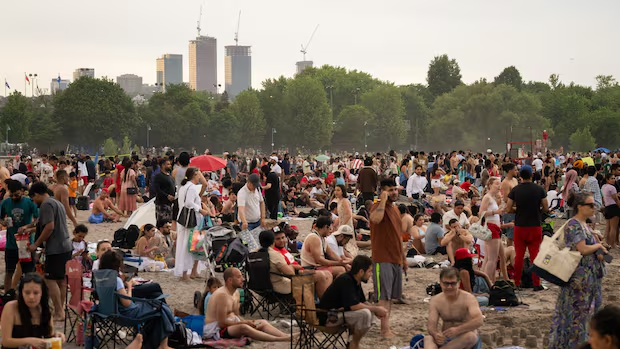
Week-long heat wave led to dozens of emergency room visits, Toronto Public Health says
Officials say 39 heat-related ER visits recorded between June 30 and July 4
Toronto's emergency departments felt the weight of last week's heat wave, with nearly 40 visits blamed directly on the scorching temperatures.
Toronto Public Health said Toronto hospitals reported a total of 39 heat-related ER visits from June 30 until July 4, when Environment Canada's orange level heat alert was in effect. The highest number was recorded at the peak of the heat wave on July 2, with 15 ER visits.
The health authority said the highest temperature during the heat wave was 36 C, and the highest humidex reading was 48.
It also noted that emergency room data doesn't capture all of the health effects linked to extreme heat, such as worsening cardiac and respiratory conditions.
Heat dome creates punishing Canada Day conditions
Dr. Edward Xie, an emergency physician at the University Health Network, said his ER was busier than usual last week, although it's difficult to say if that was directly caused by heat. It takes careful work to distinguish illnesses that are purely heat-related from cases where heat is worsening existing health conditions, he said.
"So anecdotally, yes, absolutely I would say that at the hospital that I work at, the number of patients coming in has been higher than usual during this past week," he said in an interview last Friday.
Toronto Public Health said the trend seen last week in hospitals was similar to the one seen in June 2025, when 42 people landed in emergency rooms over a three-day heat wave. Last week's heat warning lasted five days.
Extreme heat led to 42 emergency room visits in Toronto, public health agency says
Toronto's had a summer of extreme heat. In 2050, it might be par for the course, climatologist says
Direct comparisons between ER visits during this heat wave and last June's are limited because of differences in timing and duration, and the fact that Environment Canada has changed its weather warning system, a public health spokesperson said in a statement.
Plus, there were expanded heat relief measures this year and Canada Day may have affected the number of people in the city, Dane Griffiths wrote.
'We can't air condition our way out of this'
Xie said there is a broader need to enact climate change policies instead of treating extreme heat and related health conditions as a matter of individual preparedness.
"Fundamentally ... it's our political and economic decisions that are driving heat waves, because we can't air condition our way out of this root problem, and relying on air conditioning, for example, puts us one power outage away from disaster," said Xie.
Unbearable heat, poor air quality: Is this the future of Toronto summers?
Climate change, driven by the burning of fossil fuels, is increasing the severity and duration of heat waves around the world.
Xie advises people to treat heat waves like any other emergency. He recommends drinking cool fluids regularly and avoiding alcohol and sugary or caffeinated drinks, which can lead to dehydration.
He also said people should know that in very hot rooms, fans can end up just circulating hot air instead of providing a cooling effect.
"People can first prepare for it, recognize that heat waves can be dangerous, maybe not to themselves, but to people that they care about and plan for it, the same as someone might plan for an ice storm or a power outage," he said.
What's behind all the wild weather in Canada this summer?
Heat warning for Toronto extended through Saturday: Environment Canada
The latest heat wave occurred as people in the Toronto area were gathering outdoors for Canada Day and World Cup festivities. Severe heat was cited among the reasons for the cancellation of last Thursday's World Cup match broadcasts at Toronto's Nathan Phillips Square, and additional cooling measures were brought in for the final match held at Toronto Stadium that day.
Much of the province was under Environment Canada's orange warning, an uncommon alert that signals severe weather likely to cause significant damage or health effects.
Related Stories
 AI News
U.S. launches new attacks on Iran in retaliation for attacks on commercial ships, U.S. military says
36 minutes ago
 AI News
New Brunswick starts process to revive key mine producing key antimony mineral
36 minutes ago
 AI News
Italian village to impose fines of up to €200 on tourists with bare chests or in swimwear
36 minutes ago
 AI News
U.S. says it launched strikes on Iran for 'attacking commercial shipping' in Strait of Hormuz
36 minutes ago
 AI News
Punjab: Why Akal Takht has objected to a new anti
36 minutes ago
 AI News
Vancouver Island golf superintendent achieves Canada’s highest industry honour
37 minutes ago
 AI News
German aerospace company signs 10
37 minutes ago
 AI News
Halifax police seeking man who yelled racial slurs, threats at family in Costco
37 minutes ago