
What happens when a Google data centre comes to town? Southern India is finding out
What happens when a Google data centre comes to town? Southern India is finding out
Construction of a multi-billion dollar AI hub worries residents of Visakhapatnam
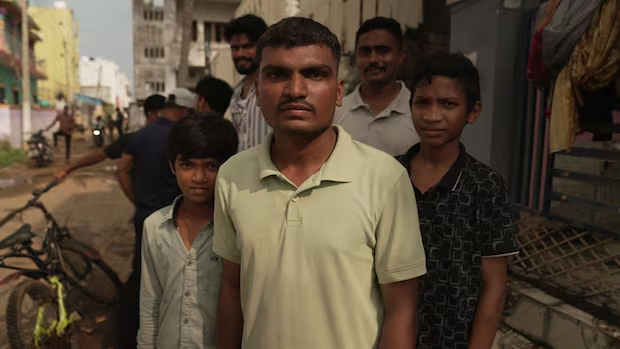
A group of farmers sits under the shade of a Jamun tree, chewing over the big news in their village: Google is moving in.
Google, with India's powerful Adani Group, is building a massive $15 billion US AI data centre hub in and around Visakhapatnam, a port city on India's east coast.
Farmer Bali Narasingha Rao owned one acre in Tarluvada. Pressured to sell, he says he got 17 lakhs, about $25,000, for his land — but he's unsettled about the future.
Earth movers are clearing more than 260 acres here — the biggest of three sites.
"Our land is gone, and that land was our livelihood," he said, adding that some of the village leaders told them the data centre was locating here because other countries didn’t want it.
All of a sudden his rural village is part of the AI boom.
In the race to secure a piece of it, the state government of Andhra Pradesh, has welcomed Google's five-year, multi-billion dollar investment, covering over 600 acres on three sites.
See the scale of Google's construction
At the ground-breaking ceremony in April, N. Chandrababu Naidu, the state's chief minister, said "Google is very important. If they are willing to come I'll do everything I can to extend co-operation."
The build out in this corner of India for a one-gigawatt hub is the largest for Google outside the U.S. and in many ways mirrors some concerns in other jurisdictions over water use, energy demands and noise from data centres.
"Having AI data centres is something I think India must do," said Sribharat Mathukumilli the MP for Vishakhapatnam, adding the state has big plans to attract fintech companies, banks and AI startups.
"So this is an ecosystem play. It is not a singular play."
But there is opposition from some environmental and human rights advocates, who argue the project's approvals were fast-tracked and that the costs outweigh the rewards.
Sribharat Mathukumilli, the MP for Vishakhapatnam, promotes the economic benefits of attracting data centres to India. (Kate Kyle/CBC)
"This data centre boom for us doesn't look more than a real estate project," said 26-year-old Deeksha Vanguru, a community organizer originally from Vizag, as Visakhapatnam is known.
"It is just whoever can secure the most amount of land, and slap a bunch of concrete there."
The "Stop Dirty Data Centres" campaign regularly canvasses villagers and neighbourhoods next to the three construction sites which make up Google's AI hub.
Recently Meta blocked the campaign's Instagram account under India's information technology rules.
India, Vanguru says, is fertile ground for big tech companies to expand.
"We have weak laws in terms of environmental laws, regulation laws and we give out a lot of subsidies," she said.
A municipal reservoir in Visakhapatnam shows the effects of this year's drought and weak monsoon. (Saraskanth TK/CBC)
To attract Google, the state offered discounts on land and concessions on water and electricity tariffs for ten years.
"This is of huge economic value," said Mathukumilli, the MP. "Over time, while [Google] may have some incentives upfront, it will be a long-term economic boost."
"The central government has categorized data centres as essential infrastructures. In a country where schools are in a bad shape, where hospitals are not available," she said. "Fix the bottom foundation first."
Google's project, according to the government, could create up to 150,000 indirect jobs in related tech industries, and 4,000 a year during construction. But running the data centres will require only hundreds of permanent employees; many of those will be service jobs to maintain the facilities, argue opponents.
Demonstrators march against the Google hub in Visakhapatnam, on Sept. 19. Activists regularly canvass villagers and neighbourhoods next to the three construction sites. (Kate Kyle/CBC)
In the rural village of Tarluvada, just outside Visakhapatnam, a group of young men approach CBC News.
"We‘re talking [for] our village members, ma'am,” said 23-year-old Bali Charan Teja. ”We are completely unhappy with the data centre."
Local farmer Bali Narasingha Rao, left, was persuaded to sell his one acre of land for the data centre. It was the only land he'd ever owned and now he worries about the next generation. (Kate Kyle/CBC)
"It's a data storage centre, useful for only storage or cooling of the systems so I can't believe that we can get any employment here."
He's studying to be a civil engineer and thought he would inherit his family's farm land — now sold off — as part of his legacy.
Nearby in Vizag, some residents are worried the data centre will use up too much water.
A weak monsoon and drought this year have stretched water resources. The local reservoir has receded and ground water is dropping.
Area resident V. Jyothi says she welcomes the potential new jobs, but worries about the water shortages already plaguing her part of Visakhapatnam. (Kate Kyle/CBC)
"The water problem has become very serious," said V. Jyothi, standing in front of her modest two-room home.
"We know that the data centre is coming, and we have heard that it could lead to water problems."
The state government says water will not be diverted from residential use, but people are skeptical.
Google, in an email statement to CBC News, says it will use an "advanced air cooling system," in place of water cooling, "limiting water consumption" to primarily restrooms and kitchens. It says the facility is designed to keep "boundary sound" outside the data centre "below 55 decibels … roughly the volume of a dishwasher."
A court challenge in August failed to halt work on the data centre hub, parts of which are scheduled to be operational in 2028. Google is also laying three subsea cables for data connectivity off the Visakhapatnam coast.
On the beach Sudeep Pillarisetty, a software developer and entrepreneur, is excited that Google chose his city for a data centre, confident it will kick off data science and engineering roles for young tech professionals.
Why are there suddenly so many data centres planned in Canada? Your questions answered
Could AI really 'kill all humans'? Breaking down the dire warnings about the technology's existential risk
How AI could usher in a 'new scientific golden age' — if it doesn't kill us all first
"I hope Google provides a subsidy for any of the Indian startups to create their own AI models — made in India," he said.
But in the village on the bench under the tree, the farmers are still debating the merits.
"This land is the only livelihood and security we have for our children, " said Bali Sanyasa Rao.
"We will know whether it is beneficial or harmful only after the data centre is completed."
Susan Ormiston is an award-winning international correspondent covering climate and world news. She's been a foreign correspondent in London, Washington and on assignment in Moscow. Susan has reported from more than 30 countries, including multiple conflict zones.
Related Stories
This is your time, opportunity, carry Tamil culture everywhere: PM Modi urges students in Chennai
1 hour ago
 India
India
Indian government detains protestors, deploys paramilitary forces in Delhi
1 hour ago
 India
India
India will become developed nation by 2047, host Olympics, send astronaut to Moon: Modi
2 hours ago
 India
India
India's 'Cockroach' protest movement leaders freed from detention
5 hours ago
 India
India
Vowing clean politics, Pargat Singh takes charge as Punjab Congress chief; leaders put up united front amid rain
6 hours ago
 India
India
No forgiveness for those who use gurdwaras for politics: DSGMC chief Kalka slams AAP
7 hours ago
 India
India
CJP at Jantar Mantar: Delhi braces for more protests as 'Cockroach' group's arrested leaders freed
7 hours ago
 India
India
Congress asks all MPs to remain in Delhi on Monday as Rahul Gandhi announces INDIA bloc protest
8 hours ago