
What is 'wishcycling,' and why are some B.C. municipalities cracking down on it?
What is 'wishcycling,' and why are some B.C. municipalities cracking down on it?
Putting the wrong items in your recycling bin could unintentionally send whole loads to the landfill
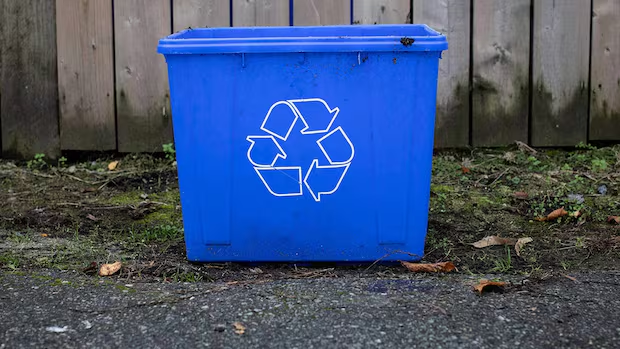
The word is a portmanteau of "wishful thinking" and "recycling," and is an ongoing challenge for the recycling system across British Columbia.
“Wishcycling is when we see residents or people using the recycling carts throwing material in them that is not recycling in the hopes that somehow the material will end up where it needs to be," Ben Routledge, the Regional District of Nanaimo's manager of solid waste services, told CBC's On the Island.
It's become enough of an issue in the Nanaimo area that officials are looking at fines for scofflaws.
Recycle B.C., the non-profit that manages residential packaging and paper recycling across the province, says just under six per cent of loads it receives are contaminated.
Routledge says the most common "wishcycled" items are things that can be recycled through a depot, but don't belong in curbside collection bins, like woven plastic or zipper lock bags. Improperly cleaned containers are also common.
How confusion and inconvenience are filling B.C. landfills with recyclable plastics
A shot at $1,000 or a guaranteed 10 cents? UBC study suggests choice could up recycling rates
But he says the region is also seeing an alarming increase in scrap metal, household appliances and even hazardous waste like propane tanks, batteries or bear spray.
“All of that stuff can [mistakenly be put] into a collection truck, which is being compacted," he said. "And those hazardous waste can either contaminate the material around them, they can explode or they can ignite.”
Contamination makes it harder to sell paper, plastic and glass to end markets where they're recycled into new material. Loads that are seriously contaminated may end up in the landfill.
Recycle B.C. sets its acceptable contamination threshold at five per cent.
The Regional District of Nanaimo has seen the rate of contamination in its recycling loads climb from four per cent to 5.4 per cent over the last year and a half, with some loads topping 18 per cent, Routledge said.
As a result, outreach teams will start issuing warnings for non-compliance. After three strikes, residents will face a $500 fine — and if they persist, the district will consider stopping pickups.
What really happens to plastic drink bottles you toss in your recycling bin
The City of Richmond is also auditing residents bins after its contamination rate climbed to 7.3 per cent for curbside pickup and 11.3 per cent for multi-family residences. People who break the rules will find an "oops" sticker slapped on their blue box.
Getting those numbers down matters — if municipalities let contamination rates rise too high, they can face hefty financial penalties.
"If it stays above the allowable threshold for too long of a period of time, we can face financial penalties that could equal as much as $120,000 per year," Routledge said.
Recycle B.C. says when a municipality's contamination routinely exceeds its thresholds, its first step is to work with the community.
"Financial penalties are only considered if contamination remains persistently high after those extended efforts," the non-profit told CBC News in an email.
If you're unsure about whether something you're throwing out belongs in your recycling bin, you can check at RecycleBC.ca or download the Recycle B.C. app.
Related Stories
 Explainers
Why Karnataka politics keeps getting caught on camera
5 days ago
 Explainers
Rare waterspout may have damaged trees near coast
5 days ago
 Explainers
Demolition of M5 bridges is 'going smoothly'
6 days ago
 Explainers
Meteorologists' warning about "El Niño": it develops a second arm from the initial mass and heightens the forecast of its effects
1 week ago
 Explainers
Trump’s new press secretary is leaving the post
1 week ago
 Explainers
What is driving young anglophones out of Quebec?
1 week ago
 Explainers
What is Starshield, SpaceX’s military
1 week ago
 Explainers
Portal Innovations Venture Team Releases New Analysis on Capital Efficiency in Emerging Biotech Ecosystems
1 week ago