
What July 1 means for CUSMA, Canada's trade deal with the U.S. and Mexico
What July 1 means for CUSMA, Canada's trade deal with the U.S. and Mexico
Trump's complaints loom large as 3 countries meet to discuss agreement's future
Canadian government officials will join their counterparts from the U.S. and Mexico on Wednesday in a landmark meeting on the future of the trade agreement between their three countries.
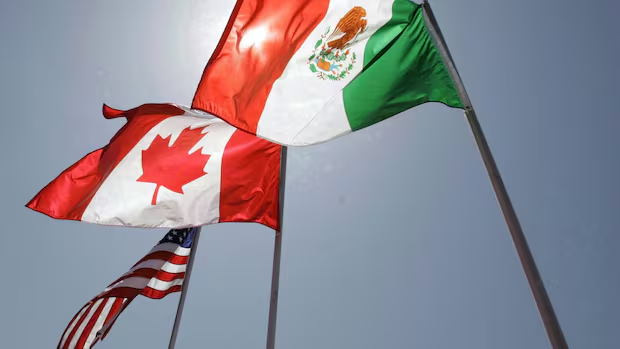
July 1 is an important day for the Canada-United States-Mexico Agreement (CUSMA), the trade deal that shields nearly 90 per cent of Canadian exports from U.S. President Donald Trump's tariffs.
It's the deadline set out in the text of the deal for each country to declare whether they want to extend the agreement for another 16 years beyond its 2036 expiry.
Here's a guide to help you understand what this July 1 deadline means for CUSMA — and what it doesn't mean.
What happens with CUSMA on July 1?
The date marks exactly six years since CUSMA took effect, replacing the North American Free Trade Agreement (NAFTA).
July 1, 2026 was set as the date for a trilateral review of the new agreement.
That review provides the countries with just two options:
CUSMA review going to 'extra innings': Ontario's trade rep. in D.C.
What do Canada and Mexico want?
Both Canada and Mexico have declared publicly and in writing that they want CUSMA extended, but are willing to discuss amendments to the deal.
The U.S. has not publicly released an official statement, but has made its position perfectly clear. The Trump administration wants to renegotiate many of the terms of the deal, and there's no chance it would give away its leverage over those talks by agreeing to an extension first.
A Canadian source with knowledge of the file tells CBC News that Canada does not expect the. U.S. will opt for extending CUSMA on Wednesday. Bilateral talks with the U.S. are expected to continue, the source said.
Even when the U.S. officially declares it doesn't want the extension, CUSMA does not suddenly expire.
The agreement is in place until 2036. The only exception is if a country withdraws from the deal, and to do so requires six months official notice.
Trump is unlikely to rip up CUSMA, his trade deal with Canada and Mexico. Here's why
So Trump cannot terminate CUSMA on July 1 despite his frequent recent complaints about the deal, which he signed in his first term and boasted of as a "colossal victory" and a "truly extraordinary agreement."
Carney not expecting 'any drama' at July 1 CUSMA review meeting
The negotiations will continue.
The U.S. and Mexico have their third official round of talks scheduled for the week of July 20.
Mexico, Canada have formed a common front on CUSMA talks, says Sheinbaum
Meanwhile, Canada's negotiators have held fresh talks with the U.S., and although they appear to be lagging behind the U.S-Mexico discussions, Canadian officials have downplayed the significance of that.
July 1 is "a checkpoint ... not a cliff," Canada's chief negotiator Janice Charette said in April.
Charette and Canada-U.S. Trade Minister Dominic LeBlanc will participate in Wednesday's virtual meeting with the U.S. and Mexico, a spokesperson for LeBlanc told CBC News.
Trump says he only signed CUSMA to get out of NAFTA, may terminate deal
What are the key issues in CUSMA talks?
The Trump administration has listed dozens of trade irritants with each of Canada and Mexico (although twice as many with Mexico as Canada, according to LeBlanc) but its major goals in renegotiating the agreement come down to two.
One is to prevent imports from other countries (particularly China) from gaining tariff-free access to the U.S. market via the back door of CUSMA (particularly through Mexico).
The other is to boost the amount of manufacturing that takes place in the U.S. rather than in Mexico or Canada.
Trump wants CUSMA to expire 'immediately.' Here's the reality behind his takes on the trade deal
In its talks with Mexico, the U.S. has proposed an increase in the U.S.-made content of auto exports, according to multiple media reports. Canadian industry officials have indicated the reported U.S. content proposals are not so high as to damage Canada's auto sector.
It's also a near certainty that the U.S. will be gunning for greater access to Canada's dairy market, a frequent complaint of the Trump administration.
For Canada, the number one issue is to get relief from Trump's tariffs — particularly those on steel, aluminum, autos and softwood lumber — seen in Ottawa as a violation of the spirit of the free-trade agreement.
However, the U.S. has sent Canada the message that it will have to live with at least some tariffs and has publicly signalled unwillingness to include tariff reduction in the CUSMA talks, although what's being said behind closed doors could be different.
When could a CUSMA deal be reached?
Consider what Carney said last week: "What I've seen with the president is that you're not close to making a deal and then you make a deal."
One school of thought is that it would be politically advantageous for the Trump administration to get a deal by Labour Day so that Trump could sell it as a big win and give the Republican Party an opportunity to campaign on the new-and-improved agreement.
There's widespread business, political and public support for CUSMA in the U.S., where the deal is known as USMCA.
Advocates for renewing the trade deal — including the powerful agricultural lobby — argue that any serious threat to the agreement risks driving up business uncertainty, harming the U.S. economy and even driving up consumer costs. All of those would pose political dangers for the Republicans at a moment when their control of Congress is at risk.
Tariff deal with Trump unlikely before U.S. midterms, says Canada's former trade chief
The other school of thought is that the Trump administration doesn't see political advantage in a deal before the midterms, but would rather drag out the talks in the hopes of exhausting Canada and Mexico into signing an agreement that's far more tilted in favour of the U.S.
Canada's former chief trade negotiator, Steve Verheul, said Monday he can see the possibility of either scenario, but believes it's more likely that the talks will run "beyond the midterms and possibly even into next year."
Mike Crawley is a correspondent for CBC News, based in Washington. He began his career as a newspaper reporter in B.C., spent six years as a freelance journalist in various parts of Africa, then joined the CBC in 2005. Mike reported on Ontario politics for 15 years. He was born and raised in Saint John, N.B.
Related Stories
 Canada
Singapore gives prime minister million
55 minutes ago
 Canada
Iceland summons US ambassador over Trump's stars and stripes map
55 minutes ago
 Canada
Italy suspends search for Canadian skyrunner
55 minutes ago
 Canada
Trump's map and moon claims are noise
55 minutes ago
 Canada
Steven Knight knew Oasis would stay together
55 minutes ago
 Canada
September 8, 2026 NewsHawk: Top World, Canada, Ontario and Thunder Bay News
1 hour ago
 Canada
Iceland summons U.S. ambassador after Trump posts map showing island under American flag
1 hour ago
 Canada
Trump’s Bombardier threat is an 'own goal' for Canada
1 hour ago