
Whey up: Protein powder prices soar as global demand grows
Whey up: Protein powder prices soar as global demand grows
Consumers, companies feel squeeze of supply shortage
Jennifer Mason is trying to eat more protein and has supplemented her diet with whey protein powder over the past few years. But lately, soaring prices are giving her sticker shock. And as a new mom with rising expenses, she's rethinking her shopping list.
"I'm just cutting back. I'm trying to find protein in whole foods that I'm eating rather than actually getting products," she says.
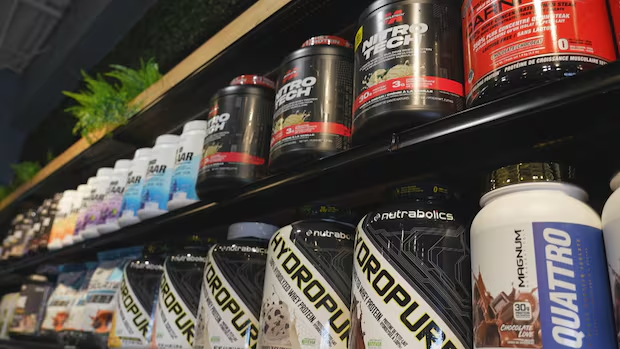
To meet growing demand, food manufacturers and fast food companies are putting whey protein into everything from snacks to drinks. That's contributing to shortages of the ingredient and pushing prices to record highs. Now whey protein is also caught in the U.S.-Canada trade war, increasing costs that may end up being passed on to consumers.
From chips and Pop-Tarts to candy, protein-packed foods are popping up on grocery store shelves. Khloé Kardashian recently launched protein popcorn. Starbucks is offering protein cold foam, catching up with the whey protein shots on the menu at Booster Juice.
Major brands are adding whey protein to their products to appeal to health-conscious consumers. Fitness influencers are pushing protein-maxxing, a trend of consuming dietary protein at every opportunity. And as more people take weight-loss drugs like Ozempic, some are also eating more protein to prevent muscle loss.
It's all eating into the global supply of whey protein concentrate, one of the most popular ingredients used in high-protein foods.
John Murray manages marketing for Daryl's Bars, a protein snack manufacturer in Tecumseh, Ont. He says as major companies secure large orders of whey, "that leaves the little guys like us scrambling to try and secure enough for our operations."
Canada imports most of its whey protein concentrate from the U.S., where prices have more than doubled over the past year and a half.
The U.S. Dairy Export Council says "domestic demand for high-protein whey has been insatiable" — so much so, that less whey is available for export.
That demand has also driven up prices. Whey protein concentrate, known as WPC80, rose 60 per cent in 2025. By June 2026, buyers were facing another 76 per cent increase.
To keep up with rising costs, Murray says his company has been forced to raise prices on its protein snacks.
"We absorbed as much as we could, but over the last year it's just been impossible. It's been outstripping our margins completely," he said.
Most of the company's whey protein comes from Wisconsin, and Murray says there are few alternatives.
"If we could source 100 per cent of everything that we needed from inside Canada, we would opt for that."
The trade war is further squeezing food manufacturers.
In retaliation for a fresh round of U.S. tariffs on Canadian goods, the federal government imposed 50 per cent tariffs on imports of American whey on Sept. 8, pushing prices even higher.
Canadian businesses can apply for relief through Ottawa's tariff-remission program, though they must demonstrate that the goods cannot reasonably be sourced domestically or from non-U.S. suppliers.
It will be difficult to boost supply quickly, said Mike von Massow, a food economist at the University of Guelph, because whey isn't produced on its own. It's a byproduct left over from making cheese. The liquid whey must be dried and turned into a powder, a complex process that requires special equipment.
"It's very expensive to dry something that is 95 per cent water and a little bit of protein," he said.
How counter-tariffs on the U.S. could backfire on Canadian whey protein companies
The U.S. produces a lot of cheese, which is why it's also a major producer of whey protein. But von Massow says Canada has limited processing capacity.
"We can't produce milk just for the whey. That's not economic. Even though the price is up, the rest of the milk would be a byproduct," he said.
The Dairy Processors Association of Canada says that with tariffs increasing the cost of U.S. imports, it expects Canadian companies to pivot toward New Zealand — though that comes with significant shipping costs.
Von Massow predicts higher prices could be passed down through the supply chain.
"I think your protein drink is probably going to get more expensive and it's likely to stay more expensive for a while," he said.
Some protein users, such as Audrey Marcoux, say they will absorb the extra cost for now.
"Unfortunately, I'm still paying the more expensive price because it's part of my routine. I work out a lot," she said.
Nathan Bugiardini says that if prices go any higher, he'll consider cutting back.
"It's a little upsetting, frankly. I usually buy in bulk which helps the price a little bit."
Some consumers are turning to plant-based alternatives and unprocessed whole foods while whey protein prices remain high.
Nineteen-year-old Melania Antic says the steep costs have left her feeling stretched.
"It discourages me a lot, especially, like, to actually get motivation to go to the gym and take protein after."
Nisha Patel is a senior reporter with CBC News. She's covered business and economics for more than a decade and spends her days talking to economists, CEOs, policymakers and everyday people to make sense of complex stories. You can find her on X at @nishapatel or by email at nisha.patel@cbc.ca.
Related Stories
 World
World
Catch all the 6DAYS® action with FIM-MOTO.TV
41 minutes ago
 World
World
PHOTO ESSAY: Flamenco's heart
41 minutes ago
 World
World
Trump claims he’s ‘doing great’ as his approval rating sinks to record low
1 hour ago
 World
World
Fort Hood shooter to be executed by firing squad
2 hours ago
 World
World
Photos of Israelis marking three years since Hamas' Oct. 7 attack as an election nears
2 hours ago
 World
World
Silent grief: An Iranian couple's search for solace
3 hours ago
 World
World
Author and former politician Jeffrey Archer dies aged 86
3 hours ago
 World
World
Saudi Arabia urged to spare man sentenced to death over Facebook post
4 hours ago