
Why Start
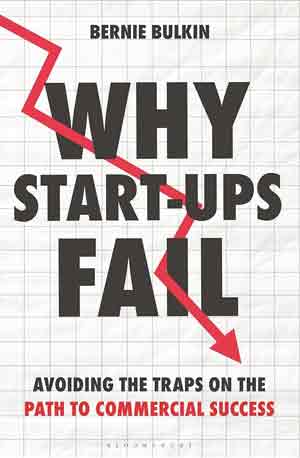
Why Start-ups Fail: Avoiding the Traps on the Path to Commercial Success
We’ve all heard the statistic: up to 90% of start-ups will ultimately fail. For decades, the global investment ecosystem has accepted this as the inevitable price for disruptive progress.
But what if that entire mindset is wrong and high failure rates are simply a design flaw?
In Why Start-ups Fail, Bernie Bulkin challenges this fatalistic dogma and delivers an optimistic, forward-looking masterclass in pattern recognition. His core thesis is simple yet empowering: start-up failure is predictable, patterned, and most importantly, preventable.
A Guide Who Has Sat at Every Table
Bulkin is uniquely qualified to write this book because he has spent decades sitting at every side of the table, including 18 years as an academic scientist (he remains an Emeritus Professorial Fellow of the University of Cambridge) before moving into industrial leadership, serving as Chief Scientist and Head of Manufacturing at BP.
From there, he crossed over into the venture capital and angel investing world, spending over 21 years backing businesses across both London and Silicon Valley, while simultaneously chairing and serving on the boards of 14 different companies.
Bulkin openly shares the personal experiences of businesses he has founded, led and invested in - including those that did fail. His diverse background offers a deep blend of scientific precision, corporate governance and investment acumen.
The Human Element: Behavioural Economics
What elevates this book is Bulkin's masterful integration of behavioural economics. He understands that start-up traps are rarely just mechanical errors and the book also explores founder ego, investor groupthink and structural self-deception.
Bulkin also argues that founders waste far too much effort obsessing over the overall size of a potential market, when they should instead be mapping the underlying structure and psychological pathways required to reach target markets. By understanding what underpins human biases, the book shows us how to actively de-risk our decision-making.
Bulkin meticulously maps out what he identifies as the six foundational causes of organisational failure. From high-growth, venture-backed scale-ups to solo founders or bootstrapped operations, these traps serve as vital guideposts:
The Macroeconomic Domino Effect
Traditionally, venture capital operates on a "home run" mentality: accept that most bets will fail, as long as one "grand slam" saves the portfolio. Bulkin aggressively pushes back on this, highlighting the immense value of the more sustainable "moderate successes” that return two or three times their initial investment.
When pattern recognition is used to eliminate avoidable design flaws, the baseline survival rate rises. This shift can, in turn, create a positive domino effect across the business ecosystem. Higher survival rates mean capital isn't pointlessly burned and wealth can be recycled back into local economies, encouraging and facilitating opportunities and funding for bootstrapped and grassroots businesses alike.
Why Start-ups Fail is a practical, common-sense guide that strips away any fear of failure and replaces it with actionable resilience. It reminds us that with the right governance, the right competencies and a healthy dose of self-critical analysis, start-up success is absolutely within reach for anyone with the ambition to build.
According to William Chen, Founding Managing Partner of ClearVue Partners, "From a founder and VC perspective, I believe Bernie Bulkin captures what most founders learn only after painful experience and what most investors never learn at all. Why Start-Ups Fail is a powerful guide for anyone determined to create real, lasting value and increase the odds of real success."
Whether your goal is a venture-backed IPO or building a self-sustaining solo business from your laptop, Bulkin’s book is a valuable read. There has never been a better time to embrace innovation, defy the statistics and build a business designed to last.
Related Stories
 Startups
Endeavor Catalyst Closes $320 Million Fund V
5 hours ago
 Startups
Beyond TechCrunch Disrupt 2026: The Side Events, Parties & Networking You Can’t Miss
2 days ago
 Startups
Marin Sonoma Impact Ventures Closes $11 Million Fund II to Back North Bay Startups
2 days ago
 Startups
The Next Chapter of USV
3 days ago
 Startups
Outgrowing the home office: Guide for expats & startups in the Netherlands
3 days ago
 Startups
Mars
3 days ago
 Startups
New book released by Open Range celebrates 40 Nebraska startups and the wider state ecosystem
3 days ago
 Startups
Dallas VC firm Disruptive is targeting a $10 billion megafund after Groq bets pay off
4 days ago