
Wildfire near Summerland threatens mountain goats living on nearby cliffs
Wildfire near Summerland threatens mountain goats living on nearby cliffs
So far experts can only speculate what happened to goats, but one says it's likely many animals were lost
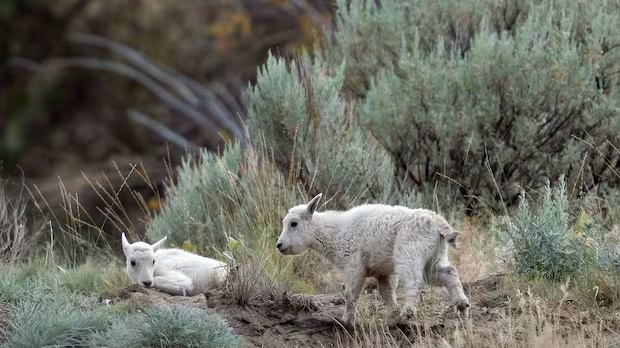
The British Columbia government says a small herd of mountain goats are "thought to have escaped" the large wildfire that burns out of control near the evacuated community of Summerland.
Motorists travelling toward the community from the north along Highway 97 could frequently spot the white animals, as they cling to the cliffs above Okanagan Lake, but their habitat falls within the borders of the Bald Range wildfire, which started last Friday and quickly spread.
That fire not only forced the rapid evacuation of Summerland, Peachland and surrounding communities, but also prompted questions and concerns about the health of the mountain goats.
What you need to know about B.C. wildfires on Aug. 13
More stories from the B.C. Interior
Michael Noonan, a biology professor at the University of B.C.'s Okanagan campus, said Tuesday he could only speculate about what happened to the animals, but he's not optimistic.
"So, there is a very good chance many animals were lost during this fire," he said in an interview Tuesday.
The Ministry of Water, Land and Resource Stewardship said in a statement issued Thursday that the herd consisting of some 30 animals is believed to be in an area north of the burn.
The statement said that, although unconfirmed, it does not expect any "direct mortality" from the wildfire at this time.
It said mountain goats are adapted to wildfire, but adds that effects are variable depending on the scale and intensity of the fire.
B.C. wildfires: Farmers reel from livestock losses, property damage
There have been unconfirmed sightings and uncertainty about the status of the goats before the ministry's statement.
The Peachland Watershed Protection Alliance said on social media that the Peachland Fire and Rescue Service has spotted an unspecified number of the goats.
But the post, which subsequently dropped any reference to the fire department, does not offer additional details, including specifics about any potential losses, and the society declined to make the person who spotted the animals available.
Peachland Fire and Rescue Service Chief Ian Cummings said he has no information one way or another about the animals.
Noonan said the animals have become "iconic" over the years, because of their visibility along Highway 97.
"You see them all the time, right?" he said. "So, there are a lot of people who have a connection with those animals just from that."
Noonan, who has studied the responses of mountain goats to the fires that burned through nearby Cathedral Park in 2003, said the animals do not immediately respond to an approaching fire.
"They respond when it is an immediate threat," he said. "So, with a fire like the Summerland fire that moved extremely fast, not having a proactive or strong proactive behaviour is a big risk for wildfire."
Noonan said his research from the Cathedral Park fire shows that mountain goats seek higher ground to escape flames, because that is their safe place.
But that risks them being trapped on steep cliffs, he added.
"The behaviour of goats of moving toward steep cliffs and moving up elevation is not really well matched to fire, because fire moves up elevation, right?" he said.
It's less risky if the animals were already above the tree line, Noonan said.
"But if they are at tree line and still within tree line and start moving, they can put themselves in a situation where they trap themselves."
It is not clear how many animals were living in the area when the fire broke out, but the number of animals living in southern B.C. is far smaller than in other parts of the province.
"The goats as a whole are doing relatively OK [across B.C.], but in our region it is more precarious," Noonan said.
Habitats already fragmented, says expert
The mountain goats in the Southern Interior live in isolated populations.
A combination of geography and human development, such as roads, agriculture and housing, have fragmented their habitat, pushing them into smaller and smaller refuges, he said.
That isolation also makes it more difficult for them to escape fires, he said.
"There are risks that a few fires like this can eliminate those animals from our region entirely," he said. "So, they are on the precipice."
Humans have developed and maintain escape routes for themselves, he added.
"We should be doing the same for goats and all our wildlife in general. So, we need to improve the connectivity."
Noonan said many questions won't have answers until after the fire, but the very possibility that these animals could have been displaced or potentially killed by this fire is still unsettling.
"Our province, our region is dealing with a loss of biodiversity ... and a little blow to these populations that are clinging on can be really difficult to bounce back from because they are already struggling," he said.
The ministry said in its statement that the herd living around Summerland has been stable for many decades.
Related Stories
 Community
Summerland family feels 'violated' after burglary during wildfire evacuation
1 hour ago
 Community
Harry and Meghan are coming back to Britain. Has the press changed?
3 hours ago
 Community
SURREY EVENTS: Afro-Caribbean fest, food, concerts and more as August fades
3 hours ago
 Community
Active shooter incident pauses Fireweed Festival in Fort Smith, N.W.T.
15 hours ago
 Community
Dog lost on mountain found three weeks later
16 hours ago
 Community
Ebola disease caused by Bundibugyo virus
17 hours ago
 Community
Why Samajwadi Party never split? Akhilesh Yadav points out 'benefit' of dynastic politics
17 hours ago
 Community
These bookshops let Chinese readers question their country
20 hours ago