
Winnipeggers losing compassion for people who are homeless or openly using drugs, survey suggests
Winnipeggers losing compassion for people who are homeless or openly using drugs, survey suggests
Social service agencies say recent policies put in place by the City of Winnipeg aren’t helping
People pack a church basement in Osborne Village to play a game of bingo at a place that offers food, programming and resources for people in need, including those who are homeless.
It's a segment of the population that a majority of Winnipeggers are losing compassion for, the results of a survey suggest ahead of the Oct. 28 civic election.
"It's pretty sad, you know. It's really very sad," said Rick Dubois, who used to be homeless. "We're living in Canada. We shouldn't have a homeless problem."
The online survey conducted by Abacus Data for CBC News in August asked 687 adults in Winnipeg, from a cross-section of demographics and backgrounds, about their views and priorities in the upcoming civic election.
Among those surveyed, 59 per cent strongly or somewhat agreed with the statement, "I'm starting to lose my compassion for people experiencing homelessness or using drugs in public."
Dubois, who now volunteers at the church with 1JustCity's Oak Table program, suspects what neighbours in condos sometimes see outside the building might have something to do with these views on homelessness.
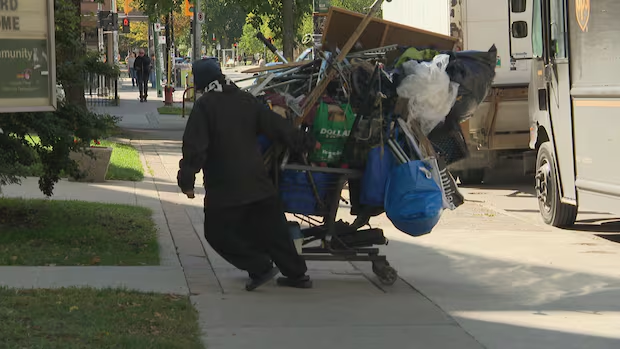
People gathered on the sidewalk, including one person who had a shopping cart overflowing with belongings, as he spoke to the CBC.
"Like this right here," Dubois said. "Take a look."
People are losing compassion because homelessness is "in their faces," he said.
Mike Green lives nearby and said this summer, he often saw people face down on the boulevard outside the church building, which is now known as the Augustine Centre.
He said he can understand why some people are losing empathy, but he still cares, despite the concerns about vandalism, discarded needles and people in crisis in his neighbourhood.
"Certainly that is happening, and I don't blame people who are losing their perspective, but I do think that's wrong," Green said.
Green acknowledged he is frustrated by what he sees as a lack of a plan to help people and address some of the issues in his neighbourhood.
"I have lost faith in the different organizations that are meant to be supporting them," he said.
He's concerned about what he sees as competition for funding and different approaches to dealing with homelessness and getting people housed.
A majority of the respondents to the Abacus survey feel neither social agencies nor governments are doing a good enough job dealing with homelessness.
Only about a third of respondents said the agencies are doing an excellent or good job, a little more than one-fifth felt that way about police, less than one-fifth of respondents felt the province was doing a good job, and only eight per cent had good things to say about the city's response to homelessness.
Because it was an online survey, a margin of error for the Winnipeg results can't be calculated. A comparable random survey would have a margin of error of 3.74 per cent, 19 times out of 20.
City policies stigmatize, advocate says
Lorie English, executive director of the West Central Women's Resource Centre, isn't surprised by the survey results.
"I think it's an unfortunate outcome of some of the policy choices that we've seen made, particularly by the municipal government and the City of Winnipeg," English said.
She cited the ban on homeless encampments in certain public spaces, including near playgrounds, parks, schools and daycares, and the police crackdown on open drug use.
"Often when we take steps to marginalize, criminalize, stigmatize people who are experiencing homelessness, it increases people's apathy towards these really complex issues," English said.
She challenged people to prioritize the lived reality of those who are homeless over their own discomfort from seeing the problem.
"It's hard for people to see suffering, and I think that's understandable," English said, but when "we couch policy in safety language," people should ask whose safety is being talked about.
"Are we talking about the safety of people who have homes to go to, who have access to a vehicle, or are we talking about the most marginalized in our community, who are actually the least safe in our city?"
English defended social service agencies, which she said are unified and working together. The problem, she said, is that agencies are underfunded and stretched beyond their capacity.
Jennifer Moore Rattray, End Homelessness Winnipeg's CEO, agrees with that sentiment and spoke against the encampment ban enacted by the City of Winnipeg.
"Housing is a human right. Shelter's a human right. If we don't have other places for people to go, what are we doing? We're just moving people around and making their own lives more difficult."
A lack of investment in affordable and social housing over decades is to blame, she said.
"It's not an easy fix," Moore Rattray said. "And I think for people to see unsheltered relatives day after day is difficult for them, so I can only guess that that is part of the reason for the survey results."
Some said it's difficult to see public spaces permanently altered where homeless encampments have been set up, like along the banks of the Red River in Point Douglas near Waterfront Drive.
One area resident lamented to CBC News about damage to vegetation, holes dug in the soil and trash left along a cycling and walking trail.
Tim Barnfather has similar concerns about the banks of the Assiniboine River.
"I'm not so concerned of them camping, or I haven't been. I'm more concerned of the garbage, the lack of respect for the land," Barnfather said.
He said he's a compassionate person and still has empathy for people who are homeless, but he doesn't see an easy solution to the problem.
At Public Domain, a live music venue, restaurant and bar on Portage Avenue between Sherbrook Street and Furby Street, general manger Brenden Gali said helping people who are homeless or high on drugs often falls on businesses like his — including administering naloxone several times a week.
People using drugs in the entrance or crowding around the venue's back door when shipments are coming in are a couple of the challenges that come with operating on the West End strip, he said.
Growing apathy in Winnipeg toward homelessness, open drug use: survey
"I don't think I've become uncompassionate in any way or have lost any compassion," Gali said. "I've definitely become desensitized to what to expect and what to do when I'm facing someone who's maybe overdosing."
Occupying a space in the area does require supporting the neighbourhood, he said, but he hopes to see policies from mayoral and council candidates that make the community healthier for everyone.
It's not just in Winnipeg — Abacus also asked people in Brandon, Steinbach, Selkirk, Thompson, The Pas and Flin Flon about homelessness and addiction.
A majority — three-fifths of respondents in the Manitoba-wide survey — strongly or somewhat agreed with the statement, "I'm starting to lose my compassion for people experiencing homelessness or using drugs in public."
A margin of error also can't be calculated for the Manitoba online survey, which 1,608 adults participated in. A comparable random survey would have a margin of error of 2.44 per cent, 19 times out of 20.
Back in Osborne Village, 1JustCity executive director Craig Wynands is concerned that, with an election looming, people's views could affect future funding and policy decisions surrounding homelessness and addiction.
Are homeless encampments legal in public spaces?
Fear of crime keeping some Winnipeggers from going out, survey suggests
"I would really worry that those systems of support and services might be impacted, and then that has a, obviously, a life-and-death impact on folks that really rely on those services."
Dubois credits the services at Oak Table for helping him out of homelessness.
He said it's important to give back and went around in his wheelchair during the day's bingo game to smudge program participants.
Dubois said whoever gets elected in October "needs to step up" and focus on building more affordable housing.
Josh Crabb has been a reporter at CBC Manitoba since January 2023. He started reporting in 2005 at CKX-TV in Brandon, Man. After spending three years working in television in Red Deer, Alta., Josh returned to Manitoba in 2010 and has been covering stories across the province and in Winnipeg ever since.
Related Stories
 Business
Sylvester Stallone calls Trump’s ‘special ambassador’ role ‘impossible’
44 minutes ago
 Business
Republican senator calls for investigation after Trump son's wedding party bankrolled by Russian oligarch
44 minutes ago
 Business
British Columbians to choose next provincial government on Oct. 24 after Eby calls early vote
45 minutes ago
 Business
John Anastasi Appointed to Massachusetts Small Business Development Center Statewide Advisory Council
47 minutes ago
 Business
Eric Ries: How to scale without losing your soul
5 hours ago
 Business
Cyera raises $400 million from Goldman Sachs, bringing 2026 funding to $1.4 billion
7 hours ago
 Business
Heidi raises $475 million, hits $1.26 billion valuation in blockbuster funding round
8 hours ago
 Business
Fixing agent memory
10 hours ago