
World Cup 2026: Canada makes history, but Switzerland loss leaves sting of missed opportunity
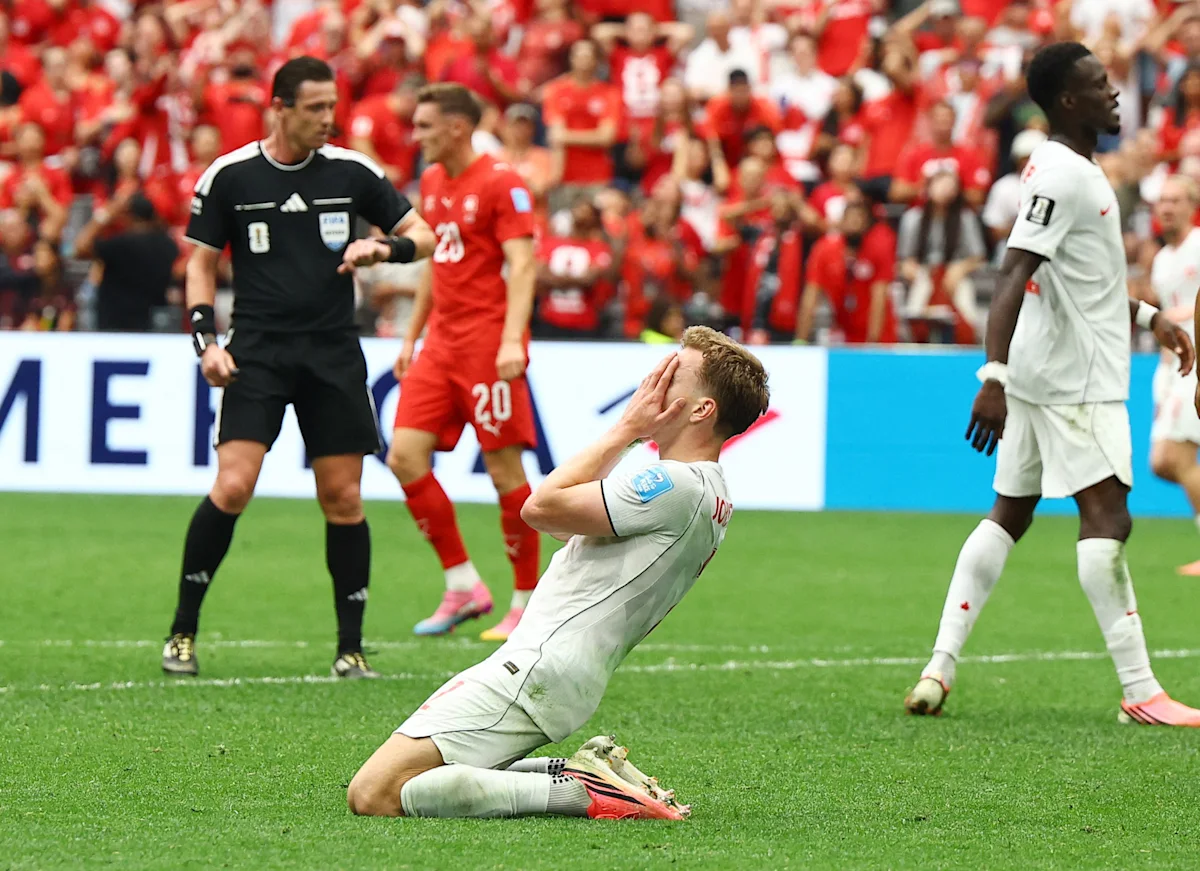
VANCOUVER – Canada made history on Wednesday, even if the disappointment of the loss made it difficult to see.
A 2-1 loss to Switzerland in the final Group B match of the 2026 FIFA World Cup pushed Canada to second place and out of Vancouver. It is a massive day in the history of the men's national soccer team, having advanced to the knockout stages for the first time and yet there is an underlying sense of disappointment in having missed out on playing a knockout match at home.
"The feeling inside the locker room is disappointment because we wanted to be here for the next two games," keeper Max Crepeau said. "The reality of things is that we go to Los Angeles and we know what to expect when we go away.
"We know how to conduct ourselves when we're on the road, but yeah, definitely some disappointment personally and collectively since we finished second."
In a lot of ways, the sense of disappointment illustrates just how far this men's program has come in a few years. Jesse Marsch talked pre-match about how people looked at him as if he was crazy two years ago when he took the job as head coach and said he wanted to get the team to where it would be competing for first place in the group.
Canada was hovering around the top 50 when Marsch took over and is now in and around the top 30. The question has shifted from whether this team could become one of the world's top 32 sides to a firm belief that it belongs there.
Switzerland is as consistent a side there is in world football, having made the Round of 16 in four of the last five World Cups. They came in as group favourites and did what they were supposed to do.
"Of course, we would've loved to top the group but we're into the knockout stage which is the bare minimum of what we wanted and that was to show where we're at as a program," defender Alistair Johnston said. "With knockouts, anything can happen, hopefully as much of that crowd as possible travel down with us and we can play off their energy and see what we can do."
Topping the group would have been a legacy-defining achievement. Finishing second means Canada met expectations. The two ends of the spectrum capture what Marsch has strived to create: a 'movement' that leaves the Canadian fan base yearning for more and valuing the journey along the way.
The latter still matters a ton.
Cyle Larin's late equalizer against Bosnia and Herzegovina, Jonathan David's hat trick against Qatar, the heartbreak of Ismaël Koné's broken leg, and the hope of Promise David's goal against Switzerland along with the exhilarating finish are big moments at home that have captivated the country. Those moments were needed and have brought a certain level of awakening. The pre-match marches to the stadium, packed bars, and the non-stop conversations about the team will leave lasting memories.
Canada made finishing atop the group their biggest goal because they knew what playing that Round of 32 match in Vancouver and possibly winning it could have have done for the sport in this country. It could have taken the passion around Canadian soccer to another stratosphere
Injuries have been cruel and arguably the biggest reason that moment won't come. There has been no respite. Alphonso Davies, Moise Bombito, Promise David, and Alfie Jones already came into the squad with issues. Then Koné broke his leg. As if all of that wasn't enough, stand-in captain Stephen Eustaquio was suddenly left out of the starting 11 against Switzerland due to muscle tightness.
"If I could have gone, I would have," Eustaquio said when asked if he could have played 90 minutes, having come on as a second-half substitute and helping change the momentum of the match.
According to Marsch, Eustaquio felt he only had 30 minutes in him. The hope now is that he will be fit to start in four days against the second-placed team from Group A – most likely South Korea.
With an injury depleted starting 11, Marsch was forced to rely on Derek Cornelius and 20-year-old Luc de Fougerolles in the back and Nathan Saliba alongside Mathieu Choiniere in front of them. They are all good players, and Saliba had the best moments of any of them, but were outplayed by Switzerland's best talents in Granit Xhaka, Bree Embolo, Johan Manzambi and Ruben Vargas.
Marsch was handcuffed in terms of who he could play and the team played as if they were frozen by the moment and overwhelmed by the talent. As much as they loved being home, the first halves against both Bosnia and Switzerland showed that there was pressure felt too.
"Bosnia, I think we could have been a little more intense and brought a little more tempo and energy in the first half and confidence and swagger which I don't think we could have brought," left-winger Ali Ahmed said about the parallels he saw between the first half of the Bosnia and Switzerland matches. "Today, I would say, first half I'll honestly give a lot of credit to the other team. Really prepared well for us and I think one of the more difficult systems and teams we had to go against."
Marsch was livid with his team during the first hydration break as Switzerland looked to be in complete command. Things improved thereafter, but the Swiss still had 70 per cent possession for the first half. Marsch had said pre-match that the worst way to score a point from this match would be to play just for a point, but the team was practically forced into playing that way.
It's hard to keep the ball without your best midfielders. Choiniere, who came in for Eustaquio, gave what he could but what he can give is a steep drop from what either of Eustaquio or Koné can.
Marsch wants this team to play with pace and power but instead it was Switzerland's Manzambi who outran Canada's defenders and Embolo who outpowered them. Bombito is Canada's fastest defender but couldn't be there. Oh, how it would have hurt him to watch his teammates lose speed races.
After the match, Marsch explained his thinking behind going with five at the back and even admitted that his earlier suggestion Davies could play was a bluff designed to force Switzerland to spend time game-planning for him. Cyle Larin, meanwhile, did not quite have the same spark he provided in the first two matches.
These are what-ifs that Canada can't spend much time pondering upon. They have the biggest match in this program's history coming up in four days. BC Place may not be full but the bars across Canada will be, as will the FIFA Fan Festivals, and the Canada Houses.
There is some loss but still a massive opportunity ahead.
"We need to continue to understand how to handle those kinds of opponents and how to handle those kinds of games," Marsch said. "And we gotta do it quickly because we're gonna be in the knockout phase which is exactly where we wanted to be.
"We wanted to be here in Vancouver but we still have a massive opportunity in front of us to find a way to push for the next match and find a way to electrify the nation even though it'll be from Los Angeles."
Related Stories
 Canada
Saskatchewan braces for fallout as U.S.
10 minutes ago
 Canada
Danielle Smith, Doug Ford discuss trade war during Monday phone call
10 minutes ago
 Canada
What we know about how the Canada
10 minutes ago
 Canada
Canada to announce retaliatory tariffs against the U.S. on Tuesday, sources tell CTV News. Live updates here.
1 hour ago
 Canada
Some Sask. industries hit hard by newest tariffs
1 hour ago
 Canada
Tens of thousands of jobs, half a point off GDP: Canada
1 hour ago
 Canada
‘Counterproductively devastating’: Auto industry reacts to Trump’s new tariff threats
1 hour ago
 Canada
US
1 hour ago