
You can only see these fire clouds during huge wildfires
You can only see these fire clouds during huge wildfires
Pyrocumulus and pyrocumulonimbus clouds are generated by wildfires and can worsen their spread
Europe’s wildfires are creating their own weather systems
A huge fire in southwest France has generated the country's first recorded pyrocumulonimbus fire cloud.
Such clouds can only be seen during huge wildfires, and are often reported in Canada during wildfire season, most recently during the Boston Bar fire in B.C.
Here's how these special clouds form and how they can make wildfires worse.
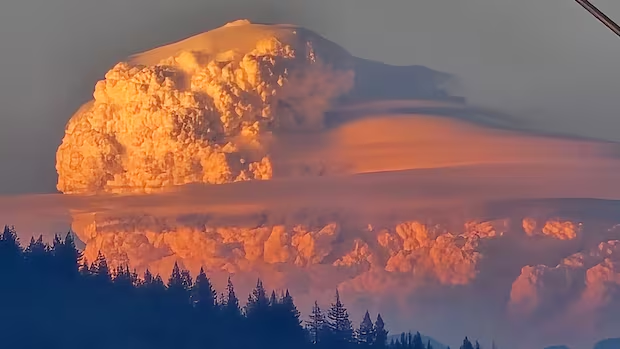
Pyrocumulonimbus or pyroCb clouds have been described as giant and cauliflower-like — so huge they can be seen more than 200 kilometres away. They're often seen hovering above dark plumes of smoke.
They generally resemble the dark, fluffy-looking cumulonimbus thunderstorm clouds that they get their name from (along with "pyro" for "fire").
They first form as smaller pyrocumulus clouds that top out at five kilometres altitude. But fuelled by large wildfires, they can grow into pyroCb clouds, reaching more than a dozen kilometres above the ground.
A "monster pyroCb" in B.C. in June 2021 was measured by NASA for sending smoke up to 16 kilometres high and spreading across more than 160,000 square kilometres.
The heat from a wildfire causes hot air to rise in an updraft, pulling moisture, smoke and even burning embers up with it.
Because the atmosphere is cooler higher up, at some point the vapour and smoke cools and spreads out, and the water condenses into a cloud above the smoke column.
While fire clouds are rare in Europe, they can appear by the dozens during wildfires in North America, according to NASA.
Mike Fromm, a meteorologist with the Naval Research Lab in Washington, D.C., says "Canada is probably the corner of the world that gets the most pyrocumulonimbus."
How wildfires create their own weather
Fromm said when they grow large enough, pyrocumulonimbus clouds start to behave like thunderstorm clouds in other ways, generating strong, erratic winds and lightning.
They can grow high into the atmosphere, where it's cold enough to freeze the water droplets into ice. Because cold air sinks, the air can drop suddenly to the ground, producing violent wind gusts called downdrafts.
The clouds also darken the sky, making visibility more difficult for firefighters. "It can truly turn mid-afternoon into nighttime conditions," Fromm said.
But because smoke particles in these clouds limit the size of water droplets, their storms don't generate much rain alongside the lightning.
Christy Climenhaga, a meteorologist for Environment Canada and former CBC climate reporter, said that lightning can start forest fires in new areas that hadn't yet started burning.
"They are something that are hard to deal with when you look especially at the fire suppression side of things because they can make the fire more unpredictable and more dangerous," she said in a 2023 CBC report.
NASA reported that the monster pyroCb in B.C. in B.C. in 2021 produced nearly 113,000 cloud-to-ground lightning strikes, or an estimated five per cent of Canada's annual lightning all at once.
PyroCbs can also disperse ash and smoke long distances by transporting it high into the lower stratosphere, where it can spread around the globe and stay in the atmosphere for months or years.
Science, Climate, Environment Reporter
Emily Chung covers science, the environment and climate for CBC News and is co-editor of CBC's What on Earth newsletter. She was part of teams that won a Silver 2024 Kavli Science Reporting Award and a 2019 Digital Publishing Award for best newsletter for What on Earth. She has a PhD in chemistry from the University of British Columbia. You can email story ideas to emily.chung@cbc.ca.
Related Stories
 Canada
Motor Mouth: Dear God, Mark, don't take this advice
19 minutes ago
 Canada
What is a heat dome and how will it affect Canada? Here’s what experts say
20 minutes ago
 Canada
Ontario Tech to celebrate future
22 minutes ago
 Canada
Prince Harry’s high-flying promise to a 102-year
1 hour ago
 Canada
Riley Laychuk's Manitoba forecast for Friday, Sept. 4, 2026
1 hour ago
 Canada
Will a heat dome in the U.S. affect Canada? Here’s what experts say
1 hour ago
 Canada
Denmark passes compensation bill for thousands of Inuit in Greenland forced to get IUDs
2 hours ago
 Canada
Hare Bay tackling climate adaptation with Climate Ready N.L.
2 hours ago