
Youth protests defy politics of fear
Youth protests defy politics of fear
Governments in a democracy need not agree with protesters, but they are obliged to respect their right to protest and engage with them
INDIA has witnessed several major protests during the Bharatiya Janata Party's (BJP) years in power: from the anti-Citizenship Amendment Act (CAA) agitation and the farmers' movement to the more recent workers' protests in Noida.
Yet the Cockroach Janta Party (CJP) protests mark a distinct departure. The mobilisation was sparked by a remark by the Chief Justice of India likening unemployed youth to "cockroaches". By the time he clarified the remark, it had already evolved into a major campaign followed by millions. Driven overwhelmingly by students and youth, it acquired an organic character that set it apart from earlier agitations.
Unlike previous mass movements, the CJP did not emerge from established organisational networks but from a satirical online campaign that disrupted the BJP's dominance of India's social media universe. Speaking the language of Instagram reels, YouTube shorts, X posts and Internet humour, it showed that memes could sometimes outrun propaganda and satire could unsettle even sharp political messaging. Its real novelty, however, lay in translating digital mobilisation into sustained political action on the ground.
The month-long occupation of Jantar Mantar, together with climate activist and educator Sonam Wangchuk's hunger strike alongside students, including those from Left organisations, culminated in the march to Parliament — a transition from the algorithm to the street that the government had failed to anticipate.
That misreading is central to understanding what followed. The grievances themselves were hardly new. Repeated paper leaks, delayed recruitment and mounting unemployment had steadily eroded young people's faith in the state's ability to provide fair opportunities.
Opposition parties had repeatedly raised these issues, yet the government appeared to believe they would remain politically manageable. It failed to anticipate that these long-standing grievances would coalesce into a wider youth uprising, one that assumed a broader political dimension, drawing support from the Congress and other Opposition parties.
The government's initial response was one of calculated restraint. When the founder of the CJP, Abhijit Dipke, arrived from Boston, he was granted permission to travel directly from the airport to Jantar Mantar, New Delhi, to begin the protest. For a government that has rarely displayed patience towards organised protests, this was surprising.
Demonstrations were subsequently held in several cities, while the sit-in at Jantar Mantar, which began on June 20, continued for four weeks without the immediate crackdown that has characterised the state's response to many earlier protests. This was widely interpreted as evidence of unusual tolerance.
More plausibly, it reflected a strategic decision to avoid immediate repression, with the expectation that public anger over the repeated mismanagement of competitive examinations would gradually subside while denying the Opposition, particularly the Congress party, an opportunity to claim political ownership of the issue and mobilise around it.
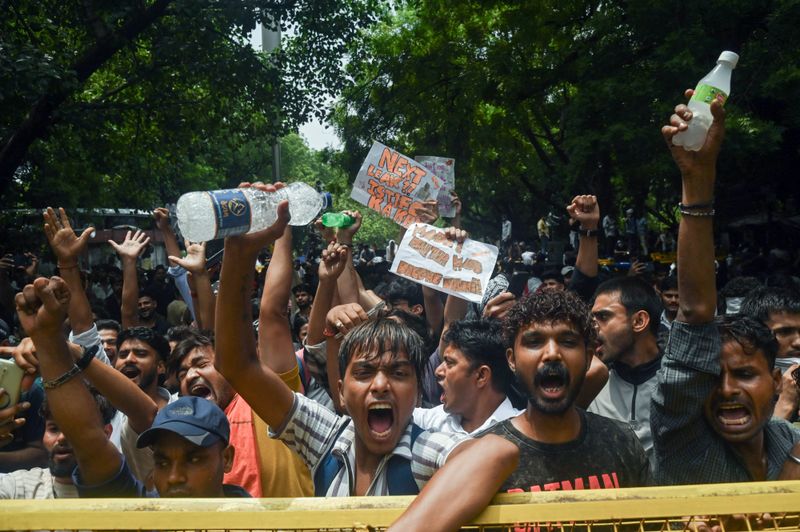
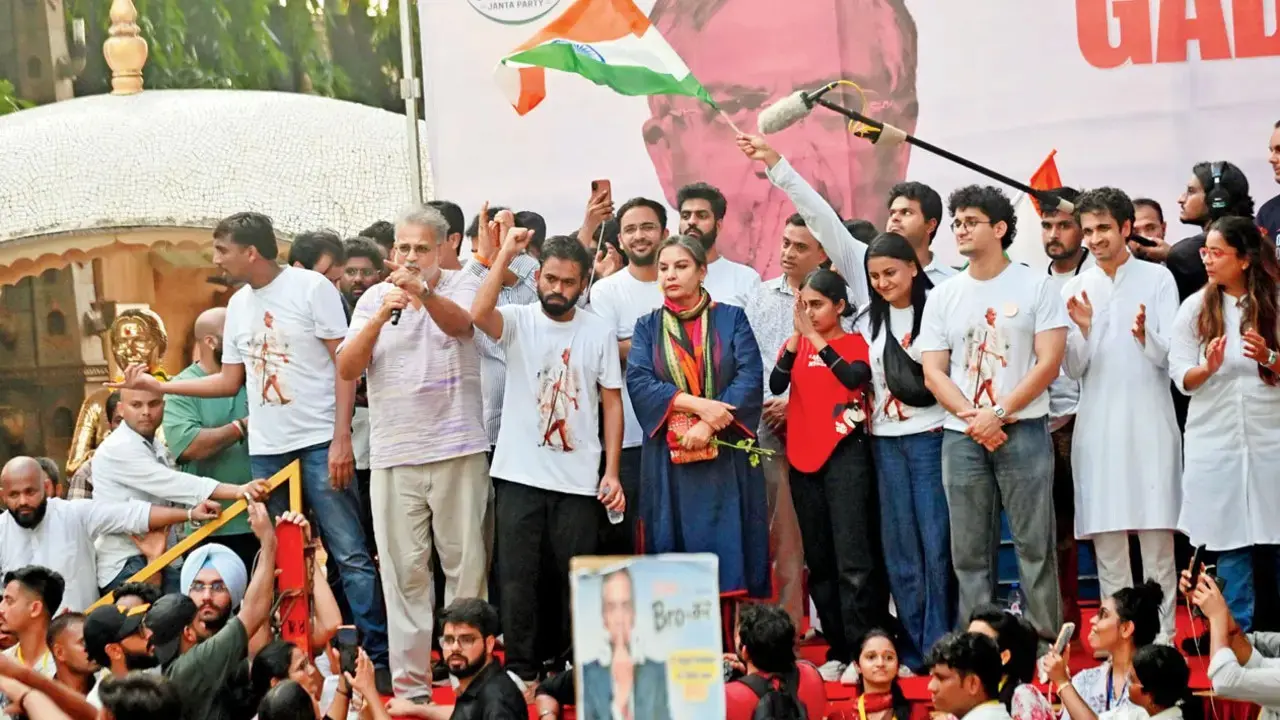
The calculation proved spectacularly wrong. As Parliament's Monsoon Session began, what had started as a limited student movement had expanded into a nationwide mass mobilisation expressing wider discontent with the government's handling of education and a range of other national issues. The March to Parliament revealed the scale of that miscalculation, drawing an unprecedented number of participants from across the country.
Two days before the march on July 20, Wangchuk was forcibly removed from Jantar Mantar; only on the morning of the march, government representatives met students, initiating dialogue for the first time in a month. By then, thousands of students were marching across central Delhi, despite prohibitory orders and a complete Internet shutdown across central Delhi.
Police deployed disproportionate force to stop the protesters, pushing students, dragging them into police vehicles, lathi-charging and tear-gassing them, reportedly deploying shock batons and pellet guns, and detaining them as they attempted to proceed peacefully. Yet after this crackdown, the government allowed the protest to resume at Jantar Mantar the very next day, reverting to a strategy of letting the protest run its course in the expectation that it would eventually lose momentum.
More striking, however, was the response of the youthful protesters, who remained remarkably fearless. This suggests that the fear which has often inhibited public protests may be receding among sections of India's youth, especially those whom the BJP cannot easily dismiss through communal or other identity-based vilification.
According to media reports, many of these students and their families are themselves BJP voters. If so, it marks an important political shift. Governments that project strength also depend, in part, on the belief that resistance is futile. Once that belief begins to weaken, repression no longer produces the political effect it once did.
The protests are no longer only about the management of exams but about larger systemic failures. By the time tens of thousands converged around Jantar Mantar on July 20, they had outgrown the CJP's campaign, becoming a spontaneous expression of discontent over deepening economic insecurity, shrinking educational opportunities, and a broader crisis of governance.
They had taken on a life of their own; the CJP had become merely their catalyst. What had begun as an online initiative had given way to a much broader student uprising, driven less by any single organisation than by a shared sense of frustration that found a common political platform.
The regime understood it could no longer neutralise this upsurge through repression or deflect it with procedural stonewalling and assurances that paper leaks would not recur. Whether or not it secures immediate policy concessions, they have already demonstrated that the government's narratives on governance and educational reform are not beyond challenge. More importantly, they suggest that the climate of fear which has long inhibited public dissent may no longer be as politically effective as it once was.
Related Stories
 India
India
Starlink, Ambani’s venture should get equal treatment, let consumers decide: Shashi Tharoor
1 day ago
 India
India
Lawrence Bishnoi’s rise: Student politics, first murder and a sprawling crime network | India News
1 day ago
 India
India
India’s finance minister says market liquidity makes it easier for investors to exit
1 day ago
 India
India
India news: CJP alleges 'deliberate' delay in leaders' release
1 day ago
 India
India
Indian Diaspora Holds Pro-Modi Counter
1 day ago
 India
India
Clashes Erupt in London as Diaspora Divided Over India's Election Chief and Electoral Roll Controversy
1 day ago
 India
India
London: Indian diaspora rallies in support of PM Modi, criticises CJP protesters
1 day ago
 India
India
Cabinet Approves Go
1 day ago