
Youth Protests Signals a New Politics in India
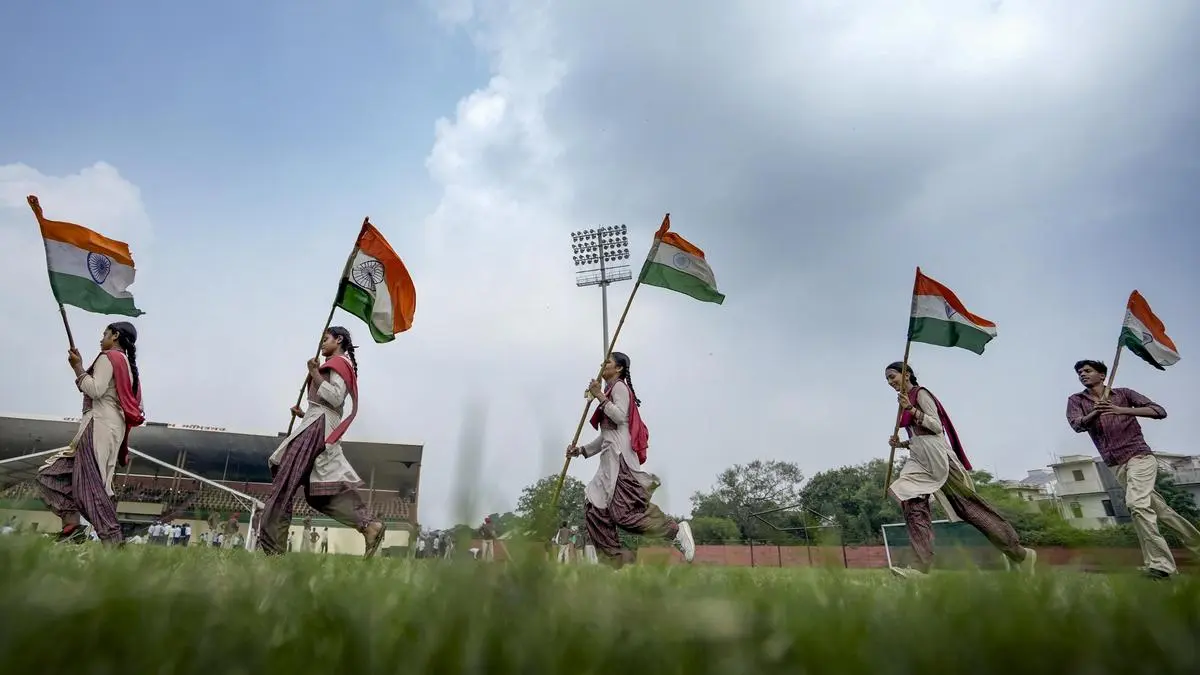
Something remarkable is happening in India. The generation that was expected merely to sit in classrooms, memorise textbooks, and prepare for examinations is beginning to ask a fundamental question: What kind of school are we being asked to study in?
The Gen Z agitation at Jantar Mantar had already broken an important psychological barrier. A people terrorised into silence saw their government being tamed. For weeks, the youth peacefully agitated over examination irregularities and demanded the resignation of the Education Minister, making him accountable. They faced police barricades, threats of eviction, and endured a hunger strike. Then, on their way to Parliament, they had to brave the brutality of the police—lathi charge, tear gas shells, and pellet guns—but they forced Dharmendra Pradhan to resign on July 25. The victory was symbolic but important; its larger significance lay elsewhere: it kindled a hope of change, dispelled fear of the government, and rejuvenated confidence that the people can win.
That discovery appears to have travelled downward—and outward. On August 15, as Narendra Modi delivered his Independence Day address from the Red Fort, the Cockroach Janta Party (CJP) launched a new campaign, “School Thik Karo” (Fix the Schools) a social audit of government school deficiencies.
The campaign has already encountered resistance, which reveals its political significance. In Bankura, West Bengal, 25-year-old CJP volunteer Shaik Abdul Hafeez visited Karisunda West Para Primary School on August 13 as part of School Thik Karo and filmed its dilapidated condition. According to his family, Hafeez and his father, Sheikh Mohammad Mafik, were subsequently assaulted by a mob reportedly belonging to the BJP. Mafik suffered severe head injuries and died two days later. Police have arrested eight people, while allegations of political involvement remain under investigation. Hafeez refused government compensation and instead demanded that a world-class school be built in his father’s name. The episode gives the campaign a grim new meaning: a demand for a functioning school has become a demand that power become answerable.
Meanwhile, schoolchildren have begun organising themselves, without any coordination from the top. So far, agitations have taken place in Uttar Pradesh, Madhya Pradesh, Uttarakhand, Rajasthan, Jharkhand, Maharashtra, and Bihar. They are rapidly multiplying, and they demand teachers, classrooms, toilets, drinking water, electricity/fans, school buildings, roads to schools, mid-day meals, protection against school closure/merger, and basic dignity of the learning environment. The authorities are nonplussed and unsure how to handle them. There is no central command, manifesto, or ideological programme behind any of this. That is precisely what makes it interesting.
Gen Alpha is showing Gen Z—and the rest of us—what politics can look like when it begins with an issue rather than an ideology.
To understand why this could spread rather than fade, look at the field of grievance available to them. Government data for 2024-25 records roughly 24.69 crore students across 14.72 lakh schools, taught by just over 1 crore teachers—government schools make up 69 per cent of that system and educate half the country’s children. This is not a marginal sector. It is one of the largest social institutions on earth.
And it is failing on its own terms. Annual Status of Education Report (ASER) 2024 found that only 44.8 per cent of Class V children in government schools could read a Class II text, and barely a quarter could do simple division sums. A child can sit through five years of government schooling in India and still not read fluently at the level expected of an eight-year-old. This describes what the state has actually delivered to tens of millions of families.
The dropout data tells the same story from a different angle. Even after recent official improvement, roughly 42.7 lakh children dropped out at the secondary stage alone in 2024-25. Secondary school retention nationally is just 47.2 per cent—that is, fewer than half the children who enter school complete schooling. In West Bengal, the secondary school dropout rate touches 20 per cent; in several States and Union Territories it is above 15 per cent. A parliamentary standing committee flagged 30-50 per cent teacher vacancies in central government-run schools like Kendriya Vidyalayas and Navodaya Vidyalayas, which were once considered showcase schools. Only 57 per cent of schools nationally have functional computers, barely over half have internet access, and single-teacher schools, while declining, still exist by the thousands.
Every fan that does not work, every locked toilet, every vacant teacher post that the children in Gaya, Jalore, Alwar, and Fatehpur are protesting is not an isolated failure. It is the lived fallout of the numbers cited above. And the children are standing up and speaking out.
This government is accustomed to defeating political opponents by labelling them. A protester can be called anti-national, urban Naxal, foreign-funded, or, now in Modi’s vocabulary from his latest Independence Day speech, a “dimagi Naxal”—or intellectual Naxal, extending the language of insurgency to any dissenter.
But what label does one apply to a 10-year-old demanding a teacher? What ideology is concealed in a child’s demand for a toilet? What foreign conspiracy lies behind children asking for a working hand pump?
This question goes beyond rhetoric. A state that jails or lathi-charges children in school uniform will have to pay a reputational cost that dwarfs anything it paid for cracking down on college-age protesters, however unfairly. Gen Z could be tear-gassed at Jantar Mantar and the government could still call it law and order, but a state cannot easily send police into a primary school in Alwar without the optics working entirely against it. It is this knowledge that has, so far, pushed district magistrates to show up in person and issue show-cause notices rather than lathis.
The official poster for the “School Thik Karo” campaign, launched by the CJP on Independence Day to improve government schools in villages. | Photo Credit: Cockroach Janta Party
A child raised with a broken fan and a clogged toilet does not need years of counter-narrative to see the gap between promise and delivery—the gap is standing in the room with her every day. The state’s usual instruments of persuasion and coercion find less purchase here, not because the children are immune to politics, but because the terrain simply isn’t built for either.
This is not an unprecedented phenomenon, and the precedents are not comforting for those in power. The most dramatic example from history is Soweto, 1976, when Black schoolchildren in apartheid South Africa—some as young as 10—marched against the imposition of Afrikaans as the language of instruction. Police opened fire, with a 13-year-old boy, Hector Pieterson, among the first to be killed. The killing of children converted a narrow curricular grievance into a nationwide uprising that spread to over a hundred townships and is now remembered as the turning point that made apartheid’s collapse inevitable. In a near-identical incident, in Birmingham in 1963, thousands of Black schoolchildren marched for desegregation after adult recruitment had stalled; the images of police dogs and fire hoses turned on the children shocked America and helped push through the Civil Rights Act. In both cases, it was not the grievance that made the movement dangerous but the state’s decision to counter children with force.
In India too, we saw a version of the escalation logic. The Gujarat student agitation of 1973-74 began over something as mundane as a rise in hostel food charges. It expanded into a movement against inflation and corruption, forced Chief Minister Chimanbhai Patel to resign, and fed directly into Jayaprakash Narayan’s Bihar movement—a chain of events that eventually shaped the politics of the Emergency itself.
The lesson from all these cases is the same: young people, especially children, puncture political complacency precisely because their grievances cannot be absorbed into the ideological script that governments are built to fight.
For decades, Indian politics has been remarkably successful at diverting anger toward questions of religion, caste, nationalism, the cow, and temples. These issues are potent because they divide people horizontally. Education, health, toilets, wages, and competent teachers do something different: they direct anger upward, at the performance of the state itself.
A Hindu and a Muslim may disagree over a temple. But both agree that their children need a working fan in July. A Dalit and an upper-caste farmer may disagree over reservation. But both need their child’s teacher to show up in class. Issues can unite where identity divides—and a state that has spent a decade mastering identity politics may find itself with far fewer tools against a politics of shared, undeniable, measurable failure.
Gen Z demonstrated that the fear of government can be broken. Gen Alpha, without meaning to, without ideology, and without anyone able to discipline them for it, may now be demonstrating what comes next: not a demand for slogans, but a demand that the state simply do its job. History suggests that this is a harder kind of movement to contain and—if the state misjudges it the way Pretoria misjudged Soweto—a more dangerous one to provoke.
Anand Teltumbde is a former CEO of Petronet India Limited (PIL), a professor at IIT Kharagpur and Goa Institute of Management, a civil rights activist, and the author of over 30 books.
Also Read | What can the Cockroaches do next?
Also Read | A cautionary tale from Jharkhand
Related Stories
 India
India
'Spineless': Anand’s Scathing Attack on Election Commission, Disses Rahul’s SIR Protest Politics
2 hours ago
 India
India
Top 6 New
3 hours ago
 India
India
Congress doesn’t believe in hatred politics, wants to uphold Punjabiat, says Pargat Singh
4 hours ago
 India
India
Is Elon Musk battling Indian oligarchs or Asia’s security state?
4 hours ago
 India
India
INDIA bloc leaders to meet President Murmu tonight on their demand for Gyanesh Kumar’s resignation
6 hours ago
 India
India
Rahul Gandhi, 'foreign collaborators' want to create anarchy in India: BJP
7 hours ago
 India
India
Starlink: Why Elon Musk is taking on Mukesh Ambani and Jio over satellite internet
8 hours ago
 India
India
Election Results Tamil Nadu: Vijay's TVK trailing behind AIADMK after three round of counting in Dharapura
9 hours ago