
‘Zero civic sense’ or racism? Unpacking global scrutiny of the Indian diaspora
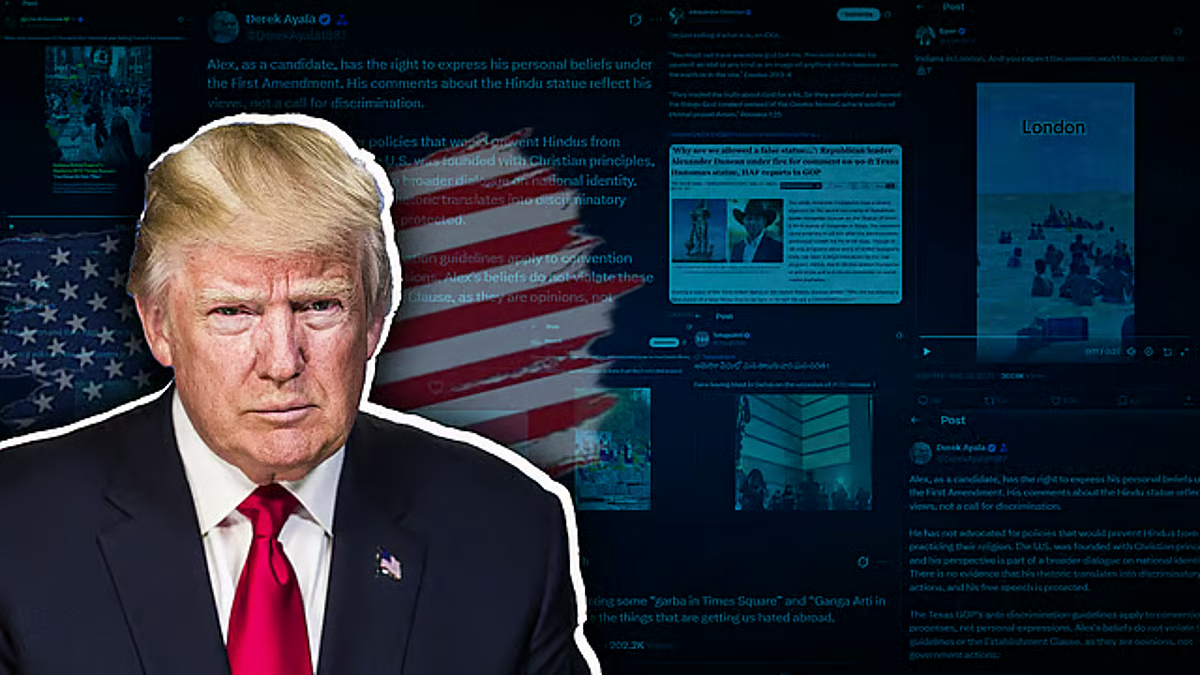
Hindu Indian Americans and organisations such as the Hindu American Foundation (HAF) were quick to call this “anti-Hindu hate”, adding that Duncan had violated the US Constitution’s First Amendment Establishment Clause. The Establishment Clause the government from “establishing” any specific religion.
Many outraged Hindus in the US and India responded to Duncan’s posts with derisive comments on Christianity. Others pointed out ironies.
Duncan also Bible verses that forbid the worship of idols.
Journalist and author Yashica Dutt, noted for her book Coming Out As Dalit, said, “There is a lot to criticise about Indian Americans, whether it is casteist entitlement, the brandishing of Hindu nationalist identities, the general shift towards right-wing politics, or racism against Black and other brown communities. But to say that the Indian diaspora doesn’t have enough civic sense is a red herring.”
She pointed out that Indians are not the only people who celebrate festivals in public spaces.
“So this criticism of a lack of civic sense is very similar to racist ideas such as ‘Indian foods are smelly’ or that ‘they have weird accents’. It’s unclear how much of the criticism is rooted in truth and how much is racist pandering to a particular audience or just posturing online,” Yashica added.
She highlighted how certain festival celebrations concentrated only in certain communities tend to be criticised as “too loud”. For example, in New York’s Chinatown, the lunar new year is celebrated with pomp and show.
Yashica further said, “If we were to unpack this idea of ‘loudness’, it’s something that is targeted at all people of colour (POCs). The Haitian parade in Brooklyn, a historically Black neighbourhood, takes place every year. It has been a part of the neighbourhood’s character for decades. When white people moved in and gentrified the neighbourhood, the noise complaints to the New York Police Department (NYPD) increased.”
Instead, she suggested that the racism against the Indian diaspora has to do with the fact that they’re the minority with the highest median income. “There were social media posts last year claiming Indians earn more than white people in the US do. This directly contradicts the idea of white supremacy,” Yashica said.
When asked if narratives such as ‘India is an emerging superpower’ are impacting how the Indian diaspora presents itself, Yashica agreed.
“Over the last 10 to 11 years, particularly among Indians who have newly migrated to the US, there is an expectation for that narrative to be widespread; a belief regarding the primacy of India. The narrative is also bolstered by Indians who have been in the US for a long time. Aside from whether that narrative is accurate or not, it doesn’t work in the US,” she said.
“There is a different form of racial structure in the US, and Indians do not fall at the top of that structure; they are in the middle. Further, upper caste and Hindu identities are being challenged,” she added.
Yashica explained that Americans who don’t identify as Republican or don’t partake in openly racist narratives around Indian Americans are beginning to recognise that there is “a weird strain of casteist and religious entitlement and fundamentalist misogyny among Indians”. That awareness among mainstream American audiences is rising.
Malini Ranganathan, political ecologist and associate professor at the School of International Service (SIS), American University, Washington, spoke to TNM on the Indian diaspora’s shifting visual representation of itself.
“When Indians first came in large numbers, in the 1970s and ‘80s, as engineers, doctors, and computer science professionals, and even later on in the ‘90s and 2000s, they were told to keep their heads down and assimilate. With the rise of Hindu nationalism, there is perhaps more of an unabashed embracing of Hindu cultural identity going on the world over,” Malini pointed out.
She added, “While there has always been anti-South Asian racism lurking beneath the surface, it’s not difficult to imagine why there might be a backlash against that more muscular visual expression of Hindu identity and religion in the public sphere.”
Malini also explained that in a time when white supremacy and nativism are emboldened, there is a “cocktail of perfect conditions” for anti-Indian racism now.
“What we're seeing today is that Indians who may have thought that they were ‘safe’ because they are generally upwardly mobile, educated, and upper caste with privilege and caste capital are not safe either. There was a certain kind of security blanket that had formed over Indians because of their proximity to the middle class and whiteness. Now they’re no longer as secure as they used to be. It must be disillusioning after having assumed that just by acting white and parroting white conservative sound bytes, you may be close to whiteness,” she said.
In her view, this seems to be the situation rather than that Indians are being disproportionately targeted. Referring to the “larger racist logic at play”, she pointed out that it is working-class Latino immigrants – particularly those who are undocumented – Muslims, and Palestinians who are truly disproportionate targets of racism.
“Ironically, while the right-wing white block and the right-wing Hindu block might actually clash in some spheres, they are completely politically aligned in other spheres,” she further said.
According to a 2024 on Indian American attitudes by the Carnegie Endowment for International Peace, 69% of Indian Americans were concerned about the rise of Hindu majoritarianism in India, compared to 81% who recognised the prospect of rising white nationalism in the United States.
“On the question of Hindu majoritarianism, Hindus [in the US] were the least likely to agree that Modi’s 2024 [General Elections] campaign speech exemplified growing threats to minorities … Of all religious groups, only Hindus were significantly less likely to express concern about the threat of Hindu majoritarianism when compared to white nationalism.”
The survey also noted that threat perception was, however, higher for all groups when it came to white nationalism in the US. 80% of Hindus, Muslims, and Christians agreed with the proposition that the 2017 Charlottesville rally represented a white nationalist threat.
The Charlottesville rally in the state of Virginia after hundreds of white nationalists gathered to oppose the removal of a Confederate statue. White nationalists in the US have long identified with the Confederate-era southern states, the history of enslavement and racial segregation, while projecting key historical figures of the time as ‘heroes’.
Yashica noted that the 2024 presidential candidacy of Kamala Harris also spurred the far right.
“Her campaign was very focused on her Black and South Asian identity. So the attacks on South Asian identities became common within Trump’s presidential campaign.”
She added, “Anti-Black hate in the US has been prevalent historically. However, there has been less conversation about South Asian hate. Factors such as Vivek Ramaswamy's Republican candidacy in the primaries and Elon Musk’s hand in employing a huge H-1B workforce played a crucial role in highlighting the South Asian, specifically Indian American, identity. Social media became a platform where hate was amplified. The narrative that Indians are extremely prosperous and visibly successful, especially in tech, became a focal point.”
It must be noted that while Kamala Harris was quick to capitalise on her South Asian identity during the 2024 presidential campaign, she failed to acknowledge the caste capital and privileges she held as the daughter of a Tamil Brahmin woman.
Yashica called attention to Project 2025, which she described as the “playbook that we are seeing unfold at this moment in the US”.
Project 2025 is a federal policy agenda and an outline for radically restructuring the executive branch of the US government. It was authored and published by former Trump administration officials in partnership with The Heritage Foundation, a conservative think tank that opposes abortion and reproductive rights, LGBTQ+ rights, immigrants’ rights, and racial equity, the American Civil Liberties Union (ACLU) .
A 900-page titled Mandate For Leadership was released as part of Project 2025, detailing restructuring for each federal government agency.
Among a host of overhauls to visa policies that the manual outlines, the H-1B visa has been described as “oft-abused”. The Mandate For Leadership says: “Transform the programme into an elite mechanism exclusively to bring in the ‘best and brightest’ at the highest wages while simultaneously ensuring that US workers are not being disadvantaged. H-1B is a means only to supplement the US economy and to keep companies competitive, not to depress US labour markets artificially in certain industries.”
US Citizenship and Immigration Services (USCIS) shows that 72 percent of H-1B beneficiaries were of Indian origin in 2023. China came in second with 12%.
H-1B beneficiaries have insisted on themselves as ‘’.
Critiquing this stance, some have asked why the financially well-off among the Indian diaspora never speak out when other People of Colour (POCs) are targeted. The distinction has also been called into question, as it hierarchises worth — ‘skilled immigrants are superior to unskilled workers, undocumented immigrants and asylum seekers’.
“Media coverage often hails Indian-origin CEOs as proof that hard work conquers all, yet rarely asks how that success supports those facing ICE (Immigration and Customs Enforcement) raids or other systemic racism. When achievement is celebrated purely as assimilation into Eurocentric hierarchies, it risks undermining solidarity,” said Jonah Batambuze, a Ugandan-American interdisciplinary artist and founder of the Blindian Project.
For example, this is reflected in the comment section of an Instagram post by US-based media outlet Juggernaut, which recently reported that Srini Gopalan is set to take over as T-Mobile’s CEO.
Related Stories
 Global Indians
Micro Mitti to host NRI realty meet in Muscat
7 hours ago
 Global Indians
Indian
13 hours ago
 Global Indians
Indian
23 hours ago
 Global Indians
The Indian American Mind Behind the World's Biggest CEOs | Dr. Ram Charan on Diaspora Dialogues by TOI
3 days ago
 Global Indians
Beyond the Diaspora: R G Chandramogan on how Arun Icecreams plans to crack the US market
4 days ago
 Global Indians
NRI tax rules: What happens to losses on foreign shares?
5 days ago
 Global Indians
GOPIO Presents Memorandum on Diaspora Issues and Suggestions to EAM Jaishankar
6 days ago
 Global Indians
Consulate expands support for nationals in US
1 week ago