
3 AI Startups Tackle M&A’s Biggest Blind Spots From Different Angles

Corporate dealmakers and private equity both agree: people are critical to the success (or failure) of a merger or acquisition, and value realization is found (or lost) during the integration. According to KPMG’s 2026 M&A Deal Market Study, both groups identified integration due diligence as the critical focus for ensuring value realization. While corporate dealmakers ranked leadership and culture misalignment as their #1 post-merger challenge, PE firms named key talent loss, a downstream consequence of failed cultural integration.
This news isn’t new. Research spanning three decades, from Cartwright and Cooper’s 1993 work in the Academy of Management Perspectives on organizational incompatibility, to Harding and Rouse’s 2007 HBR article on 'Human Due Diligence,’ to McKinsey’s 2023 study on programmatic acquirers, the research consistently shows that when the people aspect of M&A is ignored or overlooked, this contributes to deal value not being realized. Dealmakers and leaders, aware of the challenges, have struggled as they lacked the data and insights to mitigate the risk before day one.
That is about to change. According to the founders of three AI-powered platforms, Humanaq (powered by MiliMatch), Grodivo, and NayaDaya, these companies are making culture and leadership compatibility measurable before day one. In an earlier Forbes article on culture strategies in M&A, I covered how having a culture strategy drives deal success. This article goes deeper, showing how emerging AI-driven companies are trying to tackle the leadership and cultural misalignment tension that has dogged M&A value creation for decades.
How Humanaq measures executive alignment before M&A integration begins
Simone Vascotto, founder of Humanaq, watched legacy dissipate in a family-owned business. His grandfather founded the first pizzeria in their northern Italian city in the 1950s. The pizzeria became a cultural landmark and community meeting place. Yet when succession planning needed to happen, the family passed on the business. Simone shared: "Everything that had been built kind of dissipated into nothing, even after just a few years." The experience left a lasting mark.
That experience led Vascotto to create a succession planning marketplace. As he worked in that space, he realized there was a bigger challenge to acquisition success. "I pivoted from the succession marketplace because I realized culture was the main issue," he explained.
When Simone connected with Eric Becker, CEO of MiliMatch, they discovered they were solving the same problem from different entry points. Eric spent decades in M&A acquisitions and realized that knowing the market and numbers meant nothing if he didn't understand how leaders would truly work together. "What I didn't know anything about were the people," he recalls. "If they didn't like the culture, they left. So there goes a lot of the asset value and intellectual property out the door."
On his quest to solve for this problem, Eric discovered a proprietary natural language processing framework developed by Manu Rahani. Cognitive NLP™ aims to uncover the subconscious emotional intent and psychological state behind a person's words, by mapping linguistic patterns. Vascotto and Becker pursued a joint venture, packaging the technology specifically for M&A diligence.
Humanaq's Execution Alignment Index (EAI) analyzes written responses from leaders using Cognitive NLP to measure behavioral patterns in clarity, ownership, collaboration, prioritization, and adaptability. The index identifies the gap between how leaders claim to operate and how they truly prioritize and make decisions. Delivered during due diligence, the EAI surfaces execution risks before integration begins.
How Grodivo standardizes culture assessment across M&A targets
Greg Little, founder of Grodivo, sponsored M&A deals at multiple Fortune 500 companies before founding his AI platform. In that role, he witnessed what drove failure firsthand: "I've been executive sponsor for M&A deals that fail. I saw it happen over and over again. Triple digit millions spent on deals that added no value to the company or even subtracted from value." What Little observed was that while leaders and consultants cared about culture, assessment was never standardized into diligence workflows, remaining subjective and qualitative. His mission became clear: make culture measurable and comparable at scale.
"There's a belief that exists, both in leadership and generally, that there's a good or bad culture," he noted. "But the latest research supports that there isn't a right culture, it's alignment in culture throughout an organization and alignment to strategy that matters."
Grodivo's DETAILED Framework assesses eight dimensions of organizational culture (Discovery, Ecosystem, Thinking, Achievement, Interpersonal, Leadership, Execution, Differentiation) using 28 graded-force-choice questions administered to leaders across the target organization. The assessment produces standardized culture scores across all dimensions, allowing PE firms to compare a target's cultural profile against their portfolio companies to identify where friction could emerge. The standardized approach can be applied across companies, industries, and geographies, potentially giving dealmakers quantifiable metrics to evaluate cultural compatibility with the same rigor applied to financial metrics.
By identifying which cultural gaps matter most for the specific deal strategy, Grodivo enables risk-adjusted synergy modeling. If one target has higher financial synergies but major misalignment on execution rigor (critical for cost synergies), another target with better cultural alignment may capture more value post-close despite lower projected synergies. With this reframing, cultural fit becomes part of the synergy equation.
How NayaDaya detects integration risk before key talent departures cascade
Petri Järvinen, CEO of NayaDaya, and his research team studied emotion-behavior science across multiple business contexts. Based in Finland, Järvinen and his team at the University of Geneva initially explored how emotional experiences drive behavior in various organizational settings. Through their analysis, they recognized a unique convergence point in M&A. "Quite early, we noticed that M&A is really where we should be focusing," noted Järvinen. "Nowhere else are emotions very high, expectations sky high, and the risks big as well." That insight became the foundation for NayaDaya's People Impact Analytics®.
NayaDaya's approach uses a three-question survey conducted in waves during integration (typically 1-2 days after closing, then at recurring intervals). Employees select emotions from a 20-emotion framework (based on University of Geneva research), rate their strength, and explain reasons in open text. The AI analyzes emotional patterns and produces a People Risk Level score (0-100) identifying highest-risk teams and roles.
NayaDaya analyzes which leaders' behavioral patterns predict they'll clash post-close based on emotional responses. The objective is to enable proactive efforts such as reassignment, coaching, or retention strategies before talent leaves and departures cascade. The platform identifies specific integration friction points such as decision-making gridlock, collaboration breakdowns, and accountability gaps, so integration leaders can focus resources on highest-risk areas.
Better measurement may reveal the risk, but leadership still creates the value
Measurement alone won't create value. As NayaDaya's founder Petri Järvinen notes, "You need to be interested in the data, and you need to be committed to act on the data." By transforming leadership and cultural misalignment data from opaque to quantifiable, these AI platforms may finally provide leaders with the data needed to act before value leakage begins. The key will be in human judgment and how interpretation of the data is applied. While the scope of the data and insights it provides are potentially better than before, tools alone don't create value, people do.
Related Stories
 AI News
World Cup 2026: The first 4 games in the Round of 32, with penalty shootouts and 3 late goals, have been incredible
2 minutes ago
 AI News
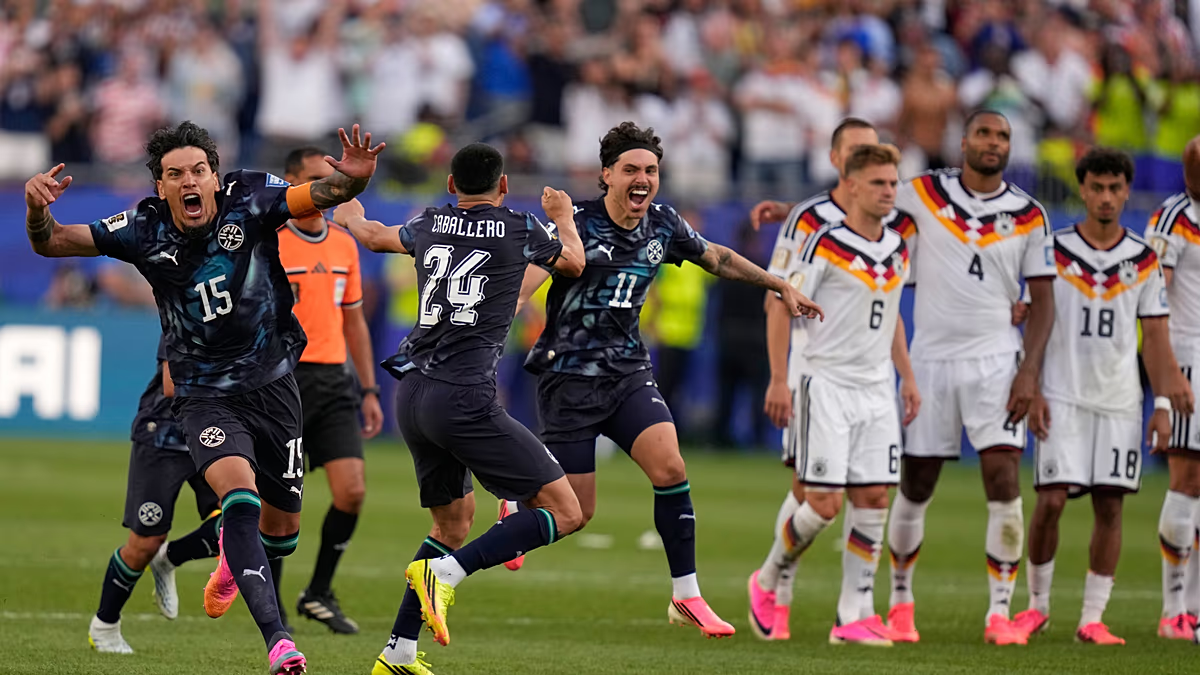
Paraguay and Morocco pull off penalty upsets as Brazil edge past Japan
2 minutes ago
 AI News
Republican Tom Kean Jr. set to return to Congress after long unexplained absence
2 minutes ago
 AI News
Feliks the eagle is back home in Serbia after a kidnap ordeal in the Middle East
3 minutes ago
 AI News
Explosion in Monaco injures 3 including Ukrainian tycoon, and suspected attacker flees to France
3 minutes ago
 AI News
Slate of downtown Victoria streets closing to vehicle traffic on Canada Day
4 minutes ago
 AI News
Fort Simpson wildfire evacuees arriving in Yellowknife
4 minutes ago
 AI News
Yodelling festival in full voice despite record temperatures
4 minutes ago