
8 ag startups offer solutions to farm challenges
Agriculture is full of innovation. Cutting-edge technologies abound, bringing farmers new options to tackle their toughest challenges. From solving labor shortages and testing autonomous field “tractors” to developing new genetics, inventors are working to find solutions for challenges in agriculture.
Check out these eight agriculture startup companies that are bringing new solutions right to your farm:
1. Barn Owl Precision Agriculture. Precision ag inventions are nothing new for the industry, but as production costs increase and herbicide resistance grows, many farmers are looking for solutions to boost efficiency. Enter the Barn Owl Precision Agriculture Autonomous Nano-Tractor.
Designed for farmers by farmers, the BOPA ANT is a leap forward in ag technology that allows farmers to worry about the big decisions on their operation. How often have a few rows been missed with a herbicide application? That’s what ANT is for.
Related:How off-farm jobs teach transferable skills
This pint-sized tractor has the power to tow an F-150 while precisely cutting down weeds in crop rows. It is formatted to work on a variety of crops and is currently being used in soybeans, potatoes, corn and other specialty crops.
Farmers don’t purchase ANT; they lease it for the season and have support for programming and field mapping. Find out more from BOPA here.
2. Helical Solar. Some consider solar farms a detriment to production agriculture due to their extensive use of farmland, but what if you were able to capitalize on the power of the sun without giving up your fields? Helical Solar is doing just that.
The company’s solar panels are designed for use along field edges and feedlot corners. Rated to structurally withstand winds greater than 125 mph, and embedded without concrete, the dual axis-articulating panel provides over 45% more power production when compared with conventional fixed solar panels. The panels have been and are currently in research trials with feedlots in Kansas, where the cattle-proof structures offer shade to livestock while protecting your energy investment.
Find out more information about Helical Solar here.
These are not your usual solar panels. Helical Solar works in tandem with farm operations to minimize space and maximize energy input. The technology has even proven to be cattle-proof for use in feedlots or livestock pens. (Helical Solar)
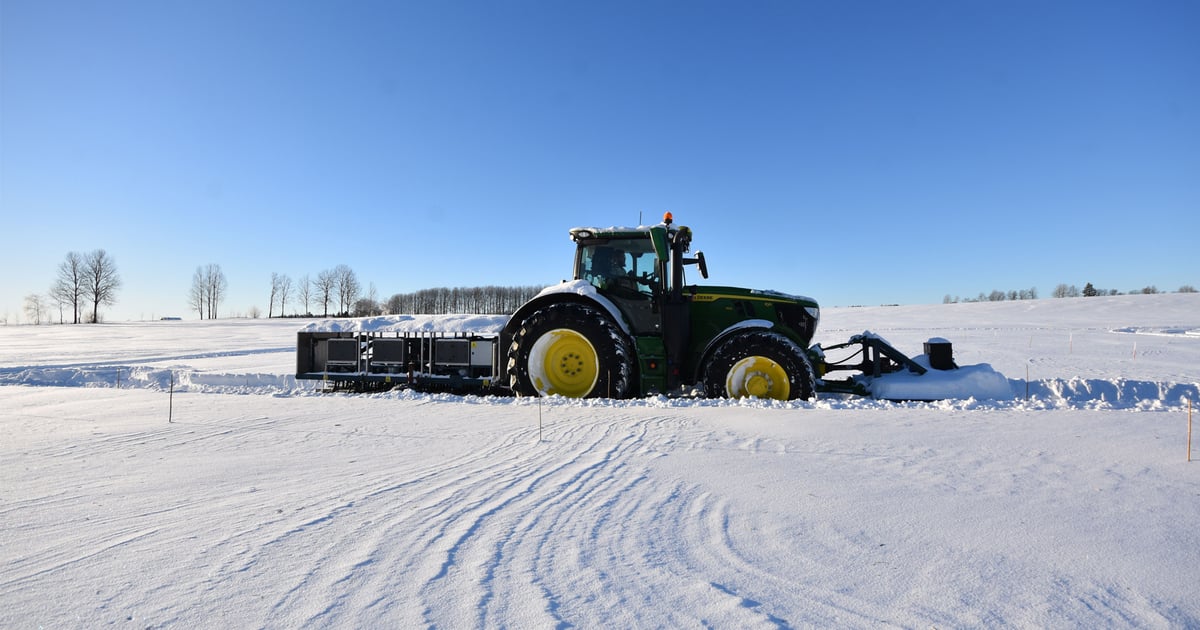
3. WinterLeap. The Northern Plains’ frigid winters bring a new opportunity, according to the founders of WinterLeap. While biology is dormant and nothing is growing, the company aims to protect next season’s crop with microwave technology.
Exposing frozen soil to microwaves, WinterLeap works to neutralize weed seed banks, soil-borne pests and even nematodes before they become problematic. The technology only works in climates cold enough for the soil to freeze, such as the northern U.S., Canada and Norway.
Related:Anheuser-Busch awards grant to support farmers
The microwaves penetrate frozen soil to take out the bad without removing the good soil biology. They don’t raise the overall soil temperature like techniques such as steaming do. Over three winters of testing in Norway, WinterLeap has been validating its technologies with growers and is now expanding testing into the U.S. and Canada.
Find out more or test WinterLeap technology by visiting the company's website.
4. New West Genetics. Without the footprint of traditional corn and soybean, but still filling a growing need, the industrial hemp industry is being hailed as a climate solution. New West Genetics is the leader in creating enhanced industrial hemp genetics for fuel, feed, nutrition and fiber.
Industrial hemp is an adaptable crop that can be used in rotation, offering flexibility to farmers to diversify their planting strategies.
New West Genetics’ Abound hemp seed varieties allow growers to benefit from all parts of the plant, bred for high grain yield and an increased biomass.
Founded in 2014, the company was first to the market with its hybrid. These genetics have been found to yield up to 3,800 pounds per acre, compared with the average variety averaging between 800 and 1,500 pounds per acre.
Related:Should you trademark your farm name?
5. Reform Bio. Turning agriculture waste into carbon-rich biochar through its proprietary process, Reform Bio is commercializing a slow-release nitrogen fertilizer product. In partnership with Iowa State University, the technology utilizes pyrolysis to create “Nitrogen Reformed.”
Biochar products can absorb a large number of nutrients, which creates a long-lasting fertilizer pellet. They are covered with a food-grade coating to ensure gradual release, and have shown several potential benefits beyond nutrient efficiency.
Offering improved fertilizer uptake, Reform Bio’s product also can help reduce input costs while the biochar releases carbon into the soil, according to research with ISU. Due to the slow release, there is an expected reduction in nitrogen run-off into waterways.
Find out more information about “Nitrogen Reformed” and Reform Bio here.
6. Sentinel Ag. Developed at the University of Nebraska-Lincoln, Sentinel Ag was created with the goal of bringing a win-win nitrogen management solution to farmers and agronomists. Delivering data, insights and decision support to nitrogen applications through its software program is what the company does best.
Through the acquisition of satellite imagery and agronomic data, Sentinel Ag’s software analyzes, brings critical insights and provides tools to help farmers make their best nutrient applications.
Integrating specialty or unique crops is a key way some farms diversify their agronomics, spread risk and open new markets. New West Genetics is developing new hemp genetics to answer the call. (New West Genetics)
Sentinel Ag is being used across the U.S. and parts of Canada, where growers are able to strategize, optimize and measure crop success. This can be done without any hardware installation, as the data is collected almost entirely remotely.
7. Edison Rubber. What if you could get two checks for one crop? Edison Rubber is developing rubber from sunflower leaves — with no harm to the seeds. This bio-based alternative to synthetic rubber unlocks new revenue for sunflower growers through collection of the leaf biomass.
Rubber is used in a myriad of products and industries, and it is most commonly synthesized from petroleum-derived sources. Sunflowers naturally have a 0.5% rubber content; however, the team at Edison Rubber is working to boost that content while keeping traditional yields as successful as possible.
Edison Rubber is building a database of fully sequenced sunflower genomes to boost production, which the startup hopes will eventually bring more income to farmers.
8. Prospect Growth. Prospect Growth’s nano-fertilizer allows nutrients to be taken into the plant in a more enduring form. Most fertilizer applications deliver soluble ions, but these ions can be reactive, which leads to volatilization or immobilization in plant tissues before crops can fully utilize them.
Developed by two chemical and environmental engineering students at Yale University, Prospect Growth aims to innovate synthetic fertilizer, a sector that has seen little advancement over the years. Currently, the startup is putting its product to the test in fields across the U.S. Through partnerships with farmers and researchers, it has found promising results in these trials.
Find out more or contact Prospect Growth to participate in upcoming field trials here.
These are only a few of the latest inventions seeking to solve various agricultural issues, with many more in all stages of development on the horizon. No matter what type of farm operation you manage, there just might be an innovator working on a solution for challenges you face.
Related Stories
 Technology
Liquidated medical
57 minutes ago
 Technology
No technology can replace a teacher: Yathindra
1 hour ago
 Technology
L&T technology services introduces FARM for startup growth
3 hours ago
 Technology
Taiwan’s Foxconn Technology posts record August revenue
6 hours ago
 Technology
IGP urges students to stay alert against drug abuse, technology addiction
8 hours ago
 Technology
INEC, JAMB Deepen Partnership On Biometric Verification Technology
11 hours ago
 Technology
Cyprus Business Now: startups, retail, Keravnos, Geely, AI strategy, BoC, CSE
13 hours ago
 Technology
Rescue satellite gets close to NASA's doomed telescope, even if it can't save it
16 hours ago