
A 1947 law cut Americans’ ancestors out of Canada. A new law just made their descendants citizens again
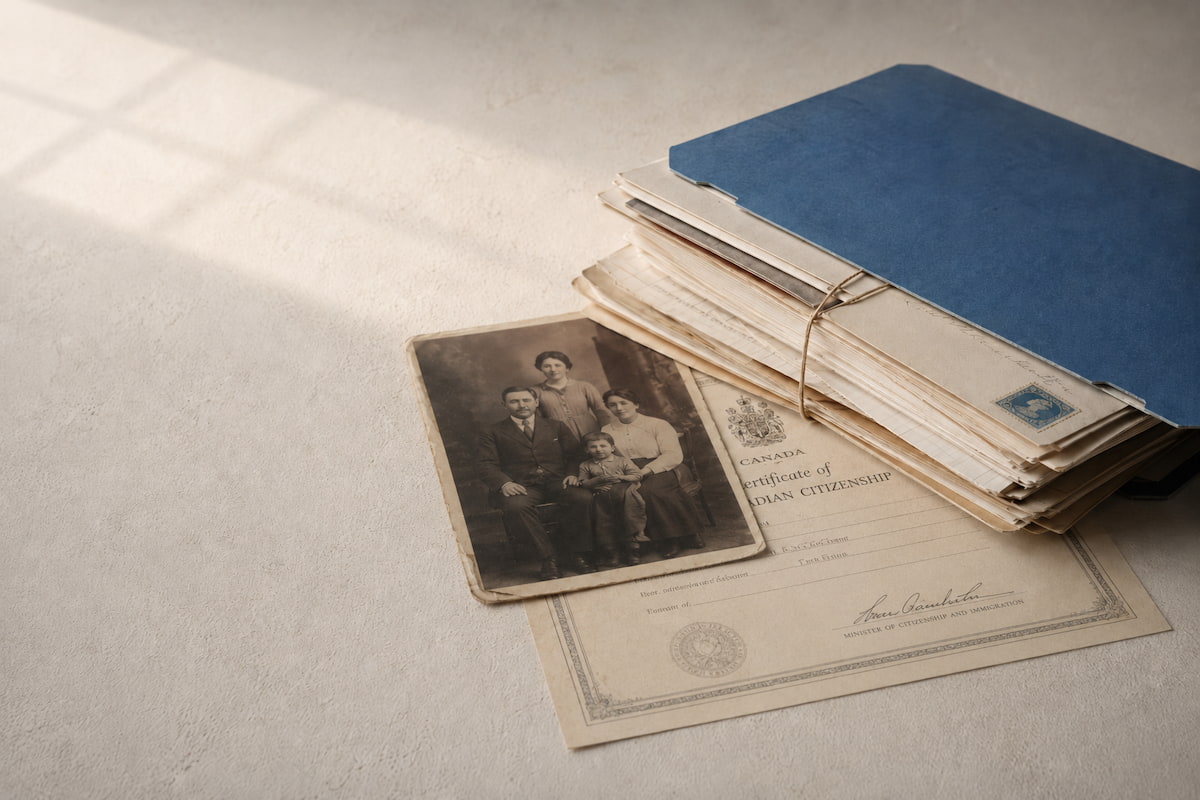
Canadian citizenship passes down through bloodlines. But if your ancestor lived in Canada before 1947, the rules of that era may have cut your family out of citizenship entirely—until now.
The pivotal year is 1947; that's when Canada created citizenship as a legal status — and decided who got it.
When Canada created its first citizenship law that January, it drew the lines around who counted as a citizen narrowly. Some people who had spent their whole lives in Canada were left outside those lines, and if your ancestor was alive then, that history shapes your claim today.
Canada’s citizenship law has since been amended to bring many of these people back in, and it now contains specific categories built for them and their descendants.
Get a Free Consultation on Applying for Proof of Canadian Citizenship
The two groups impacted by the 1947 law
Canadian citizenship only began as a legal status on January 1, 1947, with the passing of the country's first citizenship law. Before then, people in Canada were British subjects. Two features of that old law matter most.
The first is that citizenship by descent depended on gender and marital status. A child born abroad could inherit citizenship from a Canadian father when the parents were married, but could only inherit citizenship from a Canadian mother when the child was born outside marriage.
That same emphasis on gender and marriage produced what may be the most affected group of all: Canadian-born women who lost their British subject status by marrying foreign nationals before 1947.
Under the law of the time, a woman's nationality followed her husband's. A woman born and raised in Canada could marry an American or another foreign national and, in the eyes of the law, take on his nationality and lose her own.
Their children and grandchildren often grow up with a clear family memory of a Canadian mother or grandmother, unaware that her status was stripped by marriage and that the loss may sit squarely between them and a claim today. If your Canadian line runs through a woman who married a non-Canadian before 1947, this is the pattern to look at first.
The second feature is that some people who were born or naturalized in Canada before 1947, having lived as British subjects, were left to convert into citizens through specific conditions, such as still residing in Canada on the day the law took effect, rather than automatically. Those conditions are the categories covered next, which shape what you will later need to prove.
You can often spot an affected ancestor from the shape of family history. The clearest signal is the married woman described above. Still, a few other patterns recur: an ancestor born in Canada in the late 1800s or early 1900s who emigrated before 1947, or a Canadian-born grandmother whose children were born abroad, or a British subject who lived in Canada for years before moving on.
Each of these situations is exactly the kind the 1947 law treated unevenly, which is why they tend to point toward a claim worth examining.
The law was amended over the years to bring many of these people back in, and the current Citizenship Act now lists them explicitly. Claims eligible under the latest Citizenship Act run through one of the following situations tied to January 1, 1947:
Once you can place your ancestor in one of these categories, you can begin tracing the line forward to yourself.
A separate path for Newfoundland and Labrador
One case is easy to confuse with the 1947 rule, though it follows a separate track. Newfoundland and Labrador joined Canada only in 1949, so the law sets a separate date of April 1, 1949, along with its own set of categories for people tied to Newfoundland and Labrador before it became part of Canada.
These mirror the 1947 categories: people born or naturalized there, British subjects ordinarily resident there on that date, and people born abroad to a qualifying parent.
The Act even clarifies that, for the 1947 paragraphs, “Canada” means Canada as it was before Newfoundland and Labrador joined. If your family line runs through Newfoundland, this April 1, 1949, path is the one to look at, not the January 1, 1947, one.
You may have heard that Canada changed its citizenship law in late 2025. Bill C-3 received Royal Assent on November 20, 2025, and came into force on December 15, 2025.
What changed is the rule that had blocked citizenship from passing beyond the first generation born outside Canada. For people born abroad before December 15, 2025, the Act now confers citizenship by descent where outdated rules would have denied it, and that explicitly includes the kinds of older rules at the heart of the 1947 categories. In practice, this reopens claims for descendants whose line had been cut off by where, when, or to whom an ancestor was born.
For the purpose of an older family claim, the point you need is narrow. In many cases, a person born outside Canada before that date is already Canadian if a parent was a citizen at the time, including where the parent themselves became a citizen because of the changes.
That is what connects a 1947 or 1949 ancestor to you. If the law now treats your grandparent or great-grandparent as a citizen, your parent's claim, and then your own, can follow from it, and eventually claim a Canadian passport.
IRCC still asks you to apply for a certificate to confirm your status for certain, and some situations are treated differently, so the application is how you find out for sure.
Documents required for a Canadian citizenship claim
To apply for proof of citizenship, you have to support your application with authentic, reliable documents for every generation in the line, and those documents have to do more than rest on third-party records alone.
Note: Canada's immigration department recently updated what counts as proof of Canadian lineage. New applicants will need to make sure that they abide by these updated instructions. Read our dedicated article on the topic to find out more.
How you document it depends on your situation, and IRCC’s checklist sorts applicants into scenarios.
Most descendants fall into the born-abroad-to-a-Canadian-parent scenario. It asks for your own birth certificate showing your Canadian parent, plus proof of parentage and citizenship for your Canadian parent, grandparent, and earlier ancestor as applicable.
Helpfully, the same scenario accepts a British naturalization certificate issued in Canada or Newfoundland, or the kinds of evidence described below, as proof of the ancestor’s status. That is the bridge between a modern claim and a pre-1947 ancestor.
For the older British-subject situations, the checklist routes applicants to two paper-only scenarios:
One covers a person who was a British subject and meets a residence condition, such as living in Canada for five years before January 1, 1947, living there for at least 20 years before that date, or having their ordinary residence in Canada on that day (with equivalent options for Newfoundland and Labrador before April 1, 1949). It asks for documents like a long-form birth certificate, proof of British subject status, landed immigrant status where it applies, and evidence of residence before the relevant date.
A second paper-only scenario covers certain women affected by the marriage rules of the time, including women who lost their British subject status when they married. It asks for the marriage certificate and evidence of the husband’s nationality, among other documents.
Certain histories can also complicate or block a category, such as a deceased ancestor in the chain, a past renunciation of citizenship, or a declaration of alienage, and other provisions may come into play depending on the family facts. Where your line includes any of these, that is the point at which careful, case-specific review pays off.
How to apply for proof of Canadian Citizenship as a Lost Canadian descendant
If any of this sounds like your family, the first step is to see where you stand. CanadaVisa’s citizenship by descent eligibility checker walks you through your family line and points you toward whether a claim is worth pursuing.
Document gathering is typically the longest and hardest part of the application process. Pulling birth, marriage, and residence records across several generations, sometimes from provincial archives and sometimes in another language, is where many applicants decide they want help.
The more generations in your chain, and the more of the complicating histories above that appear, the more a guided application or full legal representation tends to be worth it. For most descendants, though, the encouraging truth is that this is less a long shot than a documentation exercise, built around a story their family already lived.
Compared with someone whose parent was simply born in Canada, you will typically need additional documents to establish a continuous line of descent and may need to request official records from Canadian provincial archives.
As of the time of writing, IRCC takes about 15 months to process a proof of citizenship application.
Related Stories
 Canada
Ample rainfall brings mushroom boom to Nova Scotia
29 minutes ago
 Canada
Northern Lights illuminate west Wales and England's south coast
29 minutes ago
 Canada
What you need to know about using a heat pump in northern Ontario
29 minutes ago
 Canada
1 dead, 1 hospitalized after 2
1 hour ago
 Canada
El Niño vs. the polar vortex: Canada’s winter wildcard is waking up
1 hour ago
 Canada
Why is Quebec Canada's happiest province?
1 hour ago
 Canada
Tension peaking among Albertans on separation vote
2 hours ago
 Canada
Official languages commissioner rebukes Air Canada CEO over English
2 hours ago