
A swordfish was found on Haida Gwaii. Will more follow?
A swordfish was found on Haida Gwaii. Will more follow?
UBC researcher says finding is unusual but no longer unexpected as Canadian waters warm
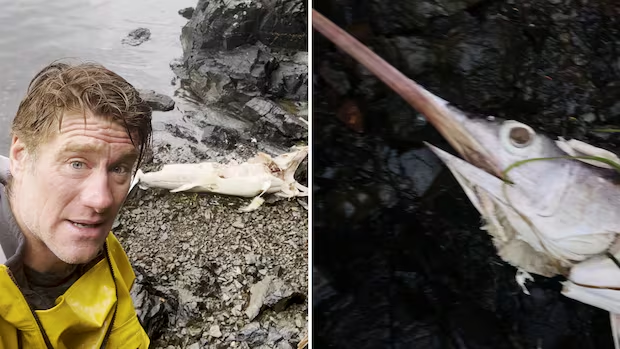
The discovery of a decaying swordfish off British Columbia's North Coast could be a sign of things to come as ocean temperatures rise, a researcher specializing in global fisheries says.
The fish was found by filmmaker and outdoorsman "Captain" Quinn Barabash while out with his oldest son and some friends on Sept. 27.
A video on his YouTube channel captures his incredulity when one of his shipmates tells him what they've found.
"That's crazy," he exclaims, moving towards the roughly six-foot-long (two-metre) carcass.
More stories from Northern B.C.
Swordfish aren't unheard of in Canadian waters: recent years have seen Atlantic fisheries report historically high hauls of the animal.
But they are more commonly found in tropical and temperate waters, particularly in the Pacific.
Barabash's video was taken off the west coast of Haida Gwaii, where he lives, approximately 800 kilometres northwest of Vancouver.
In fact, he says he could only find two other documented sightings of swordfish in B.C., both far south and much closer to the Lower Mainland.
He rates seeing the swordfish in northwest B.C. as one of his wilder encounters.
"It's one of those things that kind of, I don't know, breaks the barriers in your mind of what is possible and achievable out there," he said.
"It's a wild open expanse, and once you go below the surface of the water, the mystery just increases."
Isabella Morgante, a PhD student at the University of British Columbia's Institute for the Oceans and Fisheries, shared Barabash's wide-eyed enthusiasm for the find, confirming it as highly unusual and "really cool."
But once she got over her initial surprise, she also said it made sense that a fish normally found in more temperate waters may have made its way up north.
"It's become an increasingly common event along the B.C. coastline to see these tropical species coming up to colder waters to seek refuge from the warming oceans," the researcher said.
Through her work documenting the impacts of climate change on global fish patterns, she said there's a clear trend of people seeing sea creatures they aren't accustomed to.
A recent analysis, conducted in part by UBC researchers, found warming oceans were having an outsized impact in tropical regions — leading to lowered catches and unusual distribution of certain species.
Great white shark found dead on Haida Gwaii
Canadians should prepare for a 5 C hotter future, report warns
Morgante also noted that it is an El Niño year, which means higher sea surface temperatures in the Pacific Ocean.
But the researcher said the underlying trend shows the shifts in species distribution are more than just seasonal, but part of an ongoing shift that people out on the water should prepare for.
She said anyone who spots an unusual sea creature should do what Barbarash did: document it, take note of where it was found, and communicate the findings so researchers can record them.
And Barabash says he's going to keep on looking for new discoveries.
"The ocean is full of mysteries," he said.
Related Stories
 World
World
Gamers compete in Uckers World Championships in Portsmouth
22 minutes ago
 World
World
Porridge makers from opposite sides of globe triumph in world championship
22 minutes ago
 World
World
Debris found from plane that went missing off US coast
1 hour ago
 World
World
‘Spider
1 hour ago
 World
World
N.B. farmers grow world’s longest gourd tunnel
2 hours ago
 World
World
2 people killed in Norway after shooter opens fire on hunting party
3 hours ago
 World
World
Elena Rybakina suffers shock defeat to world No 118 Alina Charaeva after US Open triumph
4 hours ago
 World
World
Brazil goes to polls in decisive election for future of Latin America
4 hours ago