
Advances in Floating Wind Technology Target Efficiency and Cost
Wendy Laursen has more than 20 years of experience as a journalist....
Advances in Floating Wind Technology Target Efficiency and Cost
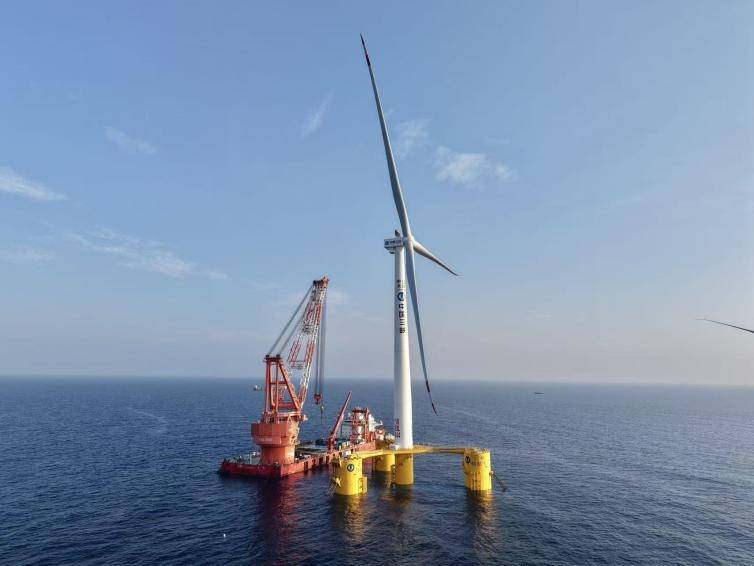
Source: China Three Gorges Corporation
This week, Apollo received an Approval in Principle from Bureau Veritas for its technology designed to simplify the connection and disconnection of dynamic cables from floating offshore wind turbines.
The design eliminates the need for specialist vessels, divers or personnel transfer.
It is just one of many advances being made to enhance the safety and economy of floating wind projects.
Also this week, Sonardyne and engineering consultancy AMOG signed a memorandum of understanding to jointly offer subsea asset monitoring services for offshore energy infrastructure. The partnership will combine Sonardyne's underwater monitoring, positioning and communication technologies with AMOG's engineering assessment capabilities to support the monitoring and integrity management of offshore assets, including floating offshore wind farms.
Another recent example is TouchWind’s floating wind turbine prototype which has now moved to in-water testing. The project team is studying how turbines with tilted rotors can deflect wakes and access higher-energy wind from upper air layers. This could increase wind farm power density.
In the academic literature, researchers from the University of Manchester have examined how water ballast, used to minimize pitch due to turbine thrust, can be fine-tuned to improving human workability and reduce the fluctuating structural stresses on floating wind platforms.
Another study aims to resolve the competing demands of maximizing energy extraction while minimizing the cost associated with inter-array cable routing via a coupled optimization procedure. The study formulates a wind farm layout optimization based on wake effects, array cable routing, and floating-specific cost components.
Proponents of the industry are pushing ahead. Last month, the China Three Gorges Corporation completed what it says is the world’s largest single-rotor floating offshore wind turbine. The 16MW "Three Gorges Navigator" is located over 70 kilometers off the coast of southern China in waters more than 50 meters deep. It consists of a 16MW ultra-large capacity wind turbine, a semi-submersible floating platform and a new mooring system. The wind turbine rotor has a diameter of 252 meters, a swept area equivalent to the area of seven standard football fields and a maximum blade tip height of more than 270 meters.
Related Stories
 Technology
When Tech Companies Die, What Happens To The Products They Leave Behind?
2 days ago
 Technology
Two Finns supplying Russia with missile tech worth tens of millions
2 days ago
 Technology
Drones with pepper spray, four
2 days ago
 Technology
Micron Technology stock pre-market at EUR 800.50: memory storage - ad
2 days ago
 Technology
TAIEX Ends at 4
2 days ago
 Technology
ZAWYA: Technology, start-ups can double India
2 days ago
 Technology
Czech government to consider CZK 1 billion fund for startups
2 days ago
 Technology
GDIN Supports Eight Startups at CEATEC 2026 in Japan, Opens Door to Local Investor Collaboration
2 days ago