
Alberta independence group releases its ‘transition plan’ to become a country
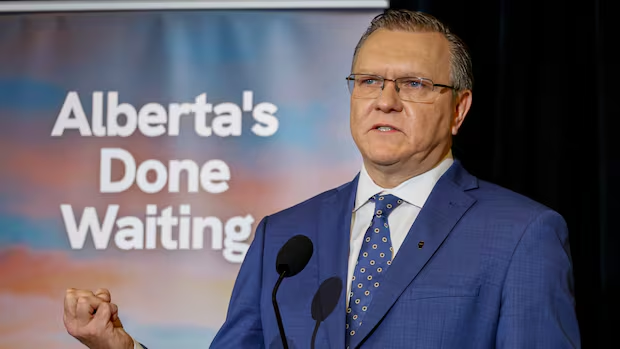
Alberta independence group releases its ‘transition plan’ to become a country
Federalist says plan like showing up for dinner after divorce
An independence group has released a “transition plan,” sketching out what it sees as a roadmap should Albertans vote in the future to become a sovereign nation.
The Alberta Transition Council released the 214-page report on Thursday, laying out a series of proposals tied to how life in Alberta might look in the event of a future “yes” vote on independence.
The report also touches on a range of regulations and institutions the group identifies that would need to transition to Alberta’s control through negotiation, including with Ottawa.
Those proposals vary in scope, from the continuity of social programs to air traffic control to the implementation of a new constitution and the relationship with First Nations.
Lawyer Keith Wilson, who leads the Alberta Transition Council and is also a leader with the independence group Let Alberta Decide, says the aim is to outline how Alberta’s exit from Canada could run smoothly.
“What we need to remember is we’re not starting from scratch, right? Those people who work at the airports, we’re not going to blow up the airport. It’s still there,” Wilson said. “All we’re doing is changing the payroll.”
But one critic argued any transition planning is far off and the plan is “unrealistic” about what are certain to be complex negotiations.
“Many of those issues would take many, many years, potentially, to be fully discussed and possibly never come to a conclusion,” said Errol Mendes, a professor of constitutional and international law at the University of Ottawa.
Not all in Alberta's control, report says
Albertans go to the polls on Oct. 19 to vote on whether Alberta should stay with Canada, or hold a second, binding referendum to separate.
Polling suggests a minority of Albertans presently support the idea of secession.
Two sides in Alberta separation debate entrenched, with majority wanting to remain in Canada: poll
The guiding idea, according to the group, is to not approach the transition as the creation of a country “from scratch.”
“Alberta independence would not eliminate Alberta’s relationship with the rest of Canada,” the report reads. “It would change the legal and governmental framework within which that relationship operates.”
At the same time, the report acknowledges not all of this is in Alberta’s control.
Debt, mobility, energy infrastructure, pensions, borders, and assets are among the areas where negotiation would be needed with Canada, First Nations and others.
Outcomes cannot be known or guaranteed, the report states.
The document claims 45 Albertans in fields including banking and currency, law, international trade, First Nations and policing contributed to the preparation and review of the package.
However, the identities of those individuals were not made public.
Wilson said confidentiality was put in place to ensure contributors don’t face “cancel culture" or harassment.
“The report will speak for itself. And Canadians, and many people in the world, are growing leery of the ‘experts say’ stuff anyway,” Wilson told CBC News. “People will be able to evaluate it.
“Each one of us have our own level of life experience that we’ll be able to hone in on — something we’re very familiar with — and say, ‘Hey, do the base facts seem accurate? Does this analysis make sense?’”
The document is one of several released recently that explore the various ways Alberta separating from Canada could impact people’s daily lives.
Alberta separation too costly with too many uncertainties, warns Calgary think-tank
A president, open-carry gun laws, elected judges: Group floats vision for an independent Alberta
From currency to mortgages to military
In the introductory section of the paper, a series of questions is posed.
“How will laws continue? How will courts operate? How will salaries and pensions continue to be paid? How will money continue to move through banks? How will airplanes continue to fly?”
The group offers some ideas. For instance, take currency. On day one of independence, the group suggests using the Canadian dollar “because it minimizes contract, pricing and consumer disruption.”
“Other possibilities — including use of the U.S. dollar, dual-currency arrangements or a future Alberta currency — remain longer-term or contingency choices,” the report reads.
In many cases, a full resolution isn’t offered yet. On pensions, the group proposes to keep pension payments going for now, leaving the negotiations over future plans for pensions and asset transfers for later.
What would happen to mortgages in the event of a separation vote has been a big question in the run-up to the referendum. Earlier this year, analysts told CBC News there are a lot of unknowns involved in what is likely to be a complicated process.
The plan proposes offering the Canada Mortgage and Housing Corporation the opportunity to continue its services in an independent Alberta.
“If they’re not interested in that, Alberta would stand up, in advance of independence … the Alberta housing mortgage corporation,” Wilson said. “And a transition would occur where the Alberta entity would agree to transfer the mortgage guarantees … so that the banks remain whole.”
Earlier this week, in a separate report, the Calgary-based public policy think-tank Canada West Foundation calculated that debt per person in Alberta could rise to between $80,000 and $95,000 post-separation, compared to $27,000 per person in 2024, based on the increased debt share Alberta could assume.
The Alberta Transition Council, while not recommending a final federal debt figure, suggests that Canada shouldn’t propose that Alberta assume a share of the debt based primarily on population.
“Such an approach would ignore Albertans’ historical fiscal contributions, which should be taken into account in any fair calculation methodology,” the report reads.
Similarly, the report doesn’t include a detailed costing of the broader dollars and cents tied to the prospect of independence, promising a companion report on those matters in the coming weeks.
The report also acknowledges First Nations have constitutionally-recognized rights and are treaty partners.
“Nothing automatically happens to reserve land merely because Alberta becomes independent,” the report reads.
Treaty 6 was signed 150 years ago. First Nations worry a push for Alberta independence puts it at risk
Should an independence vote be successful, the report presents four “relationship pathways” for First Nations, including "Option A," which would allow a First Nation to “keep its current relationship with Canada as much as possible.”
The report also suggests the Alberta Sheriffs could be expanded into a full provincial police force to replace the RCMP, and proposes an initial 2,100-member defence force, which would consist of 300 full-time permanent members and a separate, 1,800-member “territorial force.”
In its report earlier this week, the Canada West Foundation stated that negotiations for Alberta to secede from Canada would be complex, with no guaranteed outcome.
Setting up an independent Alberta would cost more than $200 billion, with ongoing costs of more than $50 billion annually, estimated former Treasury Board senior manager Lennie Kaplan.
Canada West Foundation President Gary Mar said he has yet to read the Alberta Transition Council’s full report. However, on both the “leave” and “stay” sides, there’s too much certainty, in his view, with each side seeming to be fully sure of their assumptions.
“We’ve looked into the complications of both sides, staying and leaving, and have come to conclusions,” Mar said. “I think that Mr. Wilson’s work, I don’t doubt that it’s rosy. But that’s what he’s advocating for.”
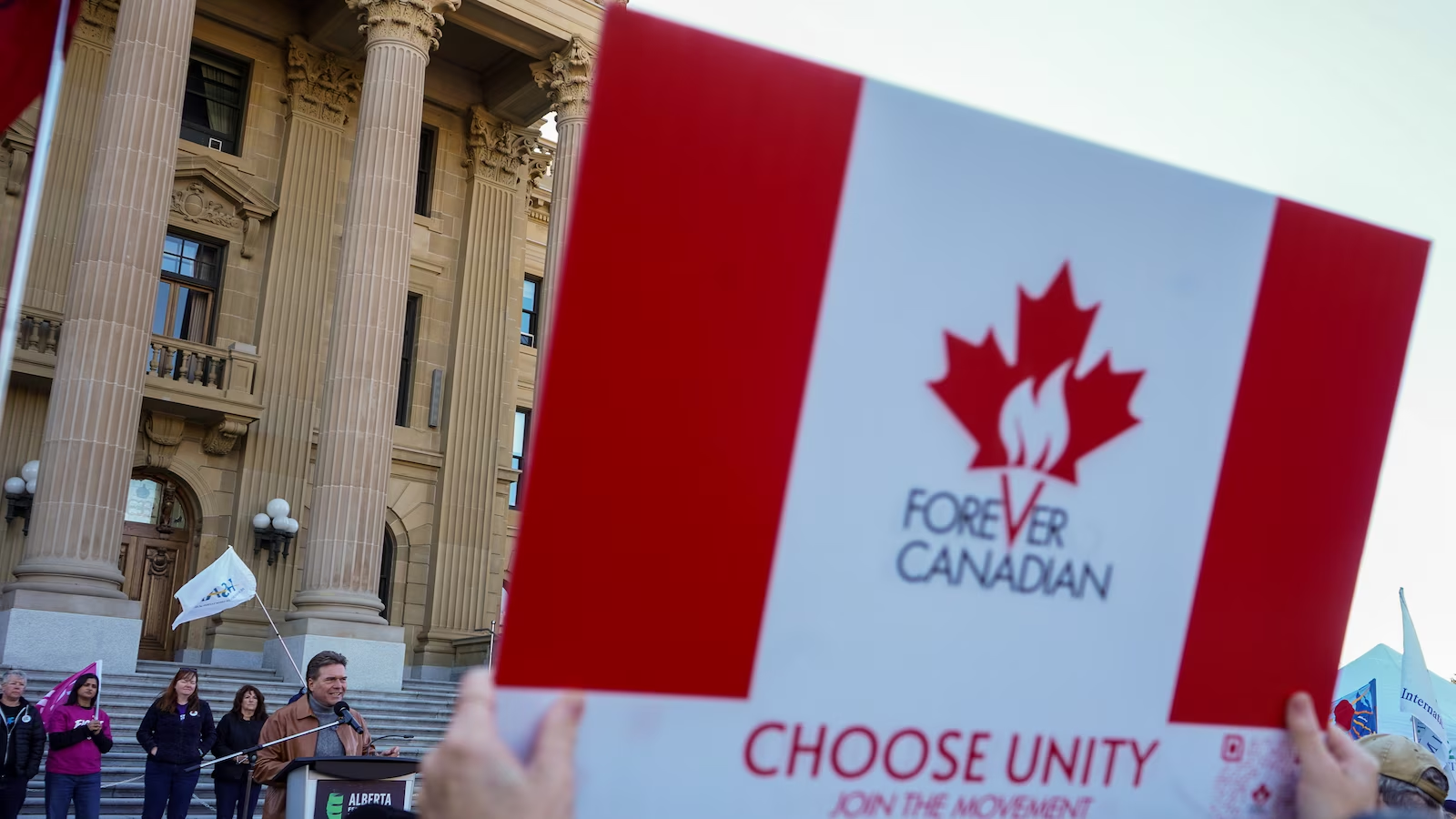
Thomas Lukaszuk, leader of the Forever Canadian movement and former deputy premier of Alberta, said he viewed the plan as “ridiculous.”
“He is the guy that thinks that he can divorce and then show up the next day and say, ‘What's for dinner, honey?’” he said. “Well, it doesn't work like that. This is a divorce.”
Wilson said his group’s report was optimistic “in the sense that we assume that the federal government and the provinces and the First Nations would enter into good-faith negotiations.”
“We know each of the services and functions that the federal government provides. We can plan for the transition of them, just as ordinary businesses do when one business acquires another. The customer is not disrupted,” he said.
Over the coming weeks, Albertans can expect even more numbers and predictions about the province’s future.
That includes the University of Calgary's study of the potential costs of Alberta leaving Canada, commissioned by the provincial government.
That report is expected to be released later this month.
Joel is a reporter/editor with CBC Calgary. In fall 2021, he spent time with CBC's bureau in Lethbridge. He was previously the editor of the Airdrie City View and Rocky View Weekly newspapers. He hails from Swift Current, Sask. Reach him by email at joel.dryden@cbc.ca
With files from Erin Collins, Morgan Black and Jennifer Keiller
Related Stories
 Canada
Albertans head to polls in historic referendum on whether they want to stay in Canada
6 days ago
 Canada
In the news today: four soldiers killed, Alberta referendum, AI privacy fears
6 days ago
 Canada
How a grass fire at a Canadian military base killed four soldiers
6 days ago
 Canada
How will household electricity rebate reduction, temporary winter pricing change impact Ontarians?
1 week ago
 Canada
Residents told to boil tap water due to bacteria
1 week ago
 Canada
Oil
1 week ago
 Canada
Albertans vote on path to independence as Carney fights to keep Canada united
1 week ago
 Canada
Two of 4 soldiers killed in fast
1 week ago