
Albertans to vote on opting out of federal programs
Albertans to vote on opting out of federal programs — while keeping cash
It’s 1 of 4 constitutional questions on October ballot, but ‘yes’ vote alone can’t change this
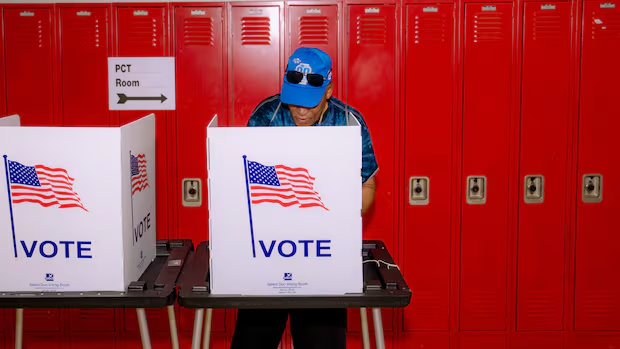
When referendum day arrives in Alberta on Oct. 19, the focus won’t just be on separation and immigration.
Albertans will also be presented with four constitutional questions that range from abolishing the Senate to whether Alberta should appoint the judges who sit on the province’s higher courts.
Third on the list will be a question tied to federal programs like pharmacare. The federal government provides funding to provinces for these programs, sometimes with conditions attached.
The Alberta government wants that to change.
As part of the referendum, voters will be asked if they support a government push to try to amend the Constitution.
The stated goal? To allow provinces to opt out of federal programs “that intrude on provincial jurisdiction such as health care, education and social services” without losing any associated federal funding for use in social programs.
“What Alberta is gunning for here is an attempt to limit what we call the constitutional spending power,” said Geoffrey Sigalet, director of the UBC Research Group for Constitutional Law.
Follow all of our Alberta referendum coverage
By constitutional spending power, Sigalet is referring to Ottawa’s ability to transfer money to provinces and attach conditions to it.
Today, provinces can decline federal funding if they don’t agree with the conditions attached.
But if agreements between provinces and the federal government aren’t reached, that can also mean leaving money on the table, which can be politically unpopular.
“Different constitutional scholars take different perspectives on this,” Sigalet said.
“Some will be more in favour of centralizing this kind of thing. … My own sense is that Alberta has a point here.”
In Sigalet’s view, setting conditions on federal funding sent to other levels of government can look a lot like policymaking in another's jurisdiction.
He noted that some scholars have argued that the spending power is unconstitutional, and others have said it could be open to future litigation.
David Schneiderman, a law professor at the University of Toronto, argued the federal government only oversteps, constitutionally speaking, when it “imposes" programs.
“When it attaches conditions to spending in an area of provincial jurisdiction, a province can simply refuse to accept federal money,” Schneiderman wrote in an email.
“Note that there has not been any serious constitutional challenge to the exercise of the modern federal spending power. Provinces prefer to accept the money — and then erode conditions, as in the case of healthcare.”
This isn’t the first time the federal government’s spending power has been debated.
The Meech Lake Accord in the 1980s was a failed attempt to amend the Canadian Constitution. One of the proposed amendments was allowing provinces to opt out with "reasonable compensation" of national shared-cost federal programs — with a notable condition.
“Under the language of Meech Lake, it was still a little limiting,” Sigalet said.
Under Meech, provinces could opt out if they established a program compatible with national objectives.
Alberta’s referendum doesn’t mention such a condition. Voters will simply be asked whether they endorse Alberta pursuing a constitutional change.
That change, as the province sees it, would allow provinces to opt out of federal programs “without a province losing any of the associated federal funding for use in its social programs.”
But as for then setting up a comparable program?
“We won’t make assumptions about the outcome or what decisions should follow until Albertans have had their say,” wrote Kyle Warner, a spokesperson for the province, in an email.
“Alberta could negotiate with the feds. It is hard to see any federal government agreeing to something short of the Meech formulation,” he said.
Much like the other constitutional questions on the ballot this October, a “yes” vote doesn’t mean immediate change.
Developing an opt-out rule, in whatever form it might take, would require the support of Parliament, as well as at least seven provinces representing at least half of Canada’s population.
All of this might sound familiar to Albertans.
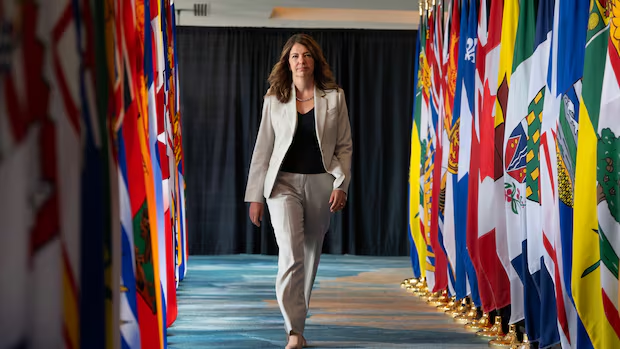
For instance, take Alberta Premier Danielle Smith’s statement in 2024 that the province would pull out of the Canadian Dental Care Plan by 2026.
There are, of course, less than four months to go in the calendar year, and Alberta has yet to exit that plan. A spokesperson for the provincial government said officials continue to work with Ottawa to ensure the province “receives its fair share” of federal funding to further expand its coverage.
Why Alberta's government wants out of the federal dental care plan — and who it could impact
Alberta wants to opt out of national pharmacare program
Fiona Clement, director of the Centre for Health Policy at the University of Calgary's Cumming School of Medicine, said that in her view, the federal government is in charge of a funding method, not a way to deliver the program.
“I would hope if we were standing something up in Alberta on its own, we would also be attracted to concepts like universality and comprehensiveness,” Clement said.
“On a general stand, I think many of the things that are done by the federal government, you are stronger together … there’s a lot of these processes that make a lot of sense to do at the national, federal level.”
The debate around how this money is spent has been going on for decades.
On Oct. 19, Albertans will have the opportunity to weigh in on whether they feel the current arrangement is working, or whether they think Alberta should fight to try to take control of those dollars — no strings attached.
Joel is a reporter/editor with CBC Calgary. In fall 2021, he spent time with CBC's bureau in Lethbridge. He was previously the editor of the Airdrie City View and Rocky View Weekly newspapers. He hails from Swift Current, Sask. Reach him by email at joel.dryden@cbc.ca
Related Stories
 Canada
CHARLEBOIS: Canada's food inflation problem isn’t Donald Trump, it’s Canada
46 minutes ago
 Canada
Carney, Macron to meet as talks of stronger Canada
47 minutes ago
 Canada
Canada eyes ‘associate member’ status with EU amid US tensions, WSJ reports
1 hour ago
 Canada
Discovery Museum hails August success
1 hour ago
 Canada
Brandon researchers working to develop more climate
1 hour ago
 Canada
Will the U.S. midterm results affect Trump's tariffs on Canada? Democrats think yes
1 hour ago
 Canada
Your guide to the U.S. midterms, and why they're crucial for Donald Trump
2 hours ago
 Canada
Man, 27, dies in motorcycle crash in northwestern N.B.
2 hours ago