
Although the use of generative artificial intelligence (AI) around the world is steadily increasing
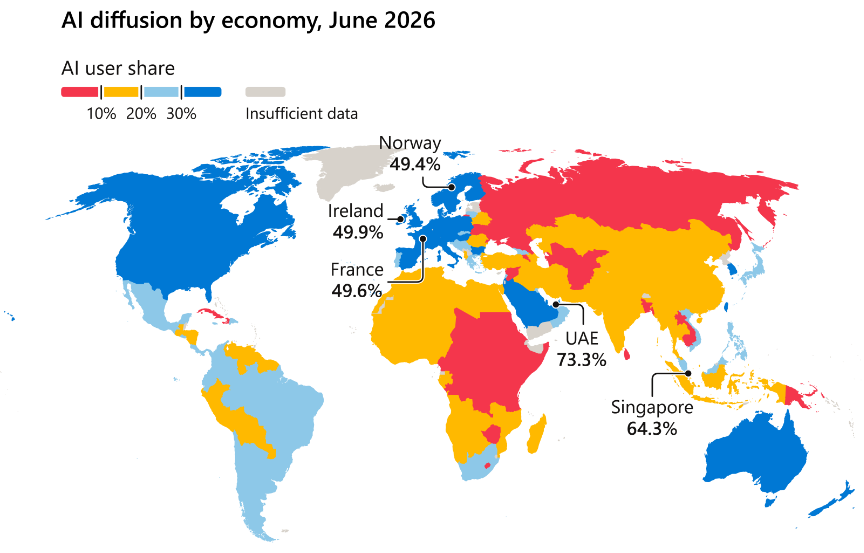
Although the use of generative artificial intelligence (AI) around the world is steadily increasing, the gap between developed and emerging countries is widening, according to an analysis. South Korea's global ranking rose from 16th in the first quarter to 12th in the second quarter due to the rapid increase in the proportion of AI users.
On the 28th, the AI Economy Institute, a think tank under Microsoft (MS), announced the "AI Spread Report: Trends and Insights in the Second Quarter of 2026."
Based on the telemetry data of de-identified MS, the report calculated the proportion of people who used Generative AI products among the world's working-age population aged 15 to 64 by country.
According to the report, the global AI usage rate recorded 18.8% in the second quarter of this year, up 1.0 percentage point from 17.8% in the first quarter.
However, the difference in the level of AI spread by region has intensified. Global North's AI usage rate, centered on developed countries, stood at 28.8%, while Global South, centered on emerging economies, stood at 16.2%. The gap between the two regions is 12.6 percentage points, continuing to grow from 10.6 percent in the second half of last year.
The way AI was used between the two regions was also different. As a result of analyzing the purpose of using Copilot for consumers, the proportion of conversations related to self-directed learning and competency development was 29.2% higher in the Global South and 32.3% higher in academic support than the global average. In the Global North, there were relatively many consumer-oriented uses such as shopping and search.
In response, MS said, "This suggests that learning support can be an important starting point for AI utilization in areas that are in the early stages of AI spread."
The AI usage rate in Korea was 40.6 percent, up 3.5 percentage points from the first quarter. The world ranking went up four places from 16th to 12th. South Korea has been cited as one of the countries with the biggest gains, with the share of users increasing by about 15 percentage points in the last 12 months.
The United Arab Emirates (73.3%) and Singapore (64.3%) ranked first and second in the world in terms of AI usage, followed by Ireland (49.9%) and France (49.6%). The U.S. recorded 33.0 percent and Japan 24.7 percent.
MS analyzed in a report that the open weight model could be a path to expanding AI accessibility in emerging countries.
Openweight models are AI models that can be modified by developers themselves or executed in their own environment by disclosing the learned weights. When MS analyzed the public data of the developer-centric platform OpenRouter, the Openweight model accounted for 75% of the total token usage.
"The gap between power supply, Internet connectivity, digital capabilities, and local language support in the Global South is a structural factor limiting the spread of AI," MS said. "Although these infrastructure constraints are difficult to solve with the open weight model alone, it can lower the cost of using AI with sufficient performance and reduce the burden of adjusting the model to meet local language and demand."
Related Stories
 AI News
No breakthrough AI agreement between Trump and Xi during US
17 minutes ago
 AI News
The energy problem of the AI data centre boom
18 minutes ago
 AI News
China, U.S. agree to AI dialogue, tariff cuts on $30 billion in goods during Xi visit
1 hour ago
 AI News
Canonical is releasing Ubuntu kernel updates faster to counter AI bug hunting
2 hours ago
 AI News
AI minister says system deployment needs regulation, but no details yet
2 hours ago
 AI News
How to avoid looking lazy and rude with your new AI tools
4 hours ago
 AI News
'The AI
4 hours ago
 AI News
Bill Gates advocates for legislation to regulate AI
4 hours ago