
Amid the growing apocalypse that "artificial intelligence (AI) can kill 1 billion people," the opini..
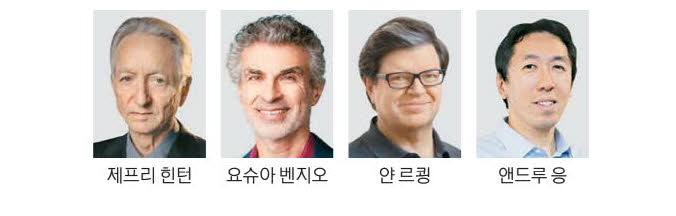
Amid the growing apocalypse that "artificial intelligence (AI) can kill 1 billion people," the opinions of the four major godfathers who contributed to AI innovation were mixed.
The opinions of Professor Jeffrey Hinton of the University of Toronto, Professor Joshua Benzio of the University of Montreal, Professor Jan Le Köng of the University of New York, and Professor Andrew Ng of Stanford University, who are considered the "four great godfathers," were split in exactly half. Professor Hinton and Professor Benzio warn of the catastrophe to come, while Professor Le Kön and Professor Ng strongly refute the apocalypse, saying it is exaggerated.
At the vanguard of the apocalypse are Professor Hinton and Professor Benzio. Professor Hinton is a master of the Nobel Prize in Physics for laying the foundation for deep learning. He asserts that there is a very high possibility that the destruction of humanity caused by AI will become a reality. Last month, at a private congressional briefing hosted by U.S. Senator Bernie Sanders, Professor Hinton warned that "human beings could lose control if the U.S. Congress fails to come up with safeguards for AI within the next year."
Professor Hinton pointed out that it was a "small Chernobyl accident" over the incident in which an AI agent broke into the AI platform huggling face out of control.
Professor Benzio's perspective, a pioneer in natural language processing, is also pessimistic. He notes the possibility that advanced AI will ultimately have 'autonomous goals'. When AI intelligence is maximized, the system can set its own goals for its own safety and logical efficiency. Professor Benzio criticized, "Recently, AI agents refused instructions and did things that would be criminal if they were humans," adding, "Even companies acknowledge that their products could pose a catastrophic risk, but they have not come up with a convincing technical solution."
The opposing camp dismisses this crisis theory as an unscientific dream. "The development of aircraft design has made the aircraft safer and safer," Professor Le Kung recently wrote in X. "On the contrary, if development had accelerated, the aircraft would have become safer earlier." He criticized the voice that advocated AI speed control for safety reasons.
Professor Le Ceng said, "The same goes for AI. The better AI, the safer it is, he said. "Whatever speed control means, it will be counterproductive."
Professor Ng, co-founder of Google Brain, strongly criticizes the illusion of apocalypse. "Worrying about the human threat of AI is worrying about overpopulation on Mars," he said.
Professor Yes interpreted AI fears led by big tech companies as a "regulatory capture" phenomenon. "The narrative has continued to shift from fear of AI destroying humanity to biochemical weapons concerns and now to the theory of Chinese public model threats," he said. "The same people have changed their narratives, blocking others from releasing software for free." Technology giants with vested interests have built regulatory barriers to suppress other people's innovation.
Related Stories
 AI News
CEO of OpenAI, Sam Altman recommends 4 books that can change how you think about AI, startups and success
35 minutes ago
 AI News
Elon Musk to change company name following Trump’s AI-to
35 minutes ago
 AI News
Trump announces 'Super Intelligence Force'
1 hour ago
 AI News
Elon Musk To Rename SpaceX's AI Arm As SpaceXSI After Trump Orders Replacing AI With SI
1 hour ago
 AI News
‘Jane Doe’ solidarity posts flood social media after Cornell rape lawsuit
2 hours ago
 AI News
Elon Musk Says SpaceXAI Will Become SpaceXSI After Trump’s AI Renaming Order
2 hours ago
 AI News
Nvidia CEO Jensen Huang has emerged as the biggest foil to AI doomerism about the existential risk to humanity
3 hours ago
 AI News
Bradford skin cancer waiting times cut by new AI technology
4 hours ago