
Analysts warn of 'uncontrolled demand destruction' as oil forecast to hit record high
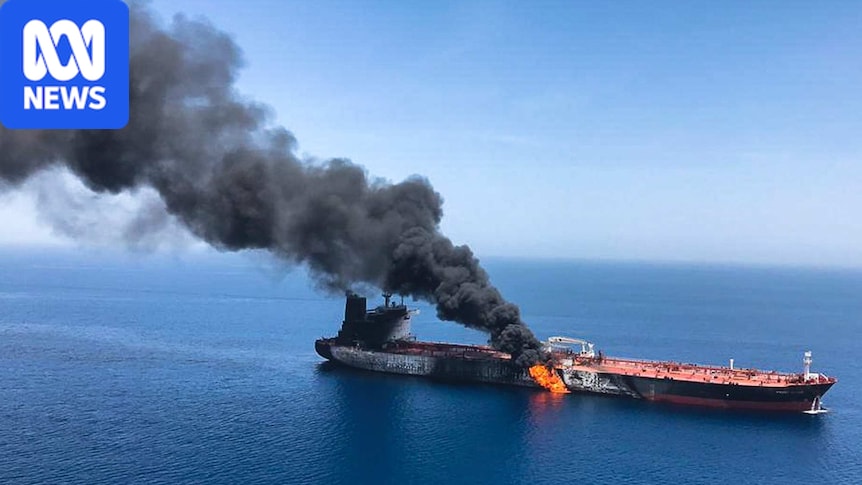
Oil price could surge to $US150 as war engulfs major Middle East supply routes, analysts say
Worsening conflict in the Middle East could lead to oil prices surging further. (AP/Iranian Students' News Agency)
The Strait of Hormuz, the Red Sea and inland Saudi Arabia are now active war zones.
Yemen's Iran-aligned Houthis fired dozens of missiles and drones at a military air base in Khamis Mushait in southern Saudi Arabia overnight.
This latest escalation follows an attack on Thursday, which knocked out the Saudis' East-West pipeline.
The pipeline played a crucial role in easing the world's concerns about an impending global oil shortage.
For months, it had allowed oil tankers to bypass the blockaded Strait of Hormuz, a critical supply route for roughly 20 per cent of the world's oil supply.
That was a major reason why oil prices were lower than they otherwise would be in the past few months.
The Houthis have also advanced rapidly in Yemen, capturing territory including Perim Island at the mouth of the Red Sea — a development which pushed oil prices above $US100 per barrel late last week.
And the British maritime security agency, UKMTO, reported on Sunday that another vessel had been struck by a projectile in the strait, forcing the crew to be evacuated as the ship caught on fire.
The fighting between the Saudis and Houthis creates another problem for US President Donald Trump and other authorities trying to minimise the disruption to global oil supply.
Saudi Arabia has led a coalition battling the Houthis since 2015, but the conflict had largely quietened under a ceasefire in the past few years.
The fragile truce collapsed in July as Houthi strikes hit Abha Airport and the Houthis declared a naval blockade targeting Saudi-linked shipping.
Reuters reported that Washington has so far resisted Saudi requests for direct military intervention beyond intelligence support.
All those worrying developments have pushed the global benchmark, Brent crude, above $US107 per barrel today.
US West Texas Intermediate (WTI) crude also jumped to $US103 per barrel.
Tapis, which is Australia's regional benchmark crude price, is now trading at $US110 per barrel, up 46 per cent since July.
The price of Tapis effects the wholesale petrol price, or what service stations pay for fuel.
But the motoring group NRMA has told the ABC that the difference between the wholesale and retail price is currently non-existent.
This means the price of fuel at the bowser is likely to increase in coming weeks.
The average price of unleaded petrol, according to NRMA, has risen to $2.19 per litre, while the national average for diesel has lifted to $2.68.
"Unfortunately, the trajectory [for motorists] for the petrol price is up," NRMA spokesperson Peter Khoury said.
Mr Khoury, however, expects the price at the bowser to fall quickly if the Middle East conflict were to de-escalate.
But the message today from oil analysts is not encouraging on that front.
"The closure of the East‑West pipeline in Saudi Arabia following multiple attacks has materially altered the state of the oil market," Commonwealth Bank's lead mining and energy commodities strategist, Vivek Dhar wrote in a note.
"[It] means that instead of 40‑45 per cent of prewar flows through the Strait of Hormuz needed to keep global oil and refined product inventories unchanged, 65‑70 per cent of prewar flows are now required.
"The sizable shift almost single-handedly reflects the closure of the East‑West pipeline."
Analysts now say the world is weeks away from returning to critically low levels of oil supply.
"Our low estimate that global markets had five to 11 weeks of global oil and refined product stockpiles is growing in likelihood," Mr Dhar said.
"This compares with our base case of 15‑20 weeks — where flows through the Strait of Hormuz were 30 per cent of prewar levels and global oil markets had the benefit of pipeline bypasses, subdued Chinese imports and rising non‑OPEC+ supply outside the Middle East."
He wrote that: "If inventory depletion is reached, we estimate that Brent oil futures may need to rise to [around] $US150 per barrel to force uncontrolled demand destruction (i.e. where high prices force lower demand) for emerging Asian economies."
That oil price would be even higher than what it was at the height of the global financial crisis.
In July 2008, Brent crude surged as high as $US147 per barrel.
"This price level is derived from the last time that emerging Asian economies saw uncontrolled demand destruction in 2008.
"With nonlinear rises in both oil and refined products now a real possibility, Iran has maximised its leverage against the US."
This will likely make it harder for Mr Trump to extract the United States out of its war with Iran, in a way that does not sound like defeat or capitulation.
Until then, the rest of the world is bearing the brunt of more expensive oil prices and higher cost of living.
Related Stories
 World
World
JSDF loses contact with unmanned reconnaissance aircraft
32 minutes ago
 World
World
Inquiry into New Zealand man who hid his kids in forest for years lambasts officials' actions
32 minutes ago
 World
World
Denmark summons Russia’s ambassador after warship fires flares at Danish army helicopter
32 minutes ago
 World
World
US confirms for first time it has deployed space weapons
1 hour ago
 World
World
Owner of so
1 hour ago
 World
World
Donald Trump Jr.’s wedding funded in part by Russian oligarch, couple says
2 hours ago
 World
World
Manchester venue floated to host G20 in 2027
2 hours ago
 World
World
Ukraine war briefing: No energy ceasefire until Russia stops, Zelenskyy confirms after Trump claim
2 hours ago