
Is AI a threat to humanity? Claude and ChatGPT’s virtual shares plummet
Is AI a threat to humanity? Claude and ChatGPT’s virtual shares plummet
For feedback, please contact english@ilsole24ore.com
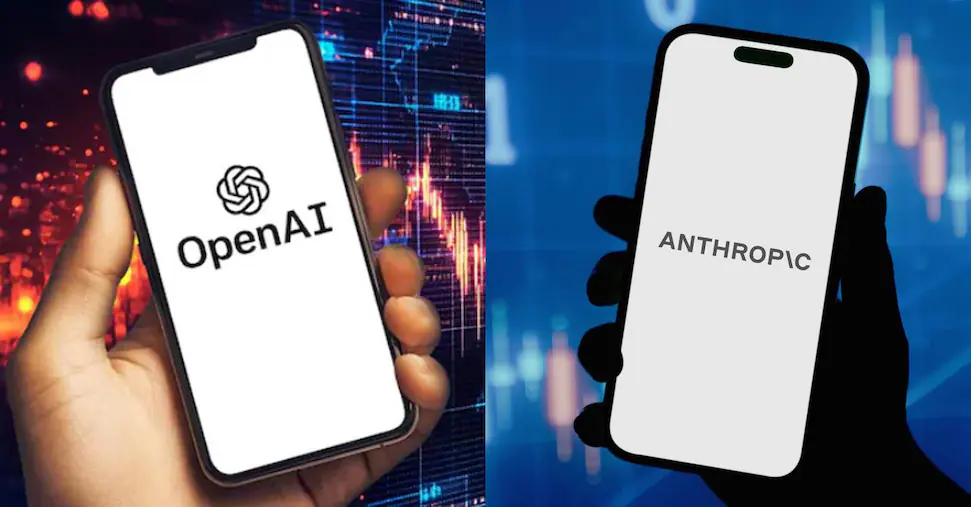
Over 270 billion dollars in implied valuation has evaporated in a matter of hours from OpenAI and Anthropic, the US companies behind ChatGPT and Claude, the two most widely used Western AI models. All of this has happened over the course of the weekend, whilst traditional markets are closed. The data comes from Hyperliquid, the decentralised platform on which contracts linked to the potential future value of some of the world’s leading private companies are traded.
The sharpest fall has been seen in OpenAI. The share price is down by around 11 per cent, bringing the implied valuation of the company behind ChatGPT to around $1,465 billion. Anthropic – the company founded by Dario Amodei and developer of Claude – is down 4% on Sunday, falling to just over 2,070 billion.
Overall, the two synthetic indices continue to value these companies at over 3,500 billion dollars. This figure is close to the market capitalisation of the world’s largest listed companies.
The fall came immediately after statements in which the heads of the two platforms indicated a willingness to slow down the development of artificial intelligence in order to mitigate its risks. The strongest message came from Dario Amodei. In an essay published on Saturday on his personal website, entitled ‘We Must Pace the Frontier’, the head of Anthropic wrote: ‘We must slow down the pace at which we improve the capabilities of AI models. Progress will continue to seem rapid, and we must use the time we gain wisely.”
Amodei is particularly concerned about so-called recursive self-improvement – the ability of artificial intelligence systems to contribute to the development of the next generation of models. This is a process that could accelerate progress beyond humanity’s capacity to understand and control these new technologies.
“If left unchecked, it could exceed our ability to understand and manage these systems and must therefore be pursued with great caution, if indeed it is to be pursued at all,” he added.
His concern also relates to the use of groups of autonomous agents to carry out cyber-attacks. According to Amodei, within six to twelve months, a swarm of more advanced agents could come to control a significant portion of the internet through a persistent network of compromised computers, causing hundreds of billions of dollars’ worth of damage.
The proposal provides for the most advanced companies to grant independent auditors ongoing access to their systems. These auditors should verify compliance with security commitments and report incidents without being subject to editorial control by the companies.
The second step involves an agreement between the leading artificial intelligence developers in democratic countries to introduce common standards and limits on the pace of progress. The final phase aims to establish a form of international coordination that also involves China, at least with regard to the uses deemed most dangerous, such as the production of biological weapons.
This is not yet an operational decision or an agreement to suspend the development of the models. Amodei has, however, explicitly highlighted the need to slow down the pace of the project.
Both Sam Altman and Elon Musk have expressed views similar to Anthropic’s. The head of OpenAI explained that he considers even a small probability that artificial intelligence might have extreme consequences for humanity to be unacceptable, whilst the founder of xAI has publicly expressed his support for Amodei’s position.
Altman also suggested that major companies might reach an agreement to coordinate safety measures. The principle put forward is that, in the face of catastrophic risks, the protection of people must take precedence over the pace of development and the economic interests of individual companies.
A second piece of news has emerged regarding OpenAI that is likely to have a direct impact on investors’ expectations. Altman has ruled out an IPO in 2026.
“Given everything that is happening on the security front, this would be an ill-advised time to list the company,” he said.
The prospect of an IPO therefore seems unlikely until at least 2027. OpenAI would have no immediate need to raise capital via Wall Street and might be called upon to take decisions that are not solely geared towards maximising short-term financial results.
The postponement helps to explain why the OpenAI contract has lost more ground than the Anthropic one. The value of these instruments depends largely on expectations regarding the future listing. When the IPO is postponed, the time until the market can assign a valuation to the company through the trading of actual shares is extended.
These statements also have an impact on the narrative that has underpinned the sector. In recent years, investors have based their valuations on the likelihood that the capabilities of these models would continue to grow at an extraordinary rate.
The outlook envisaged increasingly powerful products, the rapid proliferation of autonomous agents and the integration of artificial intelligence into an ever-growing part of the economy. It was this outlook that justified the massive investments in data centres and the procurement of the most advanced chips.
A coordinated slowdown would introduce a new variable. Longer development times for models could slow the rate of revenue growth and delay the point at which investments begin to yield adequate returns. It would also increase the risk of new regulatory constraints and stricter product controls.
One question remains: does the sharp fall in share prices over the weekend amount to the loss of hundreds of billions of dollars?
The answer is no. OpenAI and Anthropic are not listed companies, and their shares are not traded on Hyperliquid. Neither group therefore has an official market capitalisation that might rise or fall during the course of the day.
The instruments traded are synthetic perpetual futures – derivative contracts with no fixed expiry date. They allow traders to speculate on the valuation that OpenAI and Anthropic might achieve at the time of their listing or in a future capital raise.
Those who purchase these contracts do not become shareholders and do not acquire any rights in the companies. The positions are settled in cash, and the price is determined by the interplay between investors willing to bet on a rise or a fall.
The total valuation of 3,500 billion is therefore also a hypothetical figure. The most recent actual capital transactions had valued OpenAI at close to 852 billion and Anthropic at 965 billion, the latter figure having been set by the 65 billion Series H funding round closed at the end of May. The total valuation emerging from the private funding rounds therefore stands at around 1,800 billion, almost half of the figure cited by Hyperliquid.
The liquidity of these instruments is also much lower than that of traditional equity markets. Relatively small orders can result in very large percentage movements and theoretical changes in value. A 15 per cent fall applied to 3,500 billion is mathematically equivalent to over 500 billion, without that sum actually having been wiped out on the market.
These contracts also serve an interesting purpose. Hyperliquid remains open round the clock and allows investors to gauge the initial reaction to news released over the weekend.
The fall in OpenAI and Anthropic shares therefore provides an indication of market expectations ahead of the reopening of traditional trading on Monday. It will then be possible to see whether the concerns that have emerged in the synthetic derivatives market will also spill over into listed shares that are most exposed to the artificial intelligence boom.
Vito Lopssocial media editor e redattore finanza
Lingue parlate: Inglese e Francese
Argomenti: Finanza, macroeconomia e risparmio
Related Stories
 AI News
Russian SVR Hackers Used Claude AI in Cyber Strikes
6 minutes ago
 AI News
Trump slams AI critics after Anthropic CEO, OpenAI chief raise alarm: ‘Negative forces’ | World News
1 hour ago
 AI News
AI staff 'genuinely frightened' for humanity's future, ex
1 hour ago
 AI News
Z.ai’s fresh US$5b fundraising push comes hot on the heels of July capital raise
1 hour ago
 AI News
Trump downplays growing alarm over risks from artificial intelligence
3 hours ago
 AI News
OpenAI boss and Elon Musk back calls to put brakes on ‘reckless’ AI development
3 hours ago
 AI News
What are the five pros and cons of artificial intelligence?
3 hours ago
 AI News
Managers Are Quietly Asking AI How to Break Bad News to Employees
3 hours ago