
Annihilation, AI and a walkout
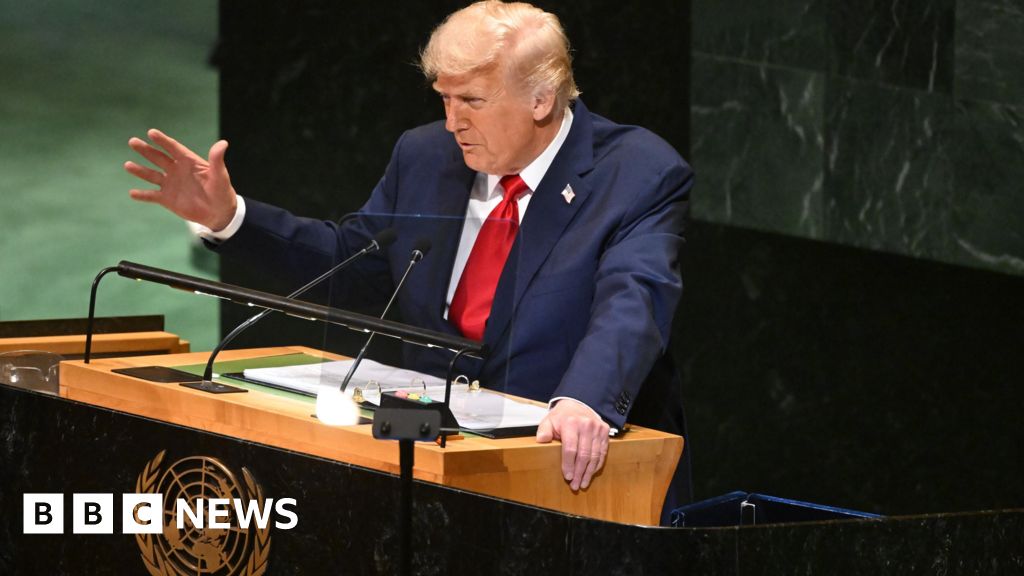
American power, AI and a walkout - key moments from Trump's UN speech
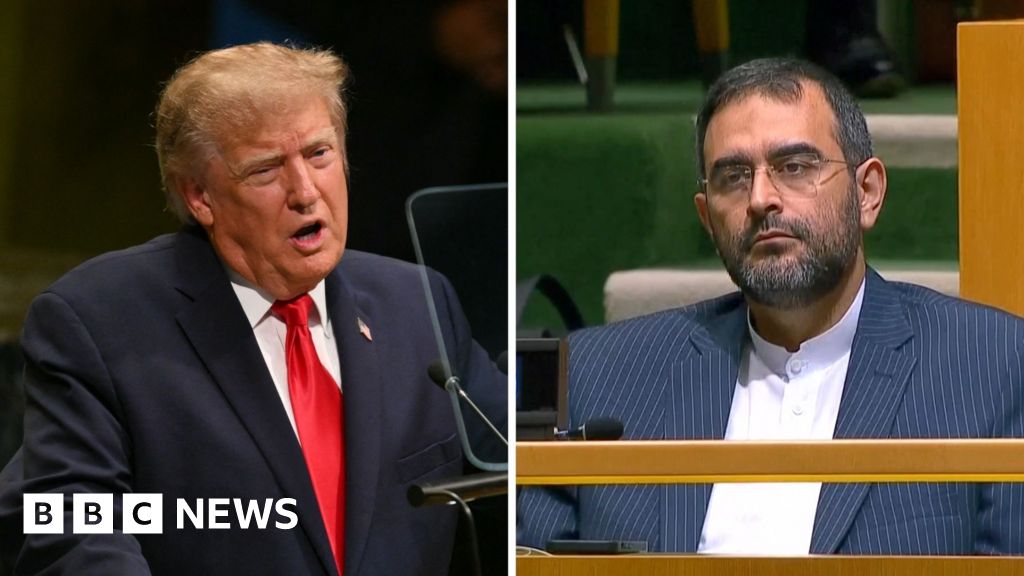
US President Donald Trump returned to the stage at the United Nations on Tuesday, where he touted his administration's policies in front of world leaders and issued pointed threats to some of those gathered in the room.
The lengthy speech was wide-ranging, covering the war in Iran, AI, Cuba and the role of America's military.
The BBC's correspondents who covered the address have picked five key moments that stood out.
1. Trump pushes message of American power
By Sarah Smith, North America editor in the room
The US president has no great respect for the United Nations – he accused it of imposing a far-left agenda – but he does relish the global platform it gives him.
He used Tuesday's speech to tout his achievements, and claim the mantle of a peacemaker, at the same time as he issued a number of pointed threats.
Iran might be annihilated, lethal strikes on small boats suspected of drug smuggling will continue and the Cuban regime may even be toppled.
The clear message was: America is still prepared to use its military might wherever Trump thinks it might be required to secure its national interests.
Trump said he was "reasserting American power" and flexed what he called the country's "unmatched military might".
"The United States will no longer permit threats to America to gain a foothold anywhere in the Western Hemisphere," he said.
Once again, Trump has made the full-throated assertion to the world of "America First".
2. Cubans walk out as Trump calls nation 'failed state'
By Bernd Debusmann Jr, White House reporter in the room
Trump took aim at one of the US's closest neighbours, Cuba, calling it "an absolutely failed state" and saying his administration has been pursuing "a fundamental change in the situation in Cuba".
The Cuban delegation walked out of the hall as Trump continued his remarks.
Over the last year, the US president become more vocal in criticising Cuba's communist government. On Tuesday, he said it was under "enormous pressure" and "failing like never before".
The US has not, however, provided a detailed picture of what it believes change will look like in Cuba.
Cuba's foreign minister reacted angrily to Trump's comments and accused the US president of spreading "falsehoods".
"The US government is incapable of accepting that Cuba is and has the right to be a full sovereign and independent country," Bruno Rodriguez wrote on X.
3. A direct threat to 'annihilate' Iran
By Khashayar Joneidi, BBC Persian correspondent in Washington
Trump presented Iran with a stark choice at the UN General Assembly: reach an agreement with Washington and rebuild the country, or face the rapid "annihilation" of the Islamic Republic.
He then again predicted that a deal to end the war would probably follow the US midterm elections in November.
His remarks illustrated Trump's familiar strategy of coercive diplomacy - keeping negotiations open while also threatening overwhelming force.
But his language blurred the distinction between destroying the political system and threatening Iran itself.
International law experts have previously expressed concern at what they called "alarming rhetoric" used by US officials, including Trump himself, who has posted that the US might "obliterate" Iran's power plants.
References on Tuesday to leaving "no chance of survival" and "no hope" for future generations will likely have stoked similar alarm. There is also an irony in delivering this warning at the United Nations, an organisation founded to save future generations from war.
Yet the speech was not a declaration that diplomacy has failed.
It was an attempt to define the terms of possible negotiations: the US remains prepared to make a deal, but only under the shadow of an existential threat.
4. Trump hails new Greenland security deal
Trump also praised a new deal with Greenland under which he said the US would build two military bases in the Arctic territory.
"We will have the complete ability to do what is necessary to defend the American continent and also Europe," he said of the deal, which he first announced on Friday.
He added that it "very much enhances" the defence alliance Nato.
The US, Denmark and Greenland held a joint signing ceremony at the UN shortly after Trump's address.
Although Greenland is a semi-autonomous territory, it is part of the Kingdom of Denmark which primarily handles its foreign policy.
Trump administration officials are already hailing the agreement as enhancing US security at minimal cost - and with relationships intact.
Denmark and Greenland's governments, however, will be hoping it ends the long-simmering disagreement that began when Trump threatened to take Greenland by force.
That threat shook the Nato alliance and sorely tested the US-Danish relationship.
Few clear details about the nature of the deal have been confirmed publicly, and given Trump had tried for months to purchase or annex the semi-autonomous territory, some analysts are viewing it as a quiet win for diplomacy.
By Nada Tawfik, New York correspondent at the UN
Trump has a penchant for branding, and in his speech he gave Artificial Intelligence a new name: Super Intelligence.
"The use of the word artificial makes it sound fake," he said. "It's not fake, it's actually amazing. But we have to be careful."
"Welcome to the new world of Super Intelligence - SI," he added.
Trump has previously argued that the US must come out on top in the AI development race, saying last week: "Whoever wins AI, wins."
The president is firmly against government regulation or introducing new guardrails - and that puts him at odds with many of those gathered at the UN.
For those who are calling for regulation, the question is whether the slow pace of diplomacy can keep up with AI's rapid development.
Related Stories
 World
World
Six-year
54 seconds ago
 World
World
Donald Trump UN speech: U.S. will still buy Canadian potash
1 minute ago
 World
World
A drone with conditional U.S. approval could be made in America if Beam Global buys its maker.
3 minutes ago
 World
World
Trump signs Arctic security deal with Greenland, Denmark
2 hours ago
 World
World
Trump’s threat to annihilate Iran to UN general assembly is stunning, even for him
2 hours ago
 World
World
OMS Group Opens Remote Operations Centre In Singapore
2 hours ago
 World
World
Watch: Trump threatens to 'annihilate' Iran if no deal reached
3 hours ago
 World
World
Trump tells U.N. he could ‘annihilate’ Iran but expects a deal after the midterm elections
4 hours ago