
Artificial intelligence: A lever for enhancing business competitiveness
AI becomes a new source of competitiveness
Following the merger of Ho Chi Minh City, Binh Duong, and Ba Ria–Vung Tau, a new development space on a larger scale has emerged. The complementary strengths of industry, logistics, urban development, science and technology, and innovation provide the city with greater scope to enhance its production capacity and gradually participate more deeply in global value chains.
As part of this process, AI is shifting from a supporting tool to an increasingly important component of business competitiveness. Integrating AI into production is not merely about automating certain processes, but also about transforming the way in which businesses operate, manage, and make decisions.
Le Thi Be Ba, Deputy Director of the Startup and Innovation Hub of Ho Chi Minh City, said that digital transformation is not simply a matter of technology, but first and foremost a change in management thinking as well as the way in which businesses organise data, operate, and create sustainable value. When data remains fragmented, processes are not interconnected, and information is not effectively utilised, then businesses face difficulties in making fast and accurate decisions.
“Businesses therefore need not only to adopt technology and AI, but also to build management foundations capable of connecting data, optimising operations, and creating new competitive capabilities,” Le Thi Be Ba said.
For businesses, the value of AI is first reflected in its ability to process large volumes of data, identify problems more quickly, and help optimise operations. When deployed effectively, the technology can help reduce costs, increase productivity, improve accuracy, and enhance the stability of production processes.
This is also an increasingly clear requirement as businesses must meet higher standards within global supply chains.
The pressure today extends beyond output to include quality, distribution, cost control, human resources, cybersecurity, and the ability to adapt to constant market fluctuations.
AI is therefore expected to become one of the tools enabling businesses to address multiple challenges simultaneously, from production management to governance and forecasting.
Viet Nam’s manufacturing sector, including that of Ho Chi Minh City, is entering a phase in which AI is becoming increasingly integrated into business operations. From process automation and data analysis to decision support, the technology offers scope for improving production efficiency and transforming operating methods. The opportunities are no longer limited to large-scale factories but are becoming increasingly accessible to small and medium-sized enterprises as well.
AI paves the way for smart manufacturing
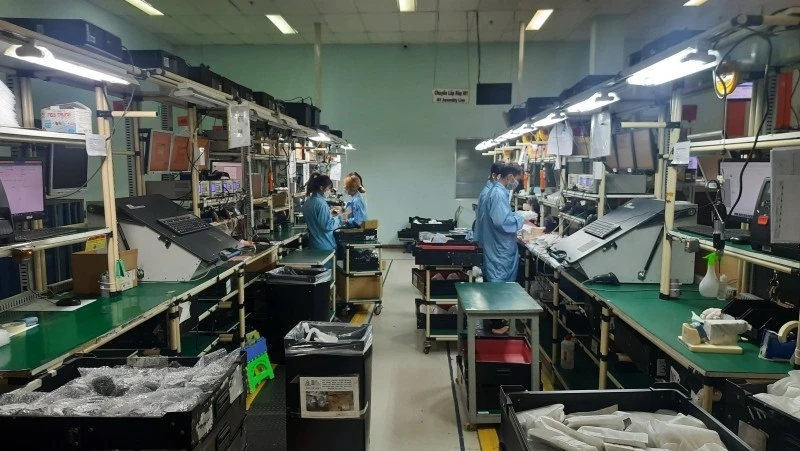
The emergence of AI is changing the way production is organised. While previous stages saw a transition from manual labour to mechanisation, electronics, and then automation, the current phase is moving towards smart manufacturing systems in which people, machines, and AI work together in the production process.
AI’s capabilities also extend beyond replacing a single task. Based on data collected during production, the technology can analyse multiple processes, identify anomalies, and help businesses make decisions more quickly.
In factories, AI can be used to allocate and coordinate tasks, predict equipment failures, optimise capacity, forecast demand, identify bottlenecks on production lines, analyse and flag data, and support monitoring and risk prevention.
The greater value of AI therefore lies not simply in its ability to replace part of the workforce but in improving the quality of decision-making and management efficiency. This is also why human resources are becoming a decisive factor in the ability to harness the technology.
According to Cao Thi Phi Van, Deputy Director of the Ho Chi Minh City Investment and Trade Promotion Centre, the city is committed to continuing to improve its policies, creating a favourable investment environment, and helping businesses gain faster access to new technologies, including AI and smart manufacturing models.
The Ho Chi Minh City Investment and Trade Promotion Centre will continue to strengthen its role as a bridge connecting businesses with experts, universities, technology organisations, and international partners, thereby helping businesses narrow the technology gap and expand their access to global markets.
However, experts say that alongside the opportunities, the adoption of AI also highlights a significant skills gap. This is one of the major obstacles that businesses face when shifting from traditional production methods to smart automation.
For manufacturing businesses, mastering AI is therefore first and foremost a human-resource challenge. Providing training for the right people, starting with specific needs, and proceeding step by step in line with internal capabilities will provide the foundation for making technology genuinely effective, rather than limiting its use to investment in equipment or trialling new tools.
In the race to adopt AI, the ultimate advantage will belong not simply to businesses with the most advanced technology but to those capable of turning technology into greater productivity, higher quality, and new value.
Related Stories
 AI News
AI Stocks Tumble On OpenAI News; GigaCloud Tech, Snowflake, GE Vernova In Focus
5 minutes ago
 AI News
As the global stock market resumes its artificial intelligence (AI) rally and the new stock price co..
6 minutes ago
 AI News
Trump wants AI renamed ‘super intelligence’
6 minutes ago
 AI News
It was difficult to classify tools related to artificial intelligence (AI) hacking that were identif..
6 minutes ago
 AI News
ChatGPT for Teens has special safeguards. A watchdog group finds most don't work
6 minutes ago
 AI News
Marco Rubio warns of Ukraine war stalemate as US pushes for peace deal
1 hour ago
 AI News
Anthropic bans 'cruel' behavior against its Claude AI
1 hour ago
 AI News
Trump calls users of term 'artificial intelligence' the 'enemy'
1 hour ago