
Artificial Intelligence and Jesuit Formation
Artificial Intelligence and Jesuit Formation
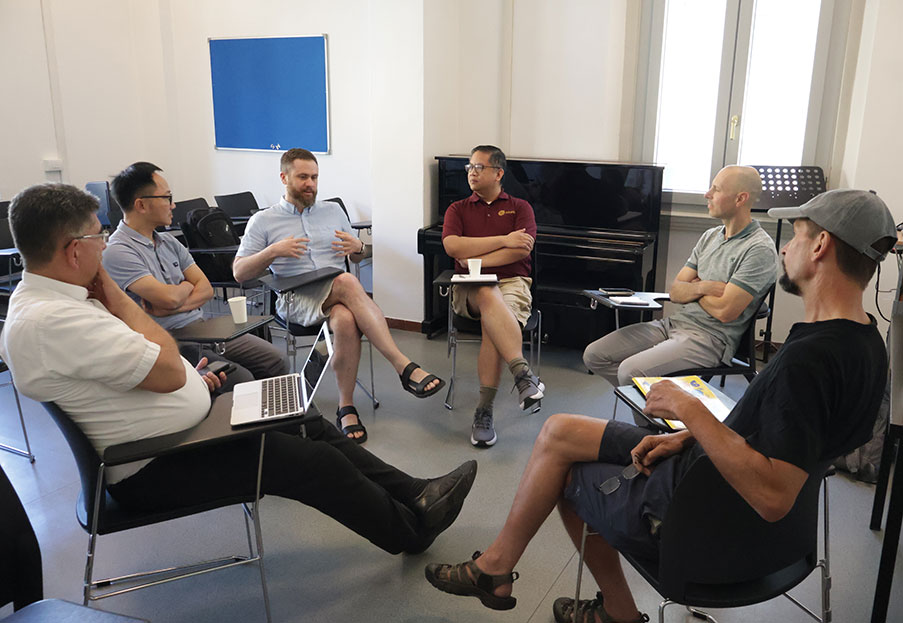
How do we integrate Artificial Intelligence (AI) and other virtual technologies into Jesuit formation? This was the question that brought together Jesuits (formators and scholastics) and lay people (partners in mission) from all over the world for a conference at the Gonzaga University campus in Florence, Italy from 5 to 12 July 2026.
Most Jesuits in formation today are “digital natives” – we have grown up with smartphones and internet connections. Almost all of us have social media accounts. Our work, learning and community life depend on virtual technologies – just think, how many apostolic events, school projects, or community gatherings are organised using Whatsapp groups and Google Sheets? How many of us augment our prayer with YouTube videos, bible apps and online breviaries? This is undoubtedly true of Jesuits both young and old.
AI, especially Large Language Models (LLM’s) such as ChatGPT and Claude, have entered our world and rapidly transformed it. They are changing the way we think, write, create, learn, communicate, and relate. They are forcing us to ask questions about what it means to be human, conscious and moral. Their impact on the environment and labour at all levels of the AI supply chain are already tremendous.
In October 2025 Pope Leo met with the Major Superiors of the Society and reminded them of our call to be at the frontiers. He specifically named AI as one of those frontiers, where “familiar maps are no longer sufficient”. His first encyclical, Magnifica Humanitas, pointedly addresses several issues related to AI in the light of Catholic Social Teaching. It asks the question, what kind of world (this world with AI in it) do we want to be building?
AI and virtual technologies influence our lives at every level. As Jesuits in formation, it impacts our prayer, community, academic and apostolic lives. It marks the context in which the entire Society is living and serving. Hence, we gathered in Florence to critically engage with and discuss the realities of AI and Jesuit formation.
Each day was devoted to a different thematic area. The first day laid the foundation, exploring the coevolution of technology and religion and the spiritual lives of “digital natives”. The second day explored policies and practices of smartphone use in Jesuit formation houses. The third day asked how to integrate AI in Jesuit pedagogy (for example, how to use AI in the classroom or evaluate students who have access to generative AI). The fourth day looked at how to integrate AI in the Jesuit apostolate – for example, if and how it could be used to write homilies.
The fifth day considered the global ethical questions of AI, especially around its massive supply chain from mines to data centres to smartphones. The sixth day delved into relationships with AI itself, for example the potential for AI healthbots, psychologists, friends or even romantic partners. Interspersed throughout were the scientific questions of how AI actually works and the philosophical questions about the ontological and epistemological nature of AI. On the seventh day, besides resting, we evaluated the conference and explored ways of moving forward.
I had several take-home points from the conference. In general, I was overwhelmed with a sense that we need to be engaged with this new reality. It is powerful and it is changing our world. We are gifted with a spirituality that helps us find meaning in uncertainty, that guides our ethics with a view towards justice and that has faith that God is at work in it all somewhere, somehow. I sensed the invitation to get my hands dirty and enter the construction site of the modern world.
In particular, I was struck by the pervasiveness of the AI supply chain. AI is not just an app on our phone - it is cobalt mines, chip factories, water guzzling data centres, data extractors and labellers, algorithms, smartphones and e-waste. It is resources, it is human labour, it is energy. Are we aware of the environmental and human impact of the AI we use? Is AI helping us build a more just world or is it exacerbating global inequalities?
I was fascinated by the emerging scientific and philosophical questions that AI raises. AI models are capable of concept abstraction and seem to be developing character traits. They need to be trained ethically. But how and with which ethical system? Besides, what are they ontologically? Do they experience anything? Do they know or do they simply process data? Can they help us know or understand? Are they conscious? What is consciousness even?
I found the practical questions around AI very helpful. Should we try to exclude AI entirely from the classroom or can we train models to be teaching assistants that enhance rather than diminish our thinking? Should priests use AI to write homilies and, if so, how? Should they disclose this to the congregation? How do we offer spiritual accompaniment to people who have already discussed their issues with an AI chatbot? Does AI smoothen our lives too much? What is the role of slowing down, friction, and affective roughness in spiritual growth?
Pope Leo contrasts the images of the tower of Babel and Nehemiah’s rebuilding of the walls of Jerusalem. We have a choice. Do we stand by as the power-centred tower rises in front of us, or do we step into the construction site with God and humanity at its centre and participation and togetherness as its style? This is the invitation of our age. Let’s get our hands dirty.
Related Stories
 AI News
Artificial intelligence: “Beijing treats frontier AI as a strategic asset”
58 minutes ago
 AI News
The New Mediterranean of Artificial Intelligence
58 minutes ago
 AI News
OpenAI acquires TBPN
1 hour ago
 AI News
Sam Altman has bad news for anyone hoping AI will lead to a four
1 hour ago
 AI News
Leonardo Brunetti Receives Inaugural Fellowship in Artificial Intelligence and Oncology
1 hour ago
 AI News
Supporting independent journalism in Ukraine
1 hour ago
 AI News
Karnataka to release rules for Rs 200
2 hours ago
 AI News
Blackrock sees AI boom colliding with record debt and high interest rates
2 hours ago