
Artificial Intelligence Camera Market Trends: Smart Surveillance, Deep Learning Integration & Forecast to 2034
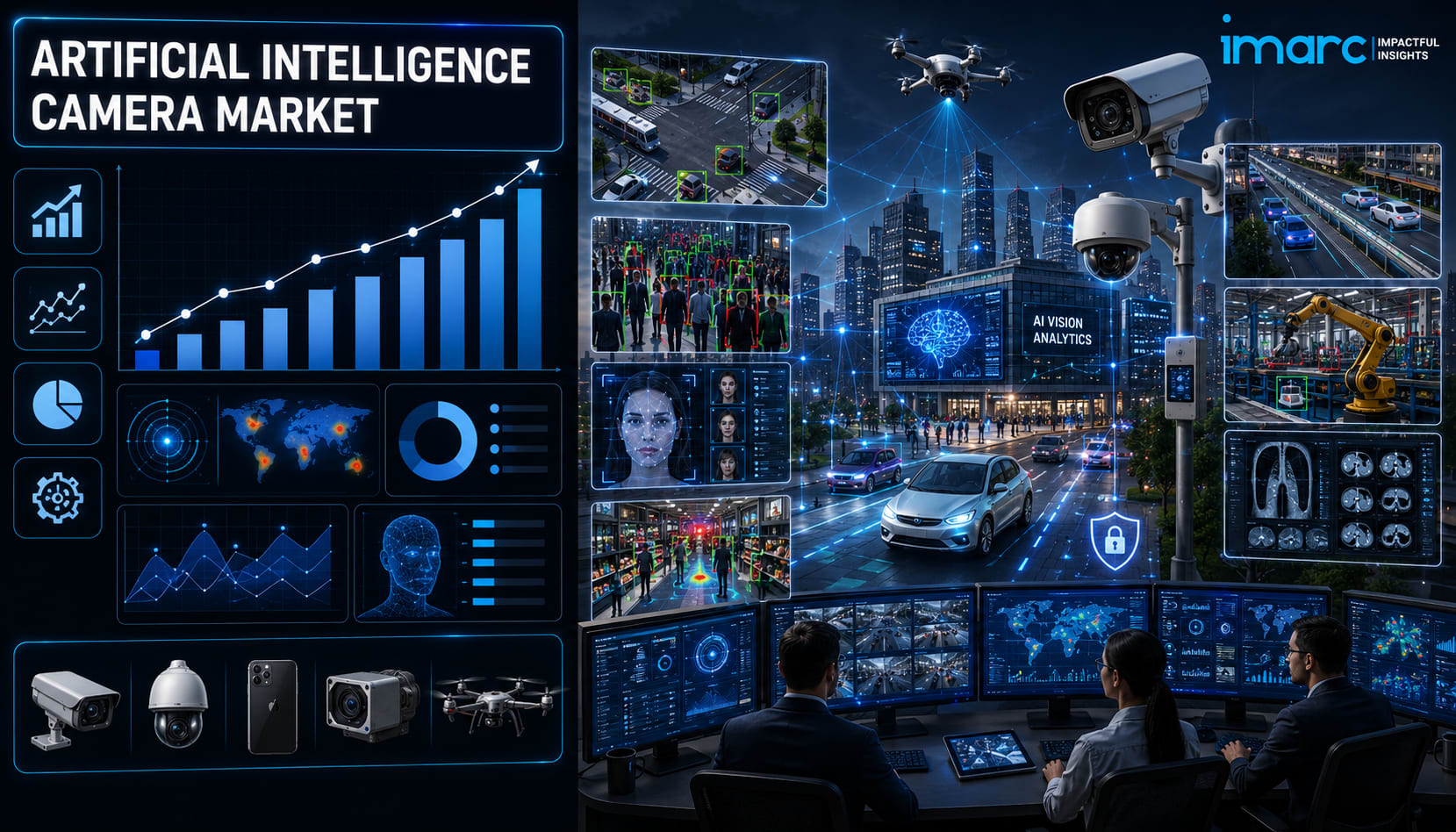
According to IMARC Group's latest research publication, The global artificial intelligence (AI) camera market size reached USD 9.0 Billion in 2025. Looking forward, IMARC Group expects the market to reach USD 27.2 Billion by 2034, exhibiting a growth rate (CAGR) of 12.74% during 2026-2034. The growing concerns regarding safety and security, rising adoption of AI-powered CCTV cameras, augmenting sales of premium feature-rich smartphones, and increasing product applications in traffic monitoring and homeland security represent some of the key factors driving the market.
How AI is Reshaping the Future of the Artificial Intelligence Camera Market
Artificial Intelligence Camera Industry Overview
The global surge in urbanization is one of the structural forces reshaping the AI camera market. With 56% of the world's population, roughly 4.4 billion people, now living in cities, and urban populations projected to represent nearly seven in ten people by 2050, governments and city planners face escalating pressure to manage infrastructure, security, and mobility with limited human resources. AI cameras have emerged as a practical and scalable response to this challenge. Smart city programs across China, India, South Korea, and the Middle East are channeling billions into integrated surveillance and traffic management networks where AI cameras serve as the primary data collection layer.
Smartphone proliferation is running in parallel as a consumer-side growth engine. Global smartphone subscriptions surpassed 6.7 billion, with penetration reaching 69%, and every new device generation brings higher-resolution, AI-enhanced camera systems. Manufacturers are competing aggressively on computational photography capabilities, embedding machine learning directly into camera chips to enable real-time scene recognition, subject tracking, and image enhancement. In July 2024, Infinix collaborated with Samsung Electronics to introduce a 108-megapixel AI-Powered Advanced Deep Learning Algorithm camera that leverages Samsung's ISOCELL sensor hardware to substantially elevate mobile photography performance.
The video surveillance sector broadly is expanding at a pace that directly lifts AI camera demand. The global video surveillance systems market reached USD 65.4 Billion, and the rapid migration from analog CCTV to AI-capable network cameras is the primary reason. Organizations are not just replacing old cameras but rearchitecting their entire surveillance infrastructure to support real-time analytics, cloud connectivity, and integration with identity management systems.
Asia Pacific holds the largest share of the global AI camera market, driven by accelerating smart city investments, high population density requiring scalable security solutions, and a regional technology manufacturing base that keeps hardware costs competitive. Countries across the region are integrating AI cameras into national-level security programs and urban infrastructure upgrades simultaneously.
Request a Sample Report with the Latest Data & Forecasts
Artificial Intelligence Camera Market Trends and Drivers
The three most significant structural drivers are safety concerns, smartphone adoption, and smart city development. Rising criminal and terrorist activities globally have pushed both public agencies and private enterprises to upgrade surveillance from passive recording to active AI-powered monitoring. The advent of 5G networks is a complementary accelerant, as high-bandwidth, low-latency connectivity makes it viable to stream multi-camera AI analytics to centralized platforms without local processing hardware at every node. Cloud-based AI camera management is now a commercially available model offered by providers across North America, Europe, and Asia.
Consumer device manufacturers are driving a secondary wave by normalizing AI camera capabilities in mass-market products. When 108-megapixel AI sensors become standard in mid-range smartphones, the underlying imaging and AI processing technology matures rapidly, and the cost curve falls for commercial and government applications drawing on the same component supply chains.
Health-conscious and safety-oriented behavior shifts following global health disruptions have also increased acceptance of contactless identification and remote monitoring technologies. AI cameras sit at the intersection of these trends, offering touchless access control and passive health monitoring without requiring individuals to interact with any equipment.
Leading Companies Operating in the Global Artificial Intelligence Camera Industry
Artificial Intelligence Camera Market Report Segmentation
Image and face recognition technology represents the largest segment, as it addresses the most immediate and widespread security need across both public and private sector applications. Network cameras follow closely, driven by demand for remote monitoring in residential and commercial settings where real-time internet-based video access is a baseline requirement.
The government segment accounts for a substantial share owing to large-scale deployments in national security, border management, and municipal surveillance programs. Healthcare is the fastest-growing end-use category, propelled by remote patient monitoring adoption and the expansion of AI-enabled clinical environments.
Asia Pacific exhibits clear dominance in the artificial intelligence camera market. Rapid urbanization, national smart city programs, and increasing government expenditure on advanced security infrastructure are the primary contributors. The integration of AI and machine learning into camera platforms, alongside ongoing innovations in image recognition and real-time analytics, continues to widen the technology gap between AI-capable systems and legacy surveillance hardware across the region.
Recent News and Developments in the Artificial Intelligence Camera Market
Note: If you require specific details, data, or insights that are not currently included in the scope of this report, we are happy to accommodate your request. As part of our customization service, we will gather and provide the additional information you need, tailored to your specific requirements. Please let us know your exact needs, and we will ensure the report is updated accordingly to meet your expectations.
Related Stories
 AI News
The CEO of the unicorn AI accounting startup, Rillet, says AI is changing who consulting firms hire
22 minutes ago
 AI News
7 ways AI can be used to enhance security operations
52 minutes ago
 AI News
Argentina Artificial Intelligence in Packaging
52 minutes ago
 AI News
Dr. Dre Says Artificial Intelligence Is Not a Threat to Creative Musicians
52 minutes ago
 AI News
Claude is down
52 minutes ago
 AI News
Omega Seiki Mobility Partners with Electra AI for Battery Health Intelligence
1 hour ago
 AI News
Artificial intelligence in action: how AI agents are transforming businesses, public administrations and strategic sectors
1 hour ago
 AI News
Alibaba’s US$10 billion share sale three times oversubscribed in Hong Kong
2 hours ago