
Artificial intelligence evaluates chemical spectra in minutes
Artificial intelligence evaluates chemical spectra in minutes
Researchers from the University of Jena, Helmholtz-Zentrum Berlin, and Zakodium develop AI system for chemical structure analysis
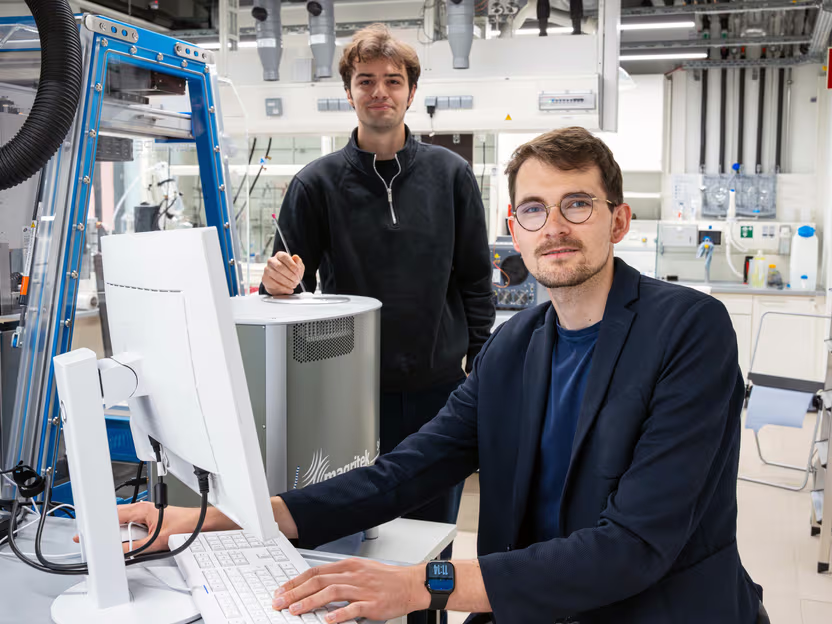
Adrian Mirza (left) and Dr Kevin Jablonka have developed an AI system that analyses NMR spectra in a matter of minutes.
Nicole Nerger (University of Jena)
Determining which substance has actually been produced in a test tube or flask is one of the central tasks of chemistry. Particularly in the case of complex or novel compounds, however, this can be extremely time-consuming, even for experienced specialists. A research team from Friedrich Schiller University Jena, Helmholtz-Zentrum Berlin for Materials and Energy, the Helmholtz Institute for Polymers in Energy Applications Jena and the Swiss software company Zakodium Sárl has now developed an artificial intelligence (AI) system that proposes suitable molecular structures from the raw data of spectroscopic measurements and assesses their plausibility. The system is openly accessible and has been presented in the journal Nature Communications.
Why structure elucidation is so challenging
“Anyone who synthesises a molecule must also prove its chemical structure,” says Dr Kevin Jablonka of the University of Jena. He adds: “To do this, chemists typically use analytical techniques such as nuclear magnetic resonance (NMR) spectroscopy, infrared spectroscopy and mass spectrometry. Each of these methods provides clues about the structure, but often only to a limited extent. The many individual measurement signals therefore form a kind of chemical puzzle that must be solved correctly.”
Structure analysis is often particularly challenging for novel molecules that have never been described before, especially because measurement data obtained in practice are frequently less than ideal. “Impurities in a substance can generate their own signals or overlap with the signals of the target compound,” explains Jablonka. “This is where our system has a particular strength: for proton NMR spectra, which are routinely measured very frequently, it can cope with impurities present in real samples.”
Researchers trained a neural network that can use ion momentum to work backward and predict the pre-blast geometry of a molecule
“The new system, SECS, combines two artificial intelligence approaches,” explains Adrian Mirza, first author of the study. “First, the model learns to translate spectra and molecular structures into a shared mathematical representation. An evolutionary algorithm then refines the results by modifying candidate molecules step by step, adding or removing atoms and bonds and repeatedly testing whether the outcome provides a better fit to the measurement data.”
The system ultimately produces a ranked list of possible structures, together with similarity scores based on the chemical context.
Comparable with experienced specialists
“In a benchmark test involving different spectroscopic methods, SECS identified the correct molecular structure as its top-ranked prediction in more than 80 per cent of cases,” says Jablonka, describing the system’s performance. It also proved capable of matching human experts in direct comparison. “In a pilot study, we asked chemists to solve 20 challenging NMR structure-elucidation problems,” Jablonka explains. The result: the AI achieved a level of performance comparable to that of the participating specialists.
“However, we do not see SECS as a replacement for human expertise,” Mirza emphasises. “The system can provide a highly useful second opinion.” If the proposed structures are plausible and receive high scores, this reinforces confidence in the interpretation. “If, on the other hand, the suggested structures differ substantially from the expected molecular structure, it may be worth taking a closer look,” Jablonka adds.
The source code, model data and a test version of the application are publicly available. According to information provided during discussions with the researchers, the current web version is primarily designed for the direct evaluation of one-dimensional proton NMR raw data. Support for additional spectral types and more complex raw datasets is planned for future releases.
Adrian Mirza, Luc Patiny, Kevin Maik Jablonka; "End-to-end multimodal structure elucidation from raw spectra combining contrastive learning and evolutionary algorithms"; Nature Communications, Volume 17, 2026-6-5
Other news from the department science
The smart fridge of the future: E-nose warns of off chicken and nut allergens
Fraunhofer scales up chemical functionalisation
New impetus for the technologies of tomorrow – Hesse is bolstering its position as a research hub with €1.5 million a year
Sodium doping and controlled lattice defects generate mechanoluminescence at pressures as low as a few kilopascals
Single-step plasma process produces optoelectronic synapse for 3D stackable neuromorphic vision
Tohoku University solves the problem of rapidly evaporating organic solvents in sample preparation
A new method could enable more accurate simulation of materials for various applications in the future
Modern drug research enables simple testing of hundreds of variants of a molecule
The proposed method extracts insights from AI models and groups materials by both structural and optical spectral similarity
The Joseph von Fraunhofer Prize for 2026 for an innovative high-temperature electrolysis stack
Researchers demonstrate an all-water supercapacitor stable over 60,000 charging cycles
CO₂ as a source of oxygen: University of Bayreuth revolutionises oxidation chemistry
Biochar produced at 450 to 550 °C generates particularly high levels of reactive oxygen species
Iron-containing MOF catalysts enable ammonia synthesis without the extreme conditions of the Haber-Bosch process.
Expected to be cheaper than other capture methods
New insights into platinum oxidation could make hydrogen technologies more affordable
In future, material losses and chemical changes could be investigated simultaneously
Jülich team wins international challenge
Nickel oxides accelerate hydrogen-based steel production by a factor of two
"This is a real game changer for the quality assurance of products of all kinds"
Family-owned company responds to intensifying competition in Asia and geopolitical crises with a global transformation program
Record funding round positions the start-up at the forefront of the international fusion industry
"This opens a new strategy for designing adaptive catalysts for a wide range of applications"
Birmingham researchers’ novel way of producing hydrogen fuel has a lower cost than existing methods
Six proposals to save the industry
At the core of the process is soda pressure leaching, which selectively extracts lithium with fewer soluble impurities in one pass
A review article demonstrates how dual-comb interferometers can determine resolution solely through temporal coherence.
Strengthening competitiveness, value creation and technological sovereignty
University of Amsterdam pilot plant brings advanced plastic recycling technology closer to industry
A scalable strategy for developing next-generation electrocatalysts for efficient and sustainable chemical production
His findings are crucial to advancing the use of renewable energy and the development of sustainable chemistry
MIT spinout Rock Zero aims to make U.S. lithium production less dependent on China
More news from our other portals
New observational study suggests processing itself could partly explain links to diabetes, heart disease, and early death
Chocolate from a bioreactor: UC Davis and food-tech start-up California Cultured aim to reinvent cocoa
Simple technology replaces expensive laboratory procedures
The active ingredient also shows anti-ageing effects
One extra bag of chips a day reduces your ability to focus and raise dementia risk factors regardless of diet quality
UMass spun off HertZ Innovation launches smartphone-based bacterial test
London-based start-up aims to activate gamma-delta T cells in both the blood and the tumour to fight cancer
Swedish clean-label pizza brand For Real! Foods and Spanish functional snack maker Mia Puccia enter the next innovation phase
Compounds created by the Maillard reaction during coffee bean roasting tame caffeine’s bitterness
A well-known soil bacterium produces a previously unknown antibiotic that was discovered through improved fractionation methods
Grains, legumes and seeds used in vegan products are particularly prone to mould exposure during cultivation and storage
Research team from Heidelberg and Milan develops novel microscopy technique to study energy materials
Eating one egg per day for at least five days a week reduces risk of Alzheimer’s by up to 27%
Study investigates tradeoffs between human health and sustainability
Cryo-electron microscopy reveals for the first time which amino acids bind water and which ones release it when acidified
Milestone for biotechnology made in Germany: More capacity for cell and gene therapies
Two high-yield beet harvests in succession, high stocks in the EU sugar market and decreasing prices have impacted the earnings position
Water molecules at the air-water interface characterised layer by layer for the first time
How wax moth larvae can help reduce the need for mammalian testing in infection research
Nestlé manager Jolanda Schwirtz takes over as head
T-CURX integrates Pantherna Therapeutics, bringing together 16 patent families and 35 employee
Healthy ultra-processed foods should be exempt from food policy restrictions
Atomic-level insights into lanthanum superhydrides are expected to enable more energy-efficient technologies in the long term
AI-supported in silico mouse model for biomedical research
New research identifies a key biological pathway that could explain how coffee helps protect against aging and chronic disease.
New method solves a key analytical challenge
Simple diet change cuts depression scores in adults with low fruit intake
The combined milk pool totals 19.4 billion kilograms annually
New value deviates significantly from a much-noticed 2019 measurement, but agrees with older quantum chemical calculations
Related Stories
 AI News
LTM inaugurates global delivery and AI competency center in Kolkata
54 minutes ago
 AI News
Scura, Wigfield, Heyer, Cammarota & Gonzalez Highlights Responsible Use of Artificial Intelligence in NJ Legal Practice
1 hour ago
 AI News
Google AI Week gives Killeen businesses hands
1 hour ago
 AI News
Artificial Intelligence Stocks To Consider
1 hour ago
 AI News
AI’s worst disasters will arrive unannounced | Letters
2 hours ago
 AI News
Anthropic Holds Talks With AI Chip Startup MatX To Accelerate Chip Development
3 hours ago
 AI News
Anthropic warns infostealer malware is hijacking Claude sessions to drain usage
3 hours ago
 AI News
Caterpillar is bringing to AI deployment what it learned from automating mining
3 hours ago