
Artificial Intelligence in Retail Market Trends: Personalized Shopping, Automation & Forecast to 2034
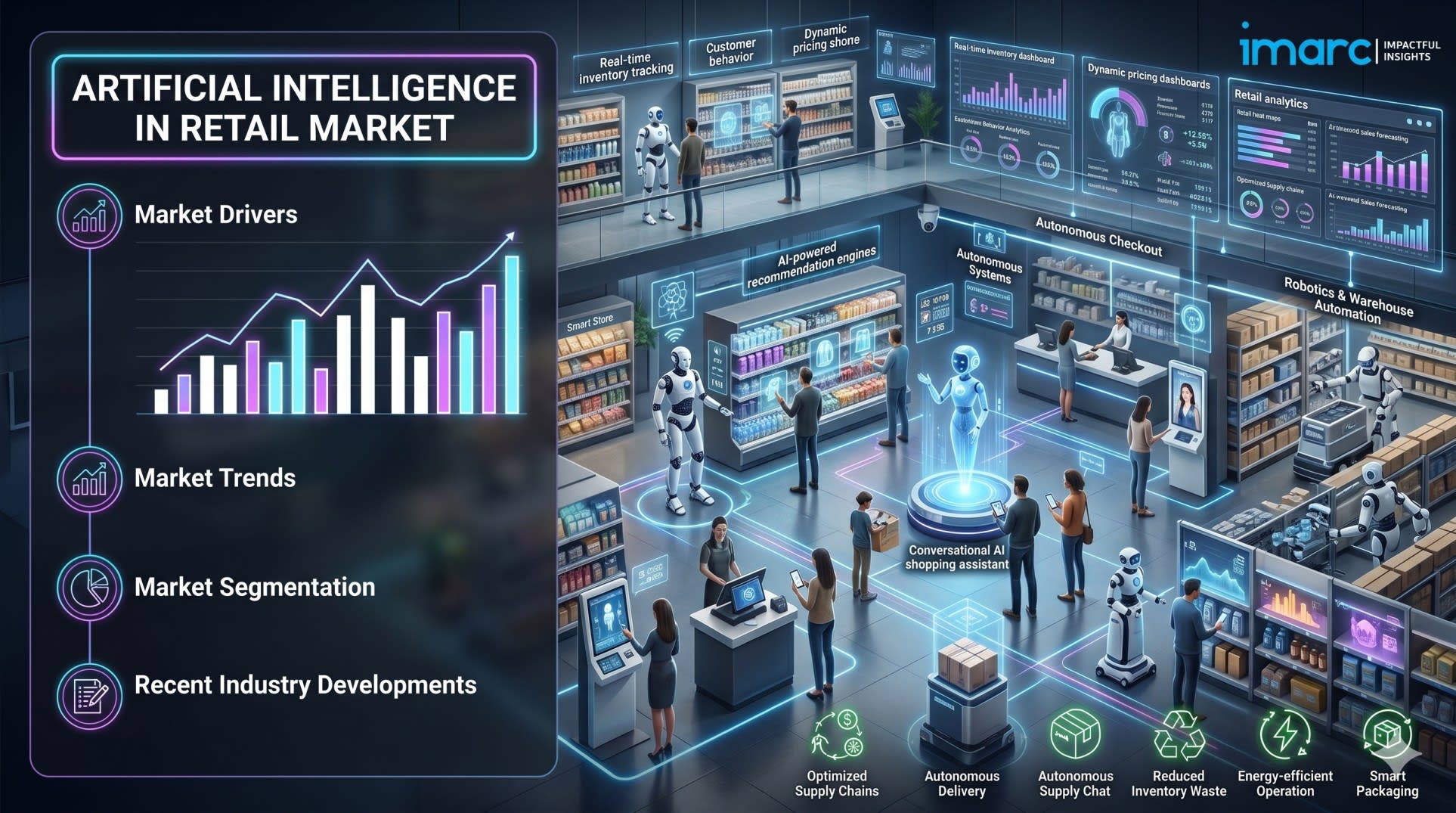
According to IMARC Group's latest research publication, The global artificial intelligence in retail market size was valued at USD 16.8 Billion in 2025. Looking forward, IMARC Group estimates the market to reach USD 77.5 Billion by 2034, exhibiting a CAGR of 17.96% from 2026-2034.
How AI Is Reshaping the Future of the Artificial Intelligence In Retail Market
Artificial Intelligence In Retail Industry Overview
The global retail landscape is undergoing a fundamental structural shift as AI moves from a niche competitive advantage to a baseline operational requirement. The solution segment commands the dominant position within the market, holding 62% of total market share, reflecting the growing retailer appetite for comprehensive AI platforms that address specific operational needs including machine learning algorithms, CRM systems, and inventory management software. Machine learning leads the technology landscape owing to its unmatched ability to analyze massive datasets and generate actionable insights that inform everything from pricing strategy to fraud prevention.
North America currently dominates the artificial intelligence in retail market, holding a market share of over 35.6%, underpinned by a mature technology infrastructure, high AI adoption rates among major retail chains, and the concentrated presence of leading solution providers. The United States in particular benefits from continuous innovation across its tech ecosystem, with companies developing cutting-edge AI tools that enhance customer experience and optimize supply chains. In 2024, Google enhanced its AI capabilities with an update for Google Lens, enabling US shoppers to obtain real-time product details, price comparisons, and reviews simply by photographing items in-store, with the feature accessible across Android and iOS platforms and backed by Google's extensive product database.
Asia Pacific is witnessing the fastest expansion in the artificial intelligence in retail market, supported by a rapidly expanding digital ecosystem, high mobile penetration, and growing government and private sector investments in AI infrastructure. China, Japan, and India are becoming significant hubs for retail AI innovation, with startups developing platforms that offer ready-to-deploy AI agents tailored to retail operations. Europe's market is characterized by a strong regulatory emphasis on responsible AI development, creating consumer trust frameworks that are accelerating AI adoption in both online and brick-and-mortar retail environments. In 2024, x-hoppers launched in France at Tech for Retail 2024, introducing an AI-powered retail communication platform integrating theft prevention through AI Video Alert technology with smart employee communication systems.
Request a Sample Report with the Latest Data & Forecasts
Artificial Intelligence In Retail Market Trends and Drivers
The explosive growth of e-commerce and digital-first retail models is the most powerful driver reshaping the artificial intelligence in retail market. Online retail platforms are deeply integrating AI for personalized product search, recommendation engines, logistics optimization, and fraud detection, creating measurable competitive gaps between AI-adopters and those relying on traditional retail methods. The cloud kitchen and delivery-first business models are similarly accelerating demand for AI tools that manage supply chains without physical retail infrastructure, enabling broader geographic market penetration.
Government-level policy frameworks are further reinforcing AI adoption in retail. The European Union's AI Act is establishing structured guidelines for responsible deployment of AI in consumer-facing applications, compelling retailers to invest in compliant, transparent AI systems that build long-term customer trust. In the United States, federal investments in digital infrastructure and public-private AI partnerships are accelerating the development and deployment of retail AI solutions, with NVIDIA's collaborations with Lowe's and major US institutions in 2024 exemplifying how policy-supported technology development filters into commercial retail applications.
The emergence of generative AI as a retail-specific tool is creating entirely new growth vectors within the market. In January 2025, Tredence launched its GenAI Suite for retail and consumer packaged goods sectors at NRF 2025, utilizing generative AI and Agentic AI to simultaneously optimize supply chains, marketing operations, and customer experience management. Amazon's August 2024 launch of Rufus, its generative AI-powered shopping assistant chatbot in India, further illustrates how major global platforms are deploying conversational AI to make product discovery, comparison, and purchase decision-making faster and more intuitive for millions of shoppers. In September 2024, Salesforce announced an AI Use Case Library containing over 100 tailored AI capabilities across 15 industries including retail, with features such as real-time inventory checks for consumer goods businesses, reinforcing how AI functionality is rapidly becoming sector-specific rather than generic.
Sustainability and responsible sourcing considerations are also shaping AI investment priorities, as retailers use AI-powered supply chain tools to increase traceability, reduce waste, and demonstrate environmental accountability to increasingly eco-conscious consumer segments.
Leading Companies Operating in the Global Artificial Intelligence In Retail Market
Artificial Intelligence In Retail Market Report Segmentation
Solution stands as the largest component, holding 62% of the market share, owing to the growing demand for comprehensive AI tools and platforms that address specific retail needs including ML algorithms, CRM systems, and inventory management software.
Machine learning holds the biggest technology share due to its ability to analyze vast datasets and generate actionable insights that drive real-time decision-making across pricing, inventory, and fraud detection.
CRM represents the largest application segment, accounting for 27.6% of market share, driven by the increasing need for personalized user experiences and AI-powered customer engagement tools.
North America exhibits clear dominance in the artificial intelligence in retail market, holding over 35.6% of total share, due to advanced technology infrastructure, high AI adoption rates, and the presence of leading tech companies driving retail innovation.
Recent News and Developments in the Artificial Intelligence In Retail Market
Note: If you require specific details, data, or insights that are not currently included in the scope of this report, we are happy to accommodate your request. As part of our customization service, we will gather and provide the additional information you need, tailored to your specific requirements. Please let us know your exact needs, and we will ensure the report is updated accordingly to meet your expectations.
Related Stories
 AI News
Threat of AI share crash puts world financial stability at risk, says IMF
33 minutes ago
 AI News
US AI data centre startups raise USD 33.5 billion in 2026 amid power constraints: Morgan Stanley
37 minutes ago
 AI News
Seoul AI startup secures prized gateway to US market via New York program
1 hour ago
 AI News
China Mobile triples capacity at mega Inner Mongolia computing hub amid AI push
3 hours ago
 AI News
Iran hardliners back threats to strike Persian Gulf digital infrastructure
3 hours ago
 AI News
AI in mental health
5 hours ago
 AI News
While hacking attacks using artificial intelligence (AI) are spreading beyond the financial sector a..
5 hours ago
 AI News
Dev used AI agents and more than 500 billion tokens to rebuild Call of Duty: Modern Warfare 2's source code
6 hours ago