
As Canada
As Canada-U.S. relations sour, border towns of upstate New York fear damage will be permanent
Officials, residents worry over fallout of trade war and Lake Ontario spat as Canadian traffic plummets
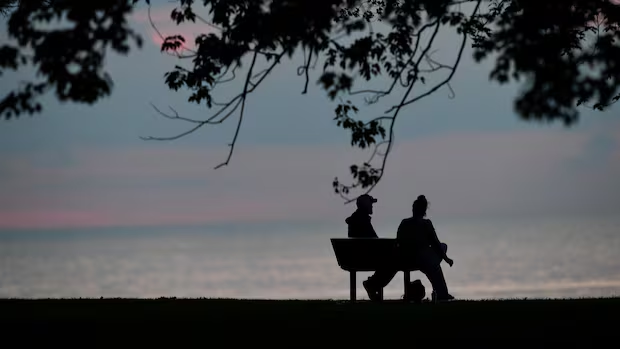
At his marina in Sackets Harbor, N.Y., on a cloudy Wednesday afternoon, Mayor Alex Morgia looks toward the water and paints a vivid picture of the beauty he often sees, even on an overcast day.
"Sometimes those are the best sunsets because the sun will peek through underneath and then you get all of the cascading colours on the underside of the clouds," Morgia says, looking out over what has recently become North America's most controversial lake.
"We get sunsets over the lake year-round," Morgia says, before clarifying: "Over Lake Ontario, not to be vague."
Sackets Harbor, located on the lake's eastern shore around a 40-minute drive from the Canadian border, finds itself caught up in a war of words and wares, as the United States and Canada feud over tariffs and U.S. President Donald Trump's decision to rename Lake Ontario "Lake America."
Ontario premier unveils Lake Ontario sign in Hamilton as tensions with U.S. escalate
The harbour, Morgia points out, was even mentioned in Trump's executive order.
It's not the first time the quaint village has been at the front lines of a fight between these two nations: Sackets Harbor was the site of two major battles during the War of 1812, Morgia says.
"People find cannonballs in their yard all the time," he said. "People use them as doorstops."
While Morgia downplayed how much support Trump has for renaming the lake, he — along with other U.S. residents and officials living near the border in upstate New York — is concerned this heightened fight could spell the end of close Canadian ties, to the detriment of their communities.
"We had a brief period of time where I thought he was distracted with other problems and was going to leave the Canadians alone and we could be friends again. Obviously, that ship has sailed," Morgia said.
About a half-hour drive north of Sackets Harbor, on the U.S. side of the Thousand Islands Bridge over the St. Lawrence River, Corey Fram is fretting that the already difficult situation he faces is about to get much worse.
As director of the Thousand Islands Regional Tourism Development Corporation, Fram is responsible for marketing on both sides of the border. But after Trump got elected for a second time, there was a substantial decline in Canadian spending and border crossing, he said.
"It hurts to lose that economic impact of Canadian visitors on the New York side. But in a border community, it hits in the heart," Fram added.
Decline in Canadian cross-border travel continues
While he understands there may be a strategy Washington and Ottawa are each pursuing that buoys their countries' economic standpoints, those efforts have the opposite effect on border communities, he said.
"There's almost a sense that those of us along the border are having to pay the price for what is a supposed economic benefit for the greater good of each of the respective countries," Fram said.
U.S. border city residents put their 'Elbows Up' for Canada amid trade war
Anthony Adamczyk is facing the same issue in Ogdensburg, N.Y., about 45-minute drive northeast. He's the executive director of the Ogdensburg Bridge and Port Authority, which owns and manages the local bridge spanning the St. Lawrence.
Despite a slight uptick in border crossings from Canada in January 2025 compared to the previous year, they declined the following month and have never recovered, Adamczyk said.
Overall, traffic volume decreased 23 per cent in 2025 compared to 2024, equating to about 136,000 vehicles. The bridge's toll revenue went down 35 per cent, representing about $536,000 in lost revenue.
Fram's longer-term concern is that the number of Canadian tourists will permanently remain lower. He told CBC's The House that each time a major crisis affects border crossings — like the COVID-19 pandemic or the 9/11 terrorist attacks — the numbers fall and never return.
"My concern is this is yet another step, a big jump down that we're not going to get back to where we were in 2024 anytime soon, and maybe not ever."
Residents divided over Trump's tactics
The ongoing fight over tariffs and Lake Ontario's name puts residents of Ogdensburg and Sackets Harbor in a complicated position. The two areas fall within St. Lawrence County and Jefferson County, respectively — both of which Trump has won by more than 10 points in previous presidential elections.
Outside a Walmart in Ogdensburg, Greg Barr told The House he visits Canada all the time and has never had any issues with Canadians. But when asked about the trade war, he said he thinks the U.S. has been "way too generous."
Carney dismisses 'unelected' Trump officials' explanation for why trade talks fell apart
"Not [just] to Canada but to other countries," Barr said. "[Trump's] getting things more even, to me. Maybe he has a different way of doing it, but he does get results."
Jim Rupert, who runs a taxi service that takes clients back and forth from Canada all the time, echoed Barr's view that Trump's tactics are a means of equalizing the playing field.
"I hate to listen to [Trump] half the time because he rambles, he rants, he does this and that, but the policies are solid."
But Carol and Gary Davis, who say they've noticed how much more their groceries cost nowadays, say they can't make sense of Trump's actions.
"When he got elected, gas was going to be cheap, food was going to be cheap," Gary said. "It's just the opposite."
Carol, who voted for Trump in the last election, said she's disappointed with the president — though she felt there weren't better options when she cast her ballot.
"So, yeah, I guess I do have regrets now."
Local Republican lawmaker weighs in
Scott Gray, a Republican assemblyman who represents Ogdensburg and Sackets Harbor, is aware of residents' concerns. He told The House he's not opposed to tariffs, but doesn't want them to harm either his residents or Canadians.
"We have enjoyed a long-time exchange in our economy and our trade, and I think we should try to maintain that," Gray said.
He said he hopes some key irritants, like U.S. access to the Canadian dairy market, can be corrected through trade negotiations. But tariffs, he added, can be disruptive — as are counter-tariffs.
Gray pushed back on behaviour from the White House, including Trump repeatedly calling Canada the 51st state and U.S. Secretary of War Pete Hegseth belittling two female Canadian cadets.
Hegseth's comments on Canadian military 'stupid,' says U.S. Democratic senator
But he also placed some blame at Canada's feet, like when Ontario Premier Doug Ford said Trump could "kiss my ass" in response to tariff threats.
"We need to make sure there's a fair trade deal, and we need to do it without creating animosity and friction, which is largely caused by whatever antics that you want to describe out there," Gray said.
Back at the marina in Sackets Harbor, Morgia questions whether the U.S. government will stop antagonizing its northern neighbour. He's sympathetic to Canadians' calls for Americans to step up and pressure their leaders to back off on punishing their country.
"I guess not until [midterm elections in] November. People are trying, but right now the Republicans control most of the government. And until that changes, I don't think he's going to be held to account."
Benjamin Lopez Steven is an associate producer for CBC's The House and a digital writer with CBC Politics. He was also a 2024 Joan Donaldson Scholar and a graduate of Carleton University. You can reach him at benjamin.steven@cbc.ca or find him on X at @bensteven_s.
With files from Catherine Cullen, Derek Vanderwyk
Related Stories
 Canada
How a Saint John man found the oldest fossils in Atlantic Canada
1 hour ago
 Canada
Quebec must unite with Canada amid Trump’s trade war, Liberal leader says
1 hour ago
 Canada
'The single largest obstacle': Expert questions whether Canada can trust another U.S. trade deal
1 hour ago
 Canada
Canada widens permanent residence track for French speakers in Sudbury
1 hour ago
 Canada
Geoff Russ: Conservatives have ceded love of Canada to Liberal vanity
2 hours ago
 Canada
As Carney advances Vancouver port expansion, environmentalists raise concern for at
2 hours ago
 Canada
Canada’s tariffs are coming for Michigan
2 hours ago
 Canada
Canadians back turning down U.S. trade deal, most support counter
2 hours ago