
“Eco-friendly businesses must become a viable business to survive”… Lee Min
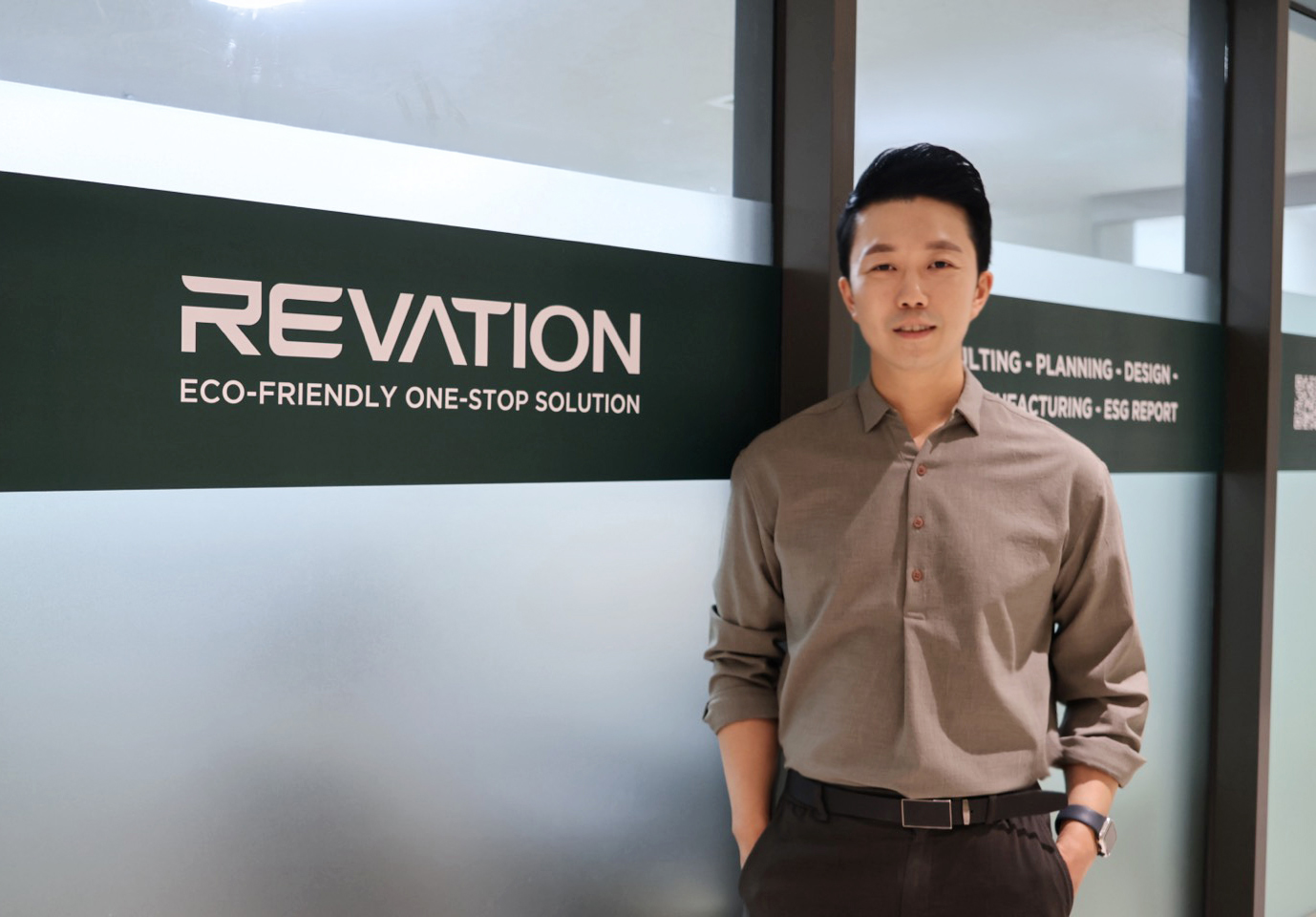
Making eco-friendly products is a different matter from making money from eco-friendliness. Material costs are high and supply is unstable, and in many cases, it is difficult to apply them directly to existing manufacturing processes. Even if customers choose a product out of empathy for its environmental value, it is difficult to ensure continued purchases if price, quality, and productivity do not keep up.
This is also the point that Lee Min-sung, CEO of REVATION, considers crucial in the eco-friendly business. He believed that for a business to be sustainable, rather than merely emphasizing the necessity of being eco-friendly, it is essential to reduce the time and cost of the product development process to the point where clients choose us again, while also ensuring design and mass production quality.
Currently, REVATION's customer repurchase rate reaches 77%. CEO Lee states that repeat purchases resulted from enhancing product development convenience through the digital transformation (DX) platform 'RESTUDIO' and compensating for the limitations of eco-friendly materials with design and manufacturing technology. Connecting the value of eco-friendliness to actual purchases and repurchases is the core of the business REVATION has built.
The first value that REVATION offers to its clients lies in the efficiency of the product development process rather than eco-friendliness itself. By consolidating the scattered manufacturing processes from planning to mass production, the company reduced the development lead time from approximately six months to three months and cut development costs by more than 30%. Furthermore, by adding high aesthetics and precise finishing quality, the focus was placed on ensuring the product standards desired by the brand while utilizing eco-friendly materials.
It also handles the environmental data required during the product manufacturing process. Going beyond simply supplying eco-friendly materials, it integrates product planning, design, and mass production into a single development process that includes the data needed to respond to global export regulations.
Supporting this structure is the DX platform 'ReStudio'. It derives mass production data for each product based on 249 recipes accumulated to date, and the item generating the highest revenue, primarily among large corporate clients, is 'paper molds'. This is a method of reusing data accumulated during the product development process for the development and mass production of the next product.
REVATION is currently assessed to have achieved the break-even point (BEP) and its unit economics have stabilized. CEO Lee views the 77% repurchase rate as a result of customers choosing the product again not only for its eco-friendliness but also for the economic viability and efficiency of the product development process.
REVATION did not adopt its current business structure from the very beginning. In its early days, the company could have grown into a specialized design firm or an eco-friendly packaging manufacturer; however, the problem CEO Lee faced in the market was that possessing design and materials alone was insufficient to translate into actual production and mass manufacturing. To ensure stable product production, it was necessary to possess not only an understanding of materials but also manufacturing technology and mass production verification. Consequently, REVATION established an in-house corporate research institute from the start and invested in materials technology and system R&D.
“In the early stages of our startup, we could have remained merely a design firm or a simple producer of eco-friendly packaging. However, to address the core market issue of ‘having designs and materials but lacking verification for production and mass manufacturing,’ we established an in-house corporate research institute from the start and invested in materials technology and system R&D. Through this, we shifted our direction to become an end-to-end solution provider, and thanks to proactive technology development, we are enjoying large-scale sales and a strong lock-in effect.”
Through these investments, REVATION’s business scope has also shifted from proposing designs and eco-friendly materials to taking responsibility for actual production and mass manufacturing. As investment in eco-friendly startups has contracted and market growth has slowed due to the recent trend of suspending ESG regulations, the company’s identity has become even clearer. Rather than emphasizing a vague eco-friendly image, the company began to place greater emphasis on being a "product development system company" that solves the structural problems clients face during product development.
As transactions with large corporations and global brands have increased, new challenges have emerged. It has become difficult to have a product's environmental value recognized solely on the basis of using eco-friendly materials, and as verification standards for greenwashing have become stricter, companies are now required to prove actual environmental effects with data.
“In collaborations with global brands, eco-friendly claims are no longer accepted merely as declarations. Through digital solutions, REVATION automatically generates and provides a 'Carbon Report Proof Package' based on product Life Cycle Assessment (LCA) data.”
Restudio's role has also changed accordingly. By adding materials, mass production data, and carbon proof to DX, which was previously used to reduce the time and cost of product development, it now handles compliance with regulations of global brands and export markets within the product development process.
REVATION aims to expand the capabilities of Re:Studio to include recommending eco-friendly materials and developing low-carbon products. This approach allows clients to receive recommendations for eco-friendly materials suitable for their products and access the necessary curation for low-carbon product development all in one go. The direction is to evolve it into an integrated solution that supports compliance with environmental regulations by utilizing data accumulated during the design, material development, and mass production processes across the entire product development process.
In particular, the company views markets with strict environmental regulations, such as the United States, France, and Canada, as key targets for expansion. Its role is to support companies in entering overseas markets more stably by managing material selection and carbon data together from the product development stage to address regulatory issues that may arise during the export process. CEO Lee envisions REVATION three years from now as an "integrated solution company that resolves environmental regulatory issues."
In the long term, the company proposed a listing on the KOSDAQ, along with the goal of completely eliminating plastic from corporate packaging and reducing carbon emissions by 100% by 2030. The direction is to create both environmental performance and corporate growth by connecting a business that started with eco-friendly products to materials, mass production, data, and responses to global regulations.
In the process of driving this growth, what CEO Lee considers most important is ultimately people. Emphasizing that "especially for startups, the key to business success is people," he personally designs individual KPIs and vision boards with his team members at the beginning of every year. Rather than the CEO unilaterally setting goals, he allows team members to establish their own objectives, and when they are achieved, he links this to clear and transparent rewards.
CEO Lee's criteria for people and investment were also influenced by his early startup experiences. After leaving a stable large corporation to enter the eco-friendly manufacturing market, which lacked infrastructure, he secured initial investment but struggled significantly with where to invest the funds. He chose to invest in the essence of the products and materials, a decision that later became the foundation for REVATION to secure mass production capabilities.
CEO Lee emphasized that for startups in the eco-friendly, materials, and manufacturing sectors to grow, policies must provide broad support that extends beyond post-production recycling to technologies that reduce plastic usage from the outset or transition to bio-based materials. Given that the materials and manufacturing sectors require significant time and capital—from R&D to facility construction and mass production verification—the perspective is that support tailored to the specific characteristics of companies developing core technologies is necessary.
Policies limited to recycling or recycled plastics (PCR) are ultimately a linear approach premised on the continued use of plastics. Innovation can only occur if institutional benefits, such as R&D support, are significantly strengthened for deep tech companies leading the transition to 'source reduction' technologies that cut plastic use from the outset—as seen in Europe—or to those driving the transition to '100% bio-based resources.'
CEO Lee does not view environmental regulations solely as a burden on companies. He believes that if standards aligned with global criteria are established early on, companies can prepare according to clear standards from the product development stage, and this can serve as an opportunity for new markets and investment demand to emerge for climate tech companies developing related technologies, such as source reduction and bio-materials.
REVATION also intends to continue its role as a company that has experienced these changes firsthand. CEO Lee expressed his intention to serve as a "catalyst," leveraging his leading technology development and business experience to help junior climate tech entrepreneurs grow in a better environment.
The eco-friendliness defined by REVATION encompasses business sustainability. Rather than relying on the mere justification that a product is good for the environment to secure a one-time purchase, the approach involves reducing development time and costs while ensuring design and mass-production quality to create a reason for customers to return. A 77% repurchase rate demonstrates these results, reflecting CEO Lee Min-sung’s business philosophy that even eco-friendly products must be chosen by the market and repurchased to survive.
The Startup Ecosystem Reporter Corps is jointly operated by KAIA and Venture Square and records various stories from the startup scene.
Related Stories
 Business
'Effectively, we're out of business': U.S. tariffs cut Manitoba honey farm off from vast majority of customers
1 hour ago
 Business
Quebec politicians, association leaders react to new U.S. tariffs Saturday morning
9 hours ago
 Business
Indian startups raised over $469 million from August 17 to August 22, 2026; Wispr Flow tops the list
12 hours ago
 Business
RCMP issues shelter-in
15 hours ago
 Business
What next for Ulster Unionist Party after turbulent week?
19 hours ago
 Business
Is this the end of Harry and Meghan’s American dream?
20 hours ago
 Business
Cuba says US sanctions block efforts to open economy
21 hours ago
 Business
Forestry giant behind idled B.C. mill received millions in government funding
21 hours ago