
As Canada's firefighting resources are stretched, how is the N.W.T. handling?
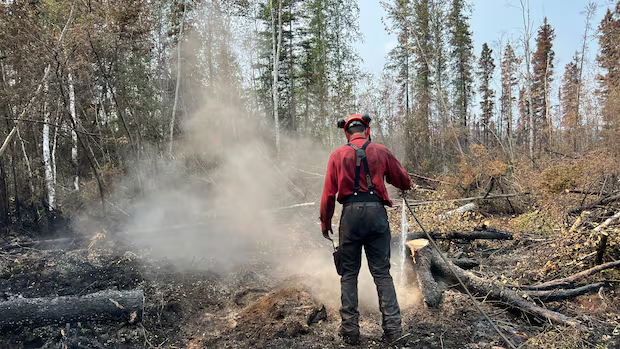
As Canada's firefighting resources are stretched, how is the N.W.T. handling?
The N.W.T. is dealing with among the highest number of fires in the country
Canada’s firefighting resources are being pushed to their limits as nearly every province and territory battle blazes.
According to the the Canadian Interagency Forest Fire Centre (CIFFC) dashboard on Friday evening, the N.W.T. is dealing with the second highest number of fires, at 190 — Ontario is dealing with 191.
The dashboard showed 904 active fires reportedly burning across the country as of Friday evening. Only Nunavut and P.E.I. remain unburned.
In response, the CIFFC has raised the national preparedness level to 4 – meaning multiple jurisdictions need equipment and crews from other parts of Canada.
There’s only one level above it: level 5, where international help is required.
“We're not there yet,” said Mike Westwick, a N.W.T. fire information officer. “We're still able to access the resources we need at this point.”
Crews from British Columbia have been helping on the fires that spurred the evacuations of Wrigley and Fort Simpson three weeks ago.
It's been a tough season in the N.W.T. already, as crews deal with numerous fires and the tragic deaths of their colleagues who were fighting a wildfire outside Fort Simpson.
'We owe them a lot': N.W.T. residents mourn 3 people killed while fighting wildfire
Westwick said crews are tired, but committed to protecting their communities.
“We've been ensuring that we provide the best supports possible, to help people feel ready to come forward and get the job done,” he said. “I know crews are really dedicated to that work.”
Weather conditions calmed earlier in the week around Fort Simpson and Wrigley, but in recent days hot weather and shifting wind caused flareups.
“So that just showed us how quickly, you know, things can change when we have increased conditions,” said Sarah Hall, another N.W.T. fire information officer.
9 new fires in North Slave in 24 hours
The N.W.T. has been dealing with fire weather in the past few days that have led to flareups in existing fires and resulted in new fires popping up.
There were nine new fires in the North Slave region in the last 24 hours.
In an update on Friday evening, N.W.T. Fire wrote there is one 35 kilometres west of Gamètì that is "growing quickly under extreme fire weather" and is "highly visible" from the community.
But the update said "there are currently no threats to communities, cabins, or infrastructure."
N.W.T. Fire says that the fire is not expected to grow any closer to the community in the short-term due to a shift in the winds, showers in the forecast and a rise in moisture.
There were no new fires recorded in the Dehcho or in the Sahtu.
There are still three fires burning between 20 and 40 kilometres from Deline. N.W.T. Fire writes that one of those fires has shown "some activity over the last 48 hours, though limited growth towards Deline."
N.W.T. Fire writes it is "continuing to look for openings to safely access the fire and work to contain it as visibility challenges continue."
Jessica Davey-Quantick has been reporting in the North since 2016. You can reach her at jessica.davey-quantick@cbc.ca.
Related Stories
 Canada
Is B.C. getting a snap election?
44 minutes ago
 Canada
Liberals table 'Building Canada Strong Act' as Parliament resumes
44 minutes ago
 Canada
More than 100 people deported over extortion ties
45 minutes ago
 Canada
Norway PM 'prepared, but not afraid' of Russian incursion
1 hour ago
 Canada
Migrants and advocates call on Ottawa for permanent status, with 11 rallies across the country
1 hour ago
 Canada
Bank of Canada governor says Atlantic Canada is less exposed to U.S. tariffs
1 hour ago
 Canada
Canadian investigation launched into data breach that exposed millions of IDs
2 hours ago
 Canada
Alberta premier adamant referendum ads are not ‘neutral’ on separation question, as UCP president claims
2 hours ago