
As Germany's far right gains ground, coded symbols are hiding in plain sight
As Germany's far right gains ground, coded symbols are hiding in plain sight
Supporters have co-opted everyday brands to signal their beliefs while skirting the law
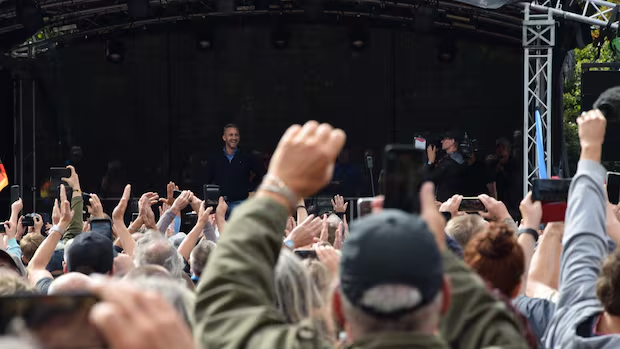
As Germany's far right gains political ground in some parts of the country, researchers say some supporters are getting more comfortable showing their views in public — albeit sometimes without displaying an explicitly political symbol.
At recent rallies for the Alternative for Germany, or AfD, that coded language was visible on things as ordinary as a pair of sneakers or a T-shirt.
Researchers say logos for brands including New Balance and Lonsdale are increasingly used as dog whistles for nationalist and Nazi symbolism — something that is especially significant in Germany, where the display of Nazi symbols is restricted by law.
"What we noticed in the last couple of years is that frequently at these events, you see a lot of people who have different signs which relate to the extreme right," said Gideon Botsch, head of the Emil Julius Gumbel Research Unit on Antisemitism and Right-Wing Extremism at Potsdam University.
"Some are clear and open right-wing and neo-Nazi symbols ... others are opaque or playing the game a little bit."
Some have co-opted New Balance, taking the large "N" on the side of its sneakers to mean "nationalist" and "NB" for Nationale Bewegung, or "national movement," Botsch said.
Likewise, Lonsdale has seen renewed use of its sportswear by the far right in part because, he says, when worn a certain way the logo spells out NSDA — the abbreviation for Germany's National Socialist Party.
"Those who know will know; those who don't know will think this is harmless," Botsch said.
The ambiguity is significant because Germany's law against Nazi symbols "expressly covers flags, badges, uniform items, slogans and forms of greeting,” said Sophie Scheuble, digital policy and counter-extremism manager at the Institute for Strategic Dialogue.
So "most of what is worn at far-right events is therefore lawful, and this distinction is well understood within right-wing extremist scenes.”
Those restrictions have led to an increase in the use of symbols recognizable only to those who know what they mean, without crossing legal lines.
When the eastern German state of Saxony-Anhalt's domestic intelligence service updated its handbook on far-right symbols in May, Scheuble said, its director noted that most extremists avoid prosecutable symbols and instead rely on codes and catchwords.
What has changed, researchers say, is the political environment where those styles are appearing.
The Alternative for Germany, or AfD, has grown from a fringe party in 2013 into the likely winner of an upcoming state election in Saxony-Anhalt. The party has been legally designated a far-right extremist group in the state.
If it wins, it would mark the first time a far-right party has had an absolute state majority in Germany since the Second World War.
Fabian Wichmann, an expert at the EU Knowledge Hub on Preventing Radicalization, said there is a growing "grey zone" between Germany's hardcore neo-Nazi movement and the broader populist right.
Members of neo-Nazi groups attend AfD rallies and meetings and have encouraged their supporters to vote for the party, he says, seeing its success as a step toward their own political goals.
"The AfD has a widespread and diverse group of followers," Wichmann said. At its election events and marches, "you will see people who look very normal in their clothing," wearing things like New Balance and Lonsdale.
He said not everyone wearing those brands is a neo-Nazi, but there are "also a lot of neo-Nazis who wear this kind of stuff because they have some typical symbols, some typical narratives they share."
But the bigger change researchers say they're seeing isn't in the clothing itself. It's in the willingness to display those signals openly.
Wichmann says that shift matches the growing strength of Germany's far right and the AfD.
"They feel like ... the culture, the temperature of a society is changing. And now it's possible to wear something like this without getting into conflict,” he said.
"There's a feeling of, 'OK, we are on the winner's side right now,' and that's the reason why they are so openly wearing it."
New Balance has no affiliation with Germany's far-right movement. The company did not respond to requests for comment, but in the past has said it "does not tolerate bigotry or hate in any form."
Likewise, Lonsdale has spent decades fighting its appropriation by the far right with anti-racism initiatives since it became popular among German skinhead and neo-Nazi subcultures in the 1980s and '90s.
But the British boxing and sportswear company says the phenomenon is returning.
"We have noticed that since around summer 2024, the Lonsdale brand has once again been increasingly worn by far-right extremists,” spokesperson Ralf Elfering said. "This earlier misuse of the Lonsdale brand — and the fact that we are seeing it again today — is very frustrating.”
Elfering said the company stops supplying retailers when it discovers Lonsdale is being sold in a clearly extremist context.
Germany tested by new divisions 65 years after Berlin Wall erected
65 years after the Berlin Wall was built, Germany’s east-west scars help feed a rising far-right party
Other brands, however, carry considerably less ambiguity, according to experts.
Botsch points to Thor Steinar, a brand known for Nordic and runic imagery that has long been associated with Germany's far-right scene.
"Thor Steinar … maybe is a clearer sign than New Balance or Lonsdale that somebody is part of the scene," he said.
The company's original rune logo prompted police seizures after German authorities argued it resembled banned SS symbolism. Higher courts ruled in 2008 that displaying the logo was not punishable, according to Scheuble, and the company had by then introduced a replacement logo.
Lisa Mayor is a current Arthur F. Burns Fellow, working with Deutsche Welle in Berlin. Originally from Thunder Bay, she previously spent years as an investigative reporter for The Fifth Estate and The National. Her current role is as a network producer for CBC's Parliamentary Bureau. Her work has been recognized with a Michener Award, several Canadian Screen Awards and RTDNAs. You can reach her at lisa.mayor@cbc.ca.
Related Stories
 World
World
1 dead and 5 wounded in a shooting at a rave in Switzerland
51 minutes ago
 World
World
3-year
51 minutes ago
 World
World
Nepal on high alert for fresh flooding after river levels rise as death toll soars past 800
1 hour ago
 World
World
Death toll rises to 38 from Russia's deadliest attack on Ukraine this year
1 hour ago
 World
World
Welsh bushcraft expert competes on Alone: World Championship
2 hours ago
 World
World
Ferry carrying nearly 270 people capsizes off northern Cyprus, killing at least 7
2 hours ago
 World
World
Iceland set to reject talks to rejoin EU, national broadcaster says
3 hours ago
 World
World
Iran's leader calls for Muslim unity, NBC crew attacked in West Bank and other Mideast news
4 hours ago