
Balwaan’s ₹100 Crore Series B and Southern Service Push
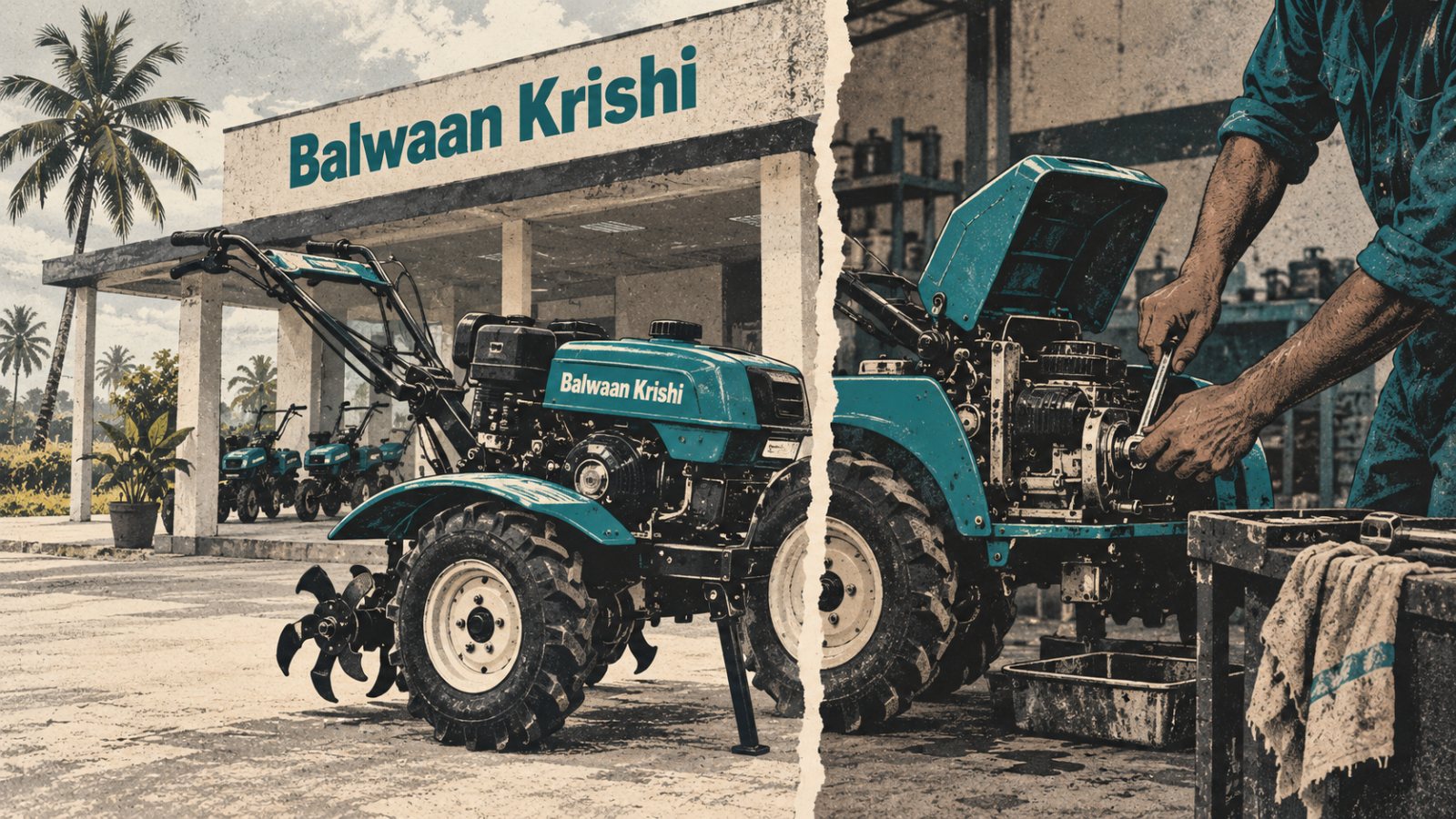
On September 28, 2026, Outlook Business reported that Jaipur-based farm machinery company Balwaan Krishi had raised ₹100 crore in a Series B led by First Bridge India Growth Fund Private Equity. Other institutional investors participated, and Right Pillar Advisors advised the transaction. The capital is intended to expand domestic manufacturing, strengthen the dealer and service network in Southern India, and develop equipment with connected and predictive-maintenance capabilities.
YourStory’s account puts Balwaan’s equipment prices at roughly ₹10,000 to ₹1 lakh and cites company figures of more than 800 dealers in Northern India and more than 400,000 farmers using its machines. The dealer and farmer totals are company claims, not independently audited reach measures. Co-founder and CEO Rohit Bajaj told Entrepreneur India, “This funding allows us to strengthen manufacturing, broaden our reach and continue building products specifically for Indian farming conditions.”
Manufacturing must match the machines dealers can sell
More domestic capacity will help the southern expansion only if it produces the equipment local outlets can move and support. The planned product-development slate includes power weeders and battery sprayers, alongside connected features. A larger production run may lower the risk of an empty shelf, but it can also leave cash tied up in the wrong models if demand differs across districts or farming tasks.
The company expects greater domestic production to improve its control over quality and supply. For the new dealer network, consistency matters beyond the initial shipment: a familiar model, available components and a clear repair procedure make it easier for a local outlet to support a sale. Manufacturing schedules and replenishment therefore need to respond to what dealers actually sell, rather than treating new factory capacity as proof that machines will be available where farmers want them.
Dealer growth brings inventory and credit demands
Balwaan enters Southern India with an established northern distribution base, but each new outlet requires a separate stock decision. A dealer may need a demonstration machine, saleable units and spare parts before it knows which models will sell locally. Those commitments consume working capital even before a farmer makes a purchase. If dealers receive time to pay for stock, some of that funding burden moves back to Balwaan until the invoices are collected.
That cash cycle matters to a business selling relatively affordable equipment. The purchase price has to cover production, transport, dealer economics and support after the sale; a slow-moving machine cannot simply be counted as distribution progress. Stocking too broad a range could strain cash, while stocking too little could turn an interested buyer away. The practical measure of dealer expansion will be whether outlets hold useful machines and parts through the selling season, not only whether more locations carry the brand.
This is a further round of financing for an existing expansion effort. VCCircle’s funding history records a ₹40 crore investment from JM Financial Private Equity in June 2024 and a $2 million pre-Series A round in 2023. The new round gives Balwaan more capital for manufacturing and distribution, while putting greater weight on how quickly stock turns into sales and payments.
Service coverage makes the southern push viable
A dealer network is useful to a farmer only when support remains close enough after the purchase. Balwaan’s company description identifies an omnichannel sales and service network as part of its approach and lists equipment such as weeders, sprayers and reapers. Extending that approach south requires trained repair staff, suitable parts and a way to move a faulty machine or technician between a field and a service point.
A shop can sell a machine long before it can repair every fault. When equipment is bought for a particular cultivation task, waiting for a component can reduce the value of a low upfront price. Dealers need enough knowledge to diagnose routine problems and a dependable route for obtaining parts; otherwise, requests travel back through a distant central operation. Service capacity has to grow alongside sales because a farmer’s experience of the brand continues after the machine leaves the outlet.
Internet of Things and predictive-maintenance capabilities are development plans, not features established across the current range. If they reach market, an alert will be useful only if the machine supplies reliable data and someone can act before a breakdown. The proposed technology could make a service network more effective, but it would also give that network another task: interpreting warnings and arranging repairs while a machine is still working.
The next meaningful evidence will be operational: southern dealer locations, the machines and parts they carry, and the repair coverage available around them. Those details will show whether the funding is turning a regional sales push into dependable access to farm equipment. For a farmer considering a purchase, the decisive consequence is whether the needed machine is available nearby and can be returned to work promptly after a fault.
Related Stories
 Business
Premji Invest to take platform approach, seek greater ownership in portfolio companies
10 minutes ago
 Business
SG's OneByZero secures $20m in Jungle Ventures
1 hour ago
 Business
MSS cuts loan rates and extends terms for Geoje, Tongyeong businesses
2 hours ago
 Business
Jeremy Allen White says Facebook's business model scares him
3 hours ago
 Business
Andhra Pradesh, PanIIT partner for Rs 500
3 hours ago
 Business
Mercury vs Relay: Two Business Cash Systems
3 hours ago
 Business
LETTER: Letter writer was wrong about Chinese
6 hours ago
'You don't want it too hot...too good': Jaishankar calls for a 'Goldilocks scenario' to navigate US
14 hours ago