
Bank of Canada says households struggling, economy vulnerable to shocks
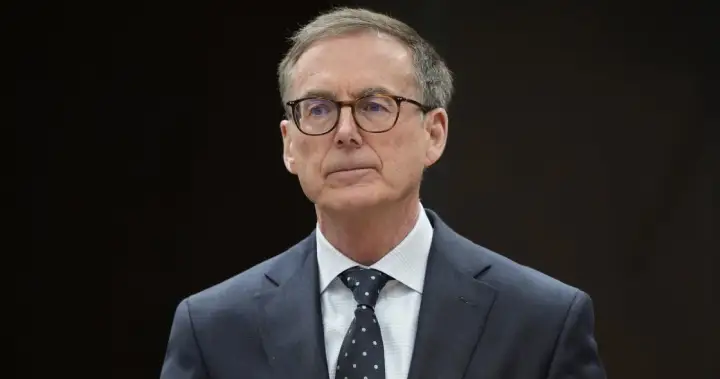
The Bank of Canada says the economy is navigating a “volatile” global environment and that “vulnerabilities” exist that could expose Canada to potential shocks on multiple fronts.
The central bank released its annual Financial Stability Report on Thursday, which gauges the resilience of the Canadian financial system and highlights key risks that could undermine that resilience. It was penned by governor Tiff Macklem, along with senior deputy governor Toni Gravelle.
“Canada’s financial system has functioned well through a challenging year,” Macklem said in the report.
“However, vulnerabilities have increased in some parts of the system.
“The economic and geopolitical environment has become more volatile. And this has made it more likely that a new shock or a combination of shocks could cause several vulnerabilities to crystalize at once. If this were to happen, these vulnerabilities could interact and reinforce each other.”
This means that Canada’s economy could be exposed to damage if some of these risks escalate and become much more serious.
Among the main risks outlined in the report is global uncertainty stemming from the war in the Middle East. The conflict, which began in February when the U.S. and Israel launched joint attacks on Iran, has jeopardized the world’s supply of oil, natural gas, fertilizer and other products.
The Iran war, the bank says, “has added to global uncertainty, leading to volatility in some markets.”
Last year’s report was heavily focused on risks stemming from the trade war and U.S. tariffs, and Macklem says those risks remain as Canada and the U.S. intensify talks towards the review of CUSMA.
Macklem also cautions about new threats emerging from artificial intelligence (AI).
“AI is expected to boost productivity and economic growth over time, but it is sparking concerns about disruption in some sectors and about overinvestment,” he said.
“AI may also increase the speed, scale and sophistication of cyber attacks.”
Gravelle then noted high household debt levels in Canada, and said this leaves many Canadians vulnerable to potential economic shocks.
“Canadians continue to carry high levels of debt relative to their income, but overall household wealth has risen,” Gravelle said.
“This overall picture masks important differences. Some households face far greater strain than others, and those with the highest debt burden have very little financial flexibility to cope with a job loss or an unexpected expense.
“The main concern for both households and businesses is a geopolitical or economic shock that leads to a deep recession and a sharp rise in unemployment.”
The Bank of Canada, including Macklem, is scheduled to deliver a speech and answer questions from the media at 11 a.m. eastern time.
Related Stories
 Canada
Police investigation underway into Lowertown death, fatal western Quebec crash
33 minutes ago
 Canada
Transformer blowout in Kanata closes nearby businesses
33 minutes ago
 Canada
‘We can’t run our businesses’: Canadian companies react to U.S. tariffs
34 minutes ago
 Canada
Conservative MP urges government to release 'full details' of U.S. trade deal that was on the table
34 minutes ago
 Canada
Mark Carney is putting Canada on the ballot for the U.S. midterms
34 minutes ago
 Canada
Carney outlines the last
1 hour ago
 Canada
'Quite the system': Rare thunderstorm wows southern B.C., causing havoc at Vancouver airport
1 hour ago
 Canada
Conservatives urge feds to release details of U.S. deal Canada walked away from
1 hour ago