
Brexit, 10 years later: What a regret
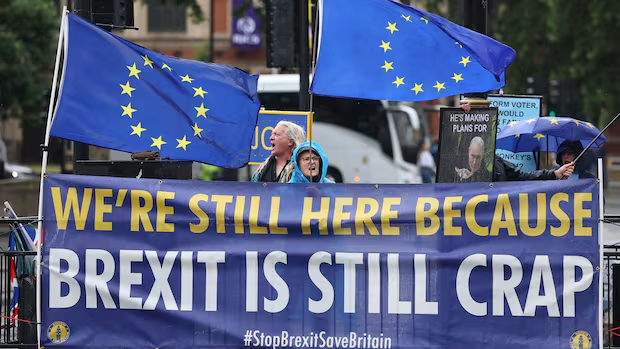
Brexit, 10 years later: What a regret-fuelled British town can teach Canada about referendums
A decade after the vote to leave the EU, neither side is happy
The upbeat reggae music bouncing off the stalls in the central market of Wakefield in Yorkshire masks a deep unease over the lacklustre economic fortunes that have befallen this part of the United Kingdom.
Ten years after people in this northern English community voted overwhelmingly to divorce from the European Union, the good vibes are hard to find, offering a stark cautionary tale for distant political battlegrounds, like Alberta.
On June 23, 2016, nationally a bare majority of 51.9 per cent voted for Brexit, while 48.1 per cent wanted to remain in the EU. In Wakefield, and many other northern English communities, the results were more lopsided — with almost two-thirds of voters in the town choosing "leave."
But talking to some of them now, what many "leavers" at the time hailed as democratic revolution has instead turned into buyer's remorse.
"The British people, I believe, voted for Brexit to control our borders, to control immigration, and it just hasn't happened," said pensioner John Welsby.
Since 2016, immigration to the U.K. has completely inverted.
Pre-Brexit, EU migration was dominant. Now, non-EU arrivals, especially from Asia and Africa, make up the vast majority of newcomers to Britain, while overall immigration levels are roughly the same.
"They're [immigrants] coming to take advantage of what we built," said Welsby, "and we still have to pay in to maintain it."
In fact, studies of immigration patterns have repeatedly concluded that immigrants from the EU have an overall positive financial impact on the U.K. Non-EU immigrants generally have a net-negative fiscal impact, but that's because they often come with children, whose eventual entry into the labour market could offset that impact.
If, for "leavers" such as Welsby, Brexit failed to deliver on its promise of increased sovereignty and border control to limit immigration, to those who voted to "remain," the exercise in exiting Britain's largest trading market produced predictably disappointing outcomes, too.
"Everything is more expensive. Food is on another level," said Donna Shaw, who didn't vote at all. She sells artificial flowers in one of the market stalls.
"There's definitely a regret for leaving, absolutely. Most people, especially my dad, and all his friends, like, in their 60s and 70s, they all thought that we're going to get his country back.
"It's made absolutely no difference."
From riots to 'regularization,' U.K. and Spain show opposing attitudes to migrants
Scarlett Wright, who who was 10 years old when the Brexit vote happened, said he thinks the impact of the Brexit decision rippled far beyond economics and immigration.
"Stuff has gone downhill due to Brexit. A lot of crime has gone up recently; we've had a lot of drug dealing and all that going on at the moment, and prices have definitely gone up," he said.
While the slogan "Broken Britain" predates the 2016 vote, in recent years it has become a widely used term to describe the U.K.'s perceived decline since leaving the EU.
Political scientist Tim Bale says the chaos unleashed by Brexit has strained the country's political structure.
"With Brexit we've seen a polarization of public opinion, which has meant that voters, as well as being more volatile and less loyal to political parties, are looking for more radical solutions," said Bale, a professor at Queen Mary University of London.
Those radical solutions include increasing support for non-traditional parties such as the Greens on the far-left side or Reform UK and Restore Britain for the far-right.
Reform UK came up the big winner in local elections in May, sweeping seats on municipal councils throughout the country while the ruling Labour Party suffered heavy losses.
When Keir Starmer resigned as Britain's prime minister on Monday and set in motion the events that will lead the nation to have its sixth leader in seven years, coming within days of the 10th anniversary of the Brexit referendum, the timing was hard to ignore.
U.K. ousts a 6th Prime Minister in 10 years. What’s behind the turmoil?
Such political volatility has left deep scars on the British economy. Bank of England data suggests the U.K. economy is roughly six per cent smaller than it would have been had it remained inside the EU.
While certain sectors such as London's tech and financial hubs have managed to insulate themselves, fields relying on lower-cost labour, particularly agriculture and transportation, have suffered severe worker shortages. This, plus supply chain challenges for food products imported from the EU, have contributed to higher prices for consumers.
"I definitely noticed it; like cheese was probably about £2.50 [$4.69 Cad], but then it's now gone up to about £5 or £6 [$11.26 Cad]," said Wright, gesturing to the market stalls.
Meanwhile, the infamous campaign promise that leaving the EU would free up hundreds of millions of pounds a week for the National Health Service has vanished.
"What I can't say has happened is an influx of additional cash," said Dr. Linda Harris, a public health official whose organization, Spectrum Community Health, works in the areas surrounding Wakefield. Instead of investing in preventive care, she says her teams spend their time "firefighting" deep health inequalities.
It is precisely this web of unintended consequences and broken promises that experts say should serve as a flashing red light for Canada.
Alberta to hold fall referendum on whether to have binding referendum on separating from Canada
Former Alberta premier Jason Kenney says Alberta separation would be 'economic catastrophe'
Flags become symbols for two sides in Alberta’s separation debate
As Alberta flirts with its own sovereign ambitions, navigating high-stakes debates over pulling out of the Canada Pension Plan and demanding distinct constitutional status, the British experiment offers a sobering mirror.
Albertan Ian Cooper, who has spent years studying the impacts of the divorce at the Dublin City University Brexit Institute, warns that referendums are often a trap.
"A referendum is like a Pandora's box," Cooper said. "It can lead to polarization of opinion, much greater division, and a really poisonous kind of political atmosphere. I don't think Albertans have a good sense of what's coming. I think that it could get really ugly."
Cooper says voters can believe a "Yes" vote is simply a peaceful negotiating tactic to force a civilized constitutional debate whereas — as the U.K. discovered — it can instead draw permanent battle lines that can paralyze a society.
Anand Menon of King's College London has been studying Britain's role in Europe as director of the UK in a Changing Europe initiative.
"Brexit is about trade-offs," he told CBC News. "If you get something, you give something in return."
"There's a menu with all sorts of options on it. The sad truth is that everything on that menu will make us feel sick in some way or another. Because it will either compromise political autonomy or it will involve economic costs."
Many who pushed for Brexit, believed a closer partnership with the United States could make up for lost ties with Europe — but Menon says Donald Trump's tariffs and his adversarial approach to friendly allies has demonstrated the weakness of that strategy.
"The world has changed in some very profound ways since 2016 and in ways which aren't necessarily helpful to the Brexit cause," he said.
All of which has a growing majority of Britons wondering if a second Brexit referendum may not be far off.
A recent Yougov poll conducted on the eve of the 10-year anniversary reveals that 55 per cent of Britons would now vote to rejoin the European Union, with only 34 per cent opposed.
But whether Britain ever gets a constitutional do-over may depend on who succeeds Starmer. The prime minister had rigidly ruled out re-entering the EU, preferring to mend ties through piecemeal deals.
Now, the front-runner poised to replace him is Andy Burnham.
The popular former Greater Manchester mayor just won a strategic byelection to enter Parliament, positioning himself to take the top job. Burnham has historically stated he wants to see Britain back in the EU "in his lifetime" — though political realities mean he, too, is expected to focus first on strengthening economic ties rather than launching a formal bid to rejoin.
The appetite for a complete Brexit reversal remains a volatile battleground.
While parties such as the Liberal Democrats and the Scottish National Party openly champion a return to the single market, the Conservative Party and the populist Reform UK party, which is led by one of Britain's biggest euroskeptics Nigel Farage, remain fiercely opposed.
In the Wakefield market, Gary Foreman, who recently opened the Sweet Tooth Bakery to sell cakes and cookies, remains deeply cautious.
"We've not exactly got what we were promised," Foreman said, looking out over the town square. Yet, even as a business owner feeling the economic squeeze, he worries about the immense acrimony a second vote would unleash.
"If we got another vote, I think it would be touch and go," he said.
It is that pervasive exhaustion — a decade spent arguing over a single ballot question with no happy consensus in sight — that serves as the warning for Canada.
Rejoining a union is far harder than leaving it.
Chris Brown is a foreign correspondent based in the CBC’s London bureau. Previously in Moscow, Chris has a passion for great stories and has travelled all over Canada and the world to find them.
Related Stories
 Canada
Innovate Canada 2026 Connects Global Event Leaders with Canada’s Technology Ecosystem
16 minutes ago
 Canada
Canada took the trade war to Trump’s backyard. Americans didn’t care
43 minutes ago
 Canada
BREAKING: ILAC Education Group in Canada files for bankruptcy
43 minutes ago
 Canada
Flood
1 hour ago
 Canada
Trump tariffs making beer cans more expensive for Canadian producers
1 hour ago
 Canada
The hidden cost of going to university in Canada, and the one place still keeping it cheap
1 hour ago
 Canada
CTV News in the Arctic: Warship commander says ‘the global order is changing’ as Canada expands presence
2 hours ago
 Canada
Multiple people treated after rabies found in skunk in Kootenay Lake region of B.C.
2 hours ago