
Can AI Map Wall Street’s Genome?

LLMs can account for 20 percent of moves following earnings announcements . . . so far.
Other competitors have been less public about their models, though evidence suggests they’re building out the kind of computing power needed to run them. Trading firm XTX Markets, for example, in January announced that it was spending upward of $1 billion to construct a data center in Finland.
HRT is training its models on more than two decades of data spanning equities, futures, and cryptocurrencies, totaling more than 100 terabytes—“something like trillions of tokens, in the same realm as what you train frontier LLMs on,” said Marc Khoury, a researcher on HRT’s AI team, speaking at the International Conference on Machine Learning in 2025.
At a high level, HRT’s goal is to model markets as sequences of interactions. Electronic markets generate detailed streams of activity, including full limit order books, executed trades, and order-level events such as placements (public limit orders, part of the exchange’s order book), cancellations, and fills. According to Khoury, much of the predictive signal lies in how these sequences evolve over time, especially during fast-moving conditions.
Khoury explained that more data boosted the model’s predictive performance, adding that the pattern mirrors what researchers see when scaling LLMs.
In language models, researchers discovered that performance kept improving predictably as they increased data, parameters, and computing power—a pattern known as scaling laws. The fact that HRT is seeing similar behavior in financial data suggests the architecture may generalize beyond text in ways that earlier approaches could not.
Training models at this scale requires substantial infrastructure. The AI boom is powered by graphics processing units that can run huge numbers of calculations at the same time, which is exactly what training and running large AI models requires. Khoury did not disclose to conference attendees how many GPUs the firm operates, but he said that HRT runs its own state-of-the-art data center and that at one point, the firm’s hardware purchases were large enough that they “bottlenecked” GPU deliveries on the US east coast.
The research effort comes as HRT has posted record results. Bloomberg reported in January that the firm generated an estimated $12.3 billion in net trading revenue in 2025. The company has also been expanding beyond high-speed trading into longer-horizon strategies, while it has continued to invest heavily in AI and data-driven trading models.
An HRT spokesperson declined to comment on the firm’s AI training efforts.
These results come with important caveats. The most straightforward: Traditional quantitative methods still hold an edge in many settings. In Rahimikia, Ni, and Wang’s study, gradient-boosted trees—ensembles of decision trees that quantitative traders have refined for years—returned about 47 percent, annualized, compared with about 37 percent for the best transformer model trained from scratch on financial data in the baseline comparison. The gap has narrowed substantially from where off-the-shelf models started, but it hasn’t closed. Pretraining these AI models on larger financial datasets, augmenting them with synthetic data, and carefully optimizing the models’ hyerparameters further improved their performance. Gradient-boosted trees are faster to train, cheaper to run, and better understood. Whether continued scaling will ultimately erase that advantage remains an open question.
In Gabaix, Koijen, Richmond, and Yogo’s study of asset embeddings, the picture is also mixed, although in a different way. The transformer outperformed the alternatives at predicting managed portfolio holdings—but on relative valuations, a simpler recommender system actually beat it. The researchers note that different models win on different benchmarks, and that the transformer may benefit from fine-tuning that it hasn’t yet received. Performance gains were real but uneven.
The computing power and data requirements are enormous. Rahimikia, Ni, and Wang logged roughly 50,000 GPU hours to train their models across 34 years of global stock data. These are not resources most researchers or even most trading firms can access.
Interpretability is another concern. Asset embeddings, by design, are latent vectors—lists of numbers without direct economic meaning. Gabaix, Koijen, Richmond, and Yogo acknowledge this and propose using LLMs to interpret what the embeddings capture, by feeding earnings-call transcripts through a model and asking it to identify shared risks among the companies that the embeddings grouped together. For regulators or risk managers who need to explain why a trade was made or why a model flagged a position, that may not be enough. (To learn more about interpretability, read “Can We Break Open AI’s Black Box?”)
A separate concern cuts across all the models: Financial regimes change. A model trained on two decades’ worth of data has learned the patterns of a specific era, like the one we’re in, marked by declining interest rates, central-bank interventions, and the growth of passive investing. Whether those patterns hold in a rising-rate environment, or during a market-structure shift, is untested.
Gabaix, Koijen, Richmond, and Yogo train their model quarterly, essentially reducing each era to three months. The LOBERT model addresses the challenge partly by making predictions only when confidence is high, filtering out cases where the model’s softmax probability doesn’t clear a 90 percent threshold. (Like a teacher grades on a curve to normalize class results, softmax takes the model’s scores and pushes the strongest patterns toward 1 while lowering weaker results toward 0 so a clear winner stands out.) But selective prediction is a partial solution. It tells you when a model is unsure; it doesn’t tell you when a model is confidently wrong because the regime has shifted in a way the model doesn’t recognize.
All that said, evidence is accumulating across time scales and data types that the same architectural breakthrough that revolutionized language processing appears to transfer to financial markets when models are trained on domain-specific data. In a separate study, Gabaix, Koijen, Richmond, and Yogo used an embeddings-informed model to extract risk signals from investors’ bond holdings. They find that it did a better job than metrics typically used by credit rating agencies of flagging investment-grade companies likely to fall to junk status. (For more, read “AI Identifies Early Signs of Ratings Downgrades.”)
At the daily level, transformers trained on global stock returns generate meaningful trading signals. At the millisecond level, they predict order-book behavior with accuracy that dwarfs prior approaches. At the industry frontier, Hudson River Trading’s scaling results suggest that more data and larger models continue to improve performance in ways that mirror the dynamics of LLMs, even if the traditional quant benchmark still edges out transformers in some head-to-head tests.
The question that will define the next chapter of this research is whether continued scaling will close that gap or whether transformers will plateau against the adversarial, low-signal-to-noise environment of financial markets. If scaling works, AI, with bigger models and more computing power, will uncover more of the hidden relationships in markets. If it does not, the transformer revolution in finance will remain a promising but incomplete translation of an architecture that found its first language in text.
Related Stories
 AI News
Bill Gross bets AI can help mass
4 days ago
 AI News
Nigeria records 93% rise in AI micro
4 days ago
 AI News
The Italian gelato maker using AI to invent new flavours
4 days ago
 AI News
Closing the Gap Between Agentic CX Pilots and Production
4 days ago
 AI News
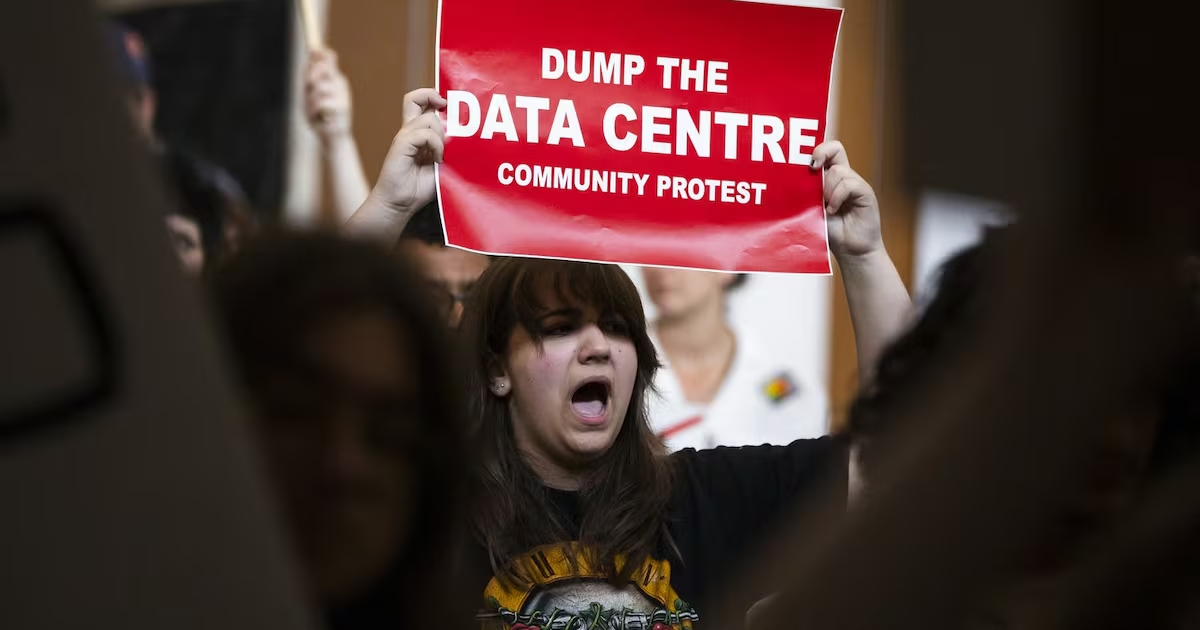
New Brunswick data centre debate highlights cross
4 days ago
 AI News
How to Structure an AI Agent Referral Fee Agreement Between Startups
4 days ago
 AI News
No, AI didn’t delete a Swedish reality TV series
4 days ago
 AI News
There is no AI in Armageddon. Artificial intelligence is a tool, not an apocalypse
4 days ago