
Canada could become the EU’s first ‘associate member.’ What would it mean for Montreal?
Nearly half of the foreign-investment projects handled by Greater Montreal’s investment-promotion agency last year came from Europe. Now, Canada and the European Union are talking about taking their relationship far beyond free trade.
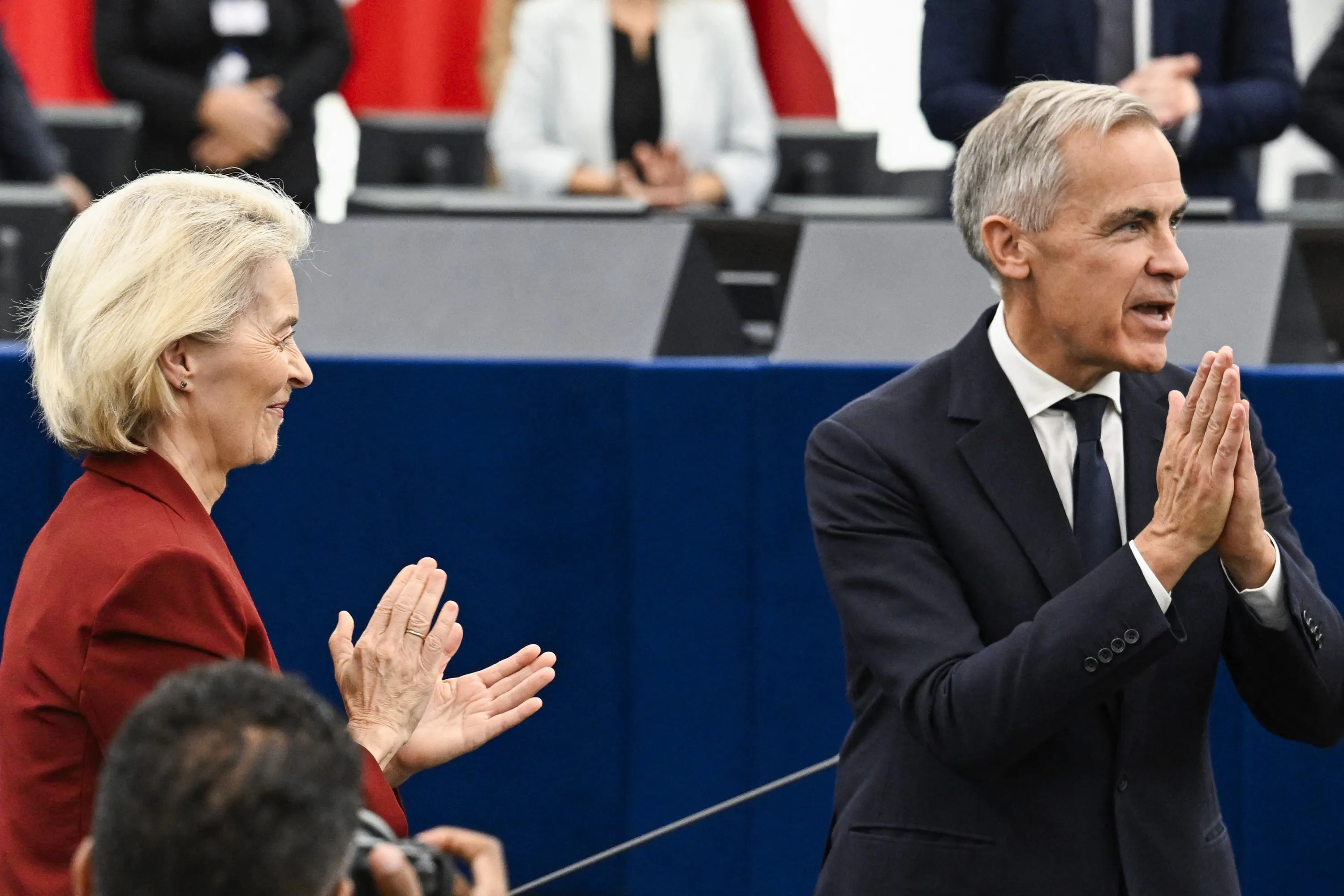
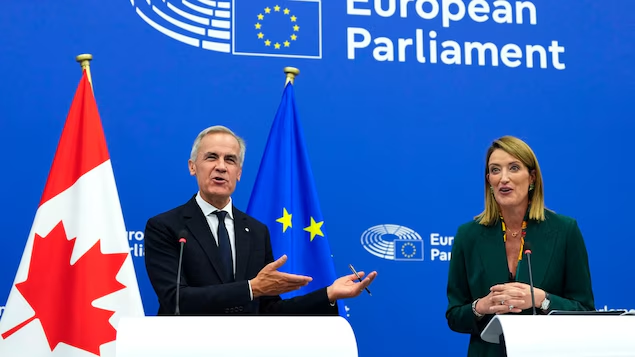
Addressing the European Parliament in Strasbourg on Thursday, Prime Minister Mark Carney called for the “deepest possible partnership” between Canada and the European Union after European Commission President Ursula von der Leyen opened the door to Canada becoming the bloc’s first “associate member.” The still-undefined proposal could go beyond the Canada-European Union Comprehensive Economic and Trade Agreement, known as CETA, toward much deeper economic and security ties between Canada and Europe.
Montréal International, the non-profit agency tasked with attracting foreign investment to Greater Montreal, says European companies accounted for 44 per cent of the projects it handled in 2025 and 38 per cent of their investment value.
“The multilingual [population] is a major, major advantage for us,” said Mark Maclean, vice-president of foreign investment at Montréal International.
Maclean said European investors often find Montreal culturally familiar, with French-language ties part of a broader connection to the continent.
That economic relationship is now being matched by a political push for closer ties.
“Eighteen months ago, no one would have thought that Canada would occupy so much space in a State of the Union speech,” said Frédéric Mérand, a Université de Montréal political scientist who specializes in European politics.
Exactly what an “associate member” would mean remains unsettled.
“It’s not in the EU treaties,” Mérand said.
Norway and Switzerland have forged close relationships with the bloc without becoming members, Mérand explained, but there is no existing EU status matching what is now being discussed.
“By associate member, we mean having a foot inside the European Union, but not being part of everything,” Mérand said.
The areas under discussion are already taking shape: AI, critical minerals, energy, defence and digital trade are among them.
Carney has also called for deeper mobility ties allowing young Canadians and Europeans to live, work and study on either side of the Atlantic, including possible Canadian membership in Erasmus+, the EU’s student-exchange program.
Montreal already offers a glimpse of what closer economic ties can look like.
Canada became the first non-European country to join the EU’s SAFE defence initiative earlier this year. In June, Montreal-based Marconi Technologies was awarded a contract worth more than $10 million to supply Canadian-made tactical radios to Poland’s Cyber Command — the first contract awarded to a Canadian company under the program.
European investment is flowing the other way, too. German security-technology company Giesecke+Devrient opened an AI hub at Mila, the Montreal-based Quebec Artificial Intelligence Institute, in June and plans to invest more than $80 million over five years.
For Sami Robotics, Europe is becoming a more immediate prospect.
In the coming weeks, a delegation of German growers is expected to travel to California’s Salinas Valley to see the Montreal-area startup’s agricultural robot at work. The visit could eventually lead to trials in Germany.
“Any initiative that can lower barriers and facilitate collaboration between Canada and Europe would help us scale faster,” said Teodora Toteva, Sami Robotics’ head of operations.
“Our next market would be Europe more than Asia-Pacific,” she said.
“CETA has opened doors. We now need to enable more businesses to walk through them,” said Isabelle Dessureault, president and CEO of the Chamber of Commerce of Metropolitan Montreal.
Quebec exported $13.8 billion worth of goods to Europe last year, according to the Chamber — 62 per cent more than in 2016.
Aerospace is another sector watching closely. Aéro Montréal president Mélanie Lussier said closer ties with Europe would fit the industry’s push to diversify its markets, particularly in sustainable aviation.
The scale of that diversification is another question.
“We are kind of in the curse of geography,” said Ari Van Assche, a professor of international business at HEC Montréal.
Trade tends to stay regional, he said, meaning deeper ties with Europe are unlikely to displace the United States as Quebec’s dominant market.
“We shouldn’t be worrying too much about this headline number, whether or not we have 70 per cent or 60 per cent of our trade going to the United States,” Van Assche said. “What we want to make sure is that, for our own sovereignty and economic security purposes, we’re not too dependent on one specific country for strategic products.”
In Quebec, the debate is also turning to who would have a say in any deeper relationship.
“Quebec cannot be a simple spectator,” Premier Christine Fréchette said in a social media post Thursday, responding to Carney’s push for a deeper Canada-EU relationship.
She formally called on Carney to give Quebec a “special status” in any new Canada-EU alliance, including a formal place at the table and direct participation in discussions affecting provincial jurisdiction and Quebec’s interests.
Some provincial involvement would be necessary regardless of whether Quebec obtains the “special status” Fréchette is seeking, Mérand said. Regulatory changes can fall under provincial jurisdiction, meaning Quebec and other provinces would need to be involved. Defence and security, by contrast, remain federal responsibilities.
“Now we need a roadmap,” Mérand said, pointing to the need to identify specific areas for deeper co-operation and how to pursue them.
Canada and EU leaders are due to meet again at their next summit Oct. 29 and 30 in Montreal.
Related Stories
 Canada
This Week in Washington: Trump calls EU
5 minutes ago
 Canada
CBC News speaks with David Plunkett about Carney’s speech on Canada
5 minutes ago
 Canada
Here are the Montreal road closures this weekend, including for the UCI Road World Championships
37 minutes ago
 Canada
Pitch for EU security council involves Canada, but it’s not clear how
1 hour ago
 Canada
Stronger Canada
1 hour ago
 Canada
Three Carleton Alumni Named to Canada’s 2026 Top 40 Under 40 List
1 hour ago
 Canada
Carney wants Canada to join Europe’s Erasmus+ program. What is it?
1 hour ago
 Canada
UCI Road World Championships: Everything you need to know to get around Montreal
1 hour ago