
Stronger Canada
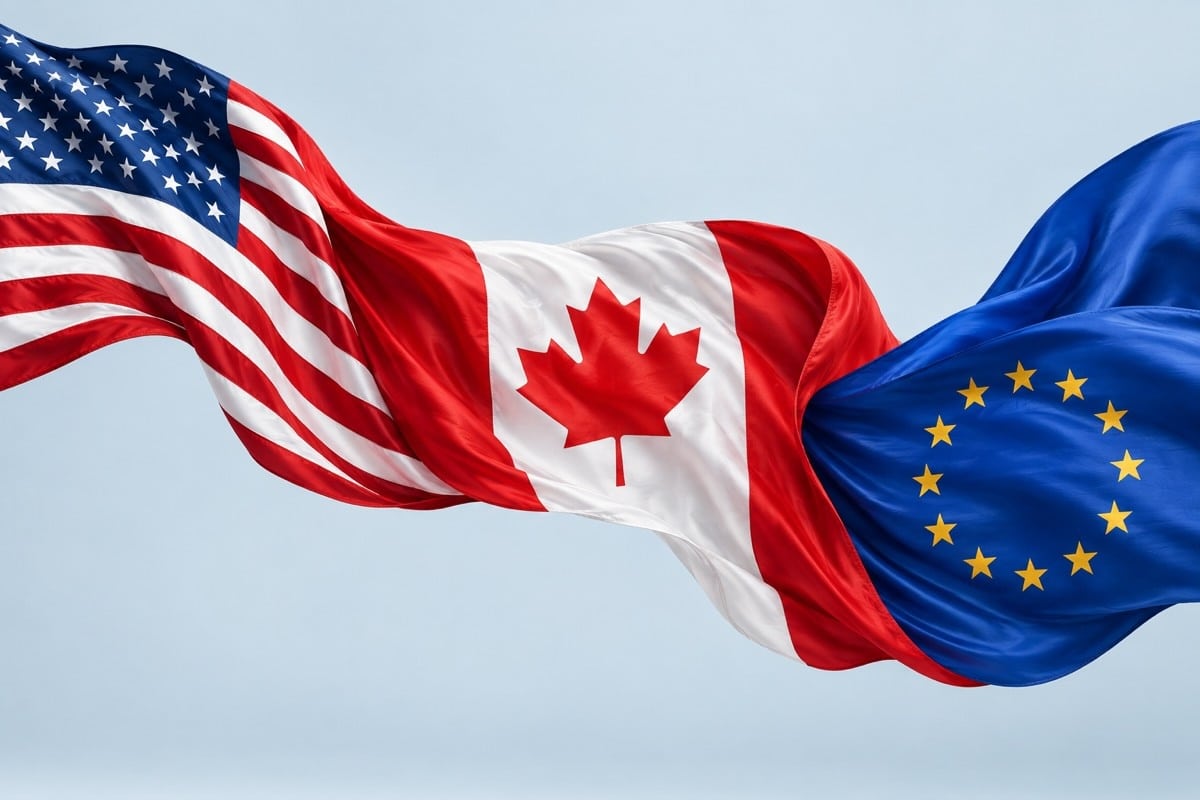
Over the course of this week, the relationship between Canada and the European Union took an unprecedented leap forward.
On September 12, the Wall Street Journal broke the news that Canadian Prime Minister Mark Carney was pursuing "associate member" status for Canada in the EU, citing unnamed officials.
Although government sources have since pushed back on claim, on September 16, European Commission President Ursula von der Leyen proposed something remarkably similar: Canada becoming the EU's first-ever "associate member.”
Get a Free Consultation on Applying for Proof of Canadian Citizenship
Carney appeared to respond the next day, September 17, telling the European Parliament in Strasbourg that, "Canada welcomes this ambition."
What closer Canada-EU ties could mean
While nothing has been finalized, and Carney has been careful to describe the talks as being at an early stage, there are some points to take note of.
The areas under discussion point towards a deeper partnership and increased cooperation in various sectors, namely energy, critical minerals, artificial intelligence, and digital trade.
Carney also raised the possibility of expanded mobility for people across Canada and Europe.
“We should deepen our people-to-people ties, allowing our youth to work, study and live where they want on either side of the Atlantic,” he said.
He went on to add, “Canadian membership of Erasmus+ would give your students and ours more opportunity to learn in some of the world’s top universities to broaden their horizon and to build those lasting ties that will sustain our alliance for the future.”
Erasmus+ is the EU's program that funds student, trainee, and youth exchanges and educational partnerships across countries.
Canada already has youth mobility agreements
Interestingly, the opportunities Carney has proposed for youth is not a new concept in Canada.
Canada already runs bilateral youth mobility agreements with over 35 countries, including more than a dozen EU members.
IEC (International Experience Canada) is a Canadian government program that lets young people from partner countries get open work permits to live and work in Canada temporarily, through categories like Working Holiday, Young Professionals, and International Co-op.
Through this, Canadian citizens under the age of 30 (or 35 in some cases) have the ability to live and work in countries such as France, Germany, and Belgium for a period of time.
It remains to be seen how a stronger EU alliance could expand Canada's existing offerings.
Meanwhile, a Canadian passport already allows visa-free short stays across the Schengen Area, and currently ranks higher than the American passport in global mobility.
Americans with Canadian ancestry also stand to gain
Thanks to a new law that took effect on December 15, 2025, millions of Americans also qualify for a Canadian passport... and stand to gain from what Canada negotiates in the future.
Bill C-3, which took effect on December 15, removed the first-generation limit on citizenship by descent for anyone born before that date. That means Americans who can trace a line of descent to a Canadian ancestor — a grandparent, great-grandparent, or further back — are also Canadian citizens,. All it takes is one Canadian ancestor, to make an entire line of descent Canadian.
As Canadian citizens, they're entitled to every benefit that citizenship carries: a Canadian passport, access to public healthcare and social services if they settle in Canada, and even access to IEC's youth mobility agreements described above. If a strategic Canada-EU alliance comes together and those agreements expand, Americans with Canadian ancestry may have a foothold in Europe that their compatriots simply don't have.
It’s worth noting that, to access the benefits of citizenship, applicants need to submit a proof of Canadian citizenship application to Immigration, Refugees and Citizenship Canada (IRCC). If successful, IRCC issues them a Canadian citizenship certificate confirming their status.
How to apply for a Canadian citizenship certificate
The process starts with identifying an "anchor ancestor" — the Canadian relative through whom the citizenship claim runs.
From there, applicants need to gather documentation proving their ancestor’s Canadian citizenship status as well as an unbroken line of descent, generation by generation, from the original source authority.
The next step is submitting a complete application form with identity documentation, photographs, and a receipt showing that the fee has been paid.
Since Bill C-3 passed, demand for Canadian citizenship certificates has surged, mostly from Americans. According to one report, the number of applications from US citizens in January 2026 alone outnumbered the combined total from the next nine source countries.
The queue keeps growing: the number of people awaiting a citizenship decision rose from 70,400 in May to 136,000 in September 2026, which means it nearly doubled in just four months.
A window that may be opening wider
For now, the Canada-EU conversation remains abstract. Carney has been careful not to overpromise, and von der Leyen's "associate member" proposal will need months, if not years, of negotiation before it takes any concrete shape.
Carney has alluded to there being a debate and vote in the Canadian parliament on the proposals. A Canada-EU summit, to take place at the end of October, could be where details are ironed out.
But for the millions of Americans who already qualify for Canadian citizenship under Bill C-3, the proposal is hard to ignore.
What started as a law change to correct a citizenship gap has put a growing number of Americans in a position to benefit from whatever Canada negotiates next — whether that's expanded trade access, deeper student exchange, or increased mobility in Europe.
For now, the surest way to capture that upside is a step within their control: applying for the proof of citizenship they're already entitled to.
Related Stories
 Canada
This Week in Washington: Trump calls EU
7 minutes ago
 Canada
CBC News speaks with David Plunkett about Carney’s speech on Canada
7 minutes ago
 Canada
Here are the Montreal road closures this weekend, including for the UCI Road World Championships
39 minutes ago
 Canada
Canada could become the EU’s first ‘associate member.’ What would it mean for Montreal?
1 hour ago
 Canada
Pitch for EU security council involves Canada, but it’s not clear how
1 hour ago
 Canada
Three Carleton Alumni Named to Canada’s 2026 Top 40 Under 40 List
1 hour ago
 Canada
Carney wants Canada to join Europe’s Erasmus+ program. What is it?
1 hour ago
 Canada
UCI Road World Championships: Everything you need to know to get around Montreal
1 hour ago