
Canada’s tariffs are coming for Michigan

WASHINGTON, D.C. — Unless Washington and Ottawa change course, Canada’s retaliatory tariffs on more than 700 U.S. products entering Canada — covering CA$27.6 billion in annual imports — are scheduled to take effect Tuesday.
The duties, ranging from 15 to 50 per cent, come as U.S. Trade Representative Jamieson Greer said this week that “there are no negotiations happening on trade right now.” A source close to the Canadian side said on Friday that no talks were underway.
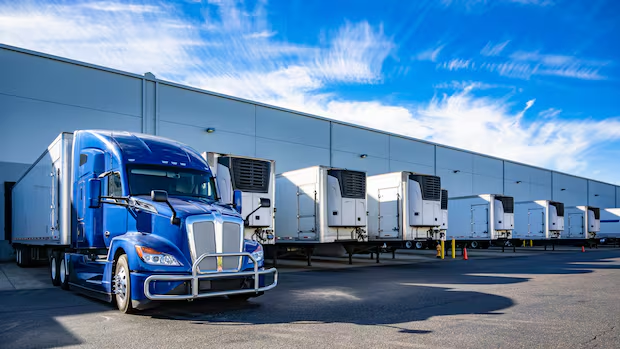
The Canadian duties would cover a broad range of vehicle-related goods, including a 25 per cent tariff on trailers and semi-trailers, as well as higher duties on steel, aluminum and industrial inputs used in automotive and equipment manufacturing. The U.S. measures raise costs for Canadian goods entering the United States; Canada’s retaliation does the same for selected U.S. goods entering Canada.
Analysts say the Canadian package is broader in scope than the U.S. measures it answers.
“The actual tariffs imposed by the United States were really a list of annoyances,” said Patrick Anderson, CEO of Lansing-based Anderson Economic Group. “The Canadian tariffs appear to be much more pervasive… Canada’s reaction here has been both rhetorically and substantively significantly larger than what the U.S. actually imposed.”
Several U.S. states will feel the impact, including Ohio, Illinois, Indiana, Kentucky, Tennessee, Texas, and Maine, but Michigan could take the hardest hit, analysts say. The mitten-shaped state is most exposed because it ships about $1.5 billion in tariff-listed products to Canada each year. Canada was the destination for 36 per cent of Michigan’s goods exports in 2025, according to U.S. trade data, and motor vehicles and auto parts accounted for a large share of that.
“Michigan is the single largest auto parts exporter to Canada,” said Jason Miller, a supply chain management expert and professor at Michigan State University, noting that “the auto parts suppliers in Michigan who are exporting to those plants are going to be hurt.”
“The Detroit metro area writ large is about the most export-dense manufacturing area to Canada of anywhere in the country,” he added.
“The worst affected province would be Ontario, and the worst affected states would be Michigan, Ohio, Indiana, Illinois and Texas,” Anderson predicted.
Analysts and industry groups say the earliest pain may show up not on factory payrolls but in wholesale margins and inventory decisions.
“Everybody’s focusing on manufacturing, but there are so many jobs in the wholesaling side of imported products,” Miller said, noting that he’s curious about “Michigan wholesalers getting caught up in this and being negatively affected.”
Drew Beardslee, the vice president of government affairs at the Michigan Retailers Association, says the earliest impacts will be on wholesale margins and inventory decisions, with consumers seeing effects within a quarter.
Related Stories
 Canada
Cape Bretoner builds virtual 18th
24 minutes ago
 Canada
Counter
24 minutes ago
 Canada
How Canada’s border offices are facing a major security gap
24 minutes ago
 Canada
What’s open, closed on Labour Day?
1 hour ago
 Canada
One of the last remaining steam tugboats in Canada is heading for restoration
1 hour ago
 Canada
Matt Bufton: Can the NFL save society?
1 hour ago
 Canada
Alumina processing plan brings optimism to Tisdale, Sask.
1 hour ago
 Canada
What some Canadians still get wrong about Type 2 diabetes
1 hour ago