
Canadian peacekeepers' cemetery in Gaza completely destroyed, satellite imagery shows
Canadian peacekeepers' cemetery in Gaza completely destroyed, satellite imagery shows
CBC News analysis finds IDF blasts caused damage deep underground
Families of Canadian servicemen buried in Gaza say they want the government to do more to protect their loved ones' remains. Some say they would like to see their relatives — the last Canadian soldiers to be buried overseas — removed from a cemetery that has been repeatedly damaged by the Israel Defense Forces and brought home.
Twenty-two Canadians are buried at the Gaza War Cemetery in the Tuffah district of Gaza City, all of whom lost their lives during the UN's first major peacekeeping operation that began following the Israeli invasion of Egypt in 1956.
Aerial images reviewed by CBC's visual investigations team show that the IDF has progressively destroyed headstones, dug berms with heavy earthmoving equipment, parked tanks and other armoured vehicles around the site and triggered explosions that saw a section of the Canadian peacekeeper plot blown into the air.
The sisters of two of the men buried in that plot, Paul Picard of Quebec and Adriaan Bons of Ontario, spoke to CBC News about their concerns for their brothers' remains.
How Canadian war graves in Gaza were destroyed
"It's like there's no headstones anymore. It just looks like dirt, gravel, sand," said Lia Bons after viewing before and after aerial images of the site.
"There's nothing standing even of the surrounding homes."
Bons said she was glad her parents were not alive to witness the "total destruction" of their son's last resting place.
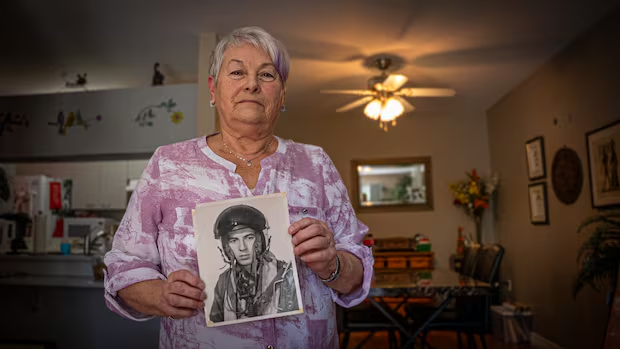
Marguerite Picard says she wishes to rebury her brother alongside their parents.
"I'm quite certain that my parents would want my brother to be repatriated," she said. "I would put him next to mom and dad, and have his name written on the headstone, so that people know he's there."
CBC News reached out to the IDF to ask about the cemetery and was put in touch with an officer of the 401st Brigade Combat Team of the IDF, who said his unit had dug to a depth of 20 to 30 metres in the cemetery to destroy a tunnel that cut under it. He said the work occurred under combat conditions and no precautions were taken to protect the remains of soldiers buried in the plot, which is administered by the Commonwealth War Graves Commission (CWGC).
In a Hebrew-language social media post in 2025, the IDF referenced an operation that aimed to collapse what it called a Hamas tunnel near "a cemetery" in Gaza City.
CBC's visual investigations team was able to geolocate that video and confirm that it shows the Gaza War Cemetery. A chain of underground explosions can be seen in the video, with three large explosive plumes of debris rocketing skywards. One of those bursts occurs at the southeast corner of the cemetery compound, where the 22 Canadian peacekeepers lie.
Dust lofts off the ground along lines running between those explosions, suggesting that the blast did run through underground passages.
Reduced to rubble, then blown up
Because the IDF does not allow journalists near the site, CBC News has only been able to examine it using satellite imagery.
That imagery shows massive damage to the site even before August 2025, with above-ground structures reduced to rubble.
But the CBC News analysis of explosive charges that appear to have been detonated between Aug. 3 and Aug. 4, 2025, clearly suggest damage deep underground.
The IDF posted its video of the demolition operation on the morning of Aug. 7.
No representative of the Canadian government has been able to visit the site, and neither has anyone from the Commonwealth War Graves Commission. The local Jaradeh family, who have tended the cemetery for four generations, were forced to flee that area as the IDF advanced. They are now in Egypt.
It was once standard practice to bury Canadian soldiers who died overseas in theatre, but the policy changed in 1970.
The 22 men who died in the UN peacekeeping mission to Gaza and Sinai were the last to be buried overseas.
One of them was Paul Picard, the only son in a family of girls in Beauharnois, Que., who became a pilot officer in the Royal Canadian Air Force in 1964. He soon found himself in the Middle East on the peacekeeping mission that would win a Nobel Peace Prize for its chief advocate, the Canadian foreign minister Lester Pearson.
He flew Dakotas and Twin Otters, delivering supplies to the forces that separated the Israeli and Egyptian combatants in the desert. The young officer became engaged to a British woman living in Beirut.
Picard signed up for a second tour, and as the end of his time in the Middle East approached, he was offered a job by Air Canada flying DC-8s.
Picard was already training the officer who would replace him when his plane developed mechanical issues and crashed soon after take-off.
"One man died on board the plane," said Marguerite Picard. "My brother and another man were able to get out, burned, and roll in the sand to extinguish the flames."
Picard suffered third-degree burns to most of his body.
The government of Canada would only pay for Paul's father to make the trip to Egypt. But local Egyptians raised money to cover his mother's flight as well, and both arrived five days after the crash, just hours before their son died.
IDF says it dug up Canadian soldiers' graves to destroy Gaza tunnel
"Paul was surprised when he heard my mother's voice," said his sister. "He spoke with them, and then he died. As if he was waiting to speak with them to die."
Paul Picard received a large funeral with military honours at the Gaza cemetery. But neither his parents nor his sisters were ever able to return to visit his gravesite.
'Bad enough that he's buried in a faraway land'
Lia Bons said her brother Adriaan grew up in a poor Dutch immigrant family, but "had great plans for his future. He wanted to travel and see the world. And I think that's why he joined the army."
Bons was happy to go on the peacekeeping mission, she said, and pictures he sent home included himself riding a camel.
"I think he loved it there," she said.
Bons died when he and another soldier went out to find a man lost in the no-man's-land between Israeli and Egyptian forces.
"Because of the shifting sands there, as he was turning back around, the wheel of the jeep hit a landmine," she said.
Lia Bons and her sister were returning home from school when they saw an unfamiliar car in their driveway.
"I remember [my father] out on the grass outside the house leaning, like kneeling, on the grass and just crying and wailing. Because he's their first-born son, right? Their baby," she said.
Adriaan Bons's father was the only member of the family who was ever able to make the trip to the cemetery, in 1986 — a period of relative quiet in the Israeli-Palestinian conflict.
Lia says the family often missed having a place to visit Adriaan. The destruction of the Gaza cemetery now compounds that.
"It's bad enough that he's buried in a faraway land," she said. "But to be disturbed like that, like, having the cemetery destroyed is just totally … it really hurts my heart. It's devastating. How dare they? How could anyone do that?"
Recent satellite images of the Tuffah area show that the IDF has continued to damage the site.
At some point between April 5 and April 16, the archway to the Canadian plot — which had at least partly survived the explosion of August 2025 — appears to have been destroyed.
Jake Godin, who works with the digital research group Bellingcat in Washington, D.C., told CBC News that the IDF did extensive damage to both the main cemetery and the attached Canadian and Indian plots during the first half of April.
"We saw essentially the construction of a massive berm following along the IDF's yellow line [line of control]. We see essentially the Canadian section be completely destroyed," he said.
"The wall is gone, the archway is gone. There's a large dirt berm and a dirt roadway."
"The lack of access to the Gaza War Cemetery is still preventing confirmation of damage, forensic assessment or timelines," Josh Bueckert of Veterans Affairs told CBC News. "As a result, the CWGC cannot send their staff to do a full assessment of the situation."
Canadian officials would not tell CBC News what steps they have taken with the government of Israel.
"Canada is deeply troubled by reports that the Gaza War Cemetery was damaged," Brittany Fletcher of Global Affairs Canada told CBC News. "Canada underscores in the strongest possible terms the importance of ensuring that historical and memorial sites dedicated to those who served are preserved with the utmost respect."
She said Global Affairs would not "comment on confidential state-to-state communications among officials," but added that the department "has been in touch with local authorities," without specifying who those authorities were.
Evan Dyer has been a journalist with CBC for 25 years, after an early career as a freelancer in Argentina. He works in the Parliamentary Bureau and can be reached at evan.dyer@cbc.ca.
With files from Ivan Angelovski
Related Stories
 AI News
Thousands of Canada, Switzerland fans march to BC Place ahead of game
47 minutes ago
 AI News
Ontario announces more highways where speed limit will be 110 km/h
47 minutes ago
 AI News
Qatar’s Madibo banned for 5 games after breaking leg of Canada’s Kone
47 minutes ago
 AI News
‘It’s like a furnace’: French struggle with heat
48 minutes ago
 AI News
Thieves jailed for stealing 25 cars worth £600k
48 minutes ago
 AI News
Grocery store coming as part of Portage Place redevelopment
48 minutes ago
 AI News
Switzerland leads Canada 2-0 in tense World Cup group game
49 minutes ago
 AI News
Concerns persist at secure care home, says Ofsted
49 minutes ago