
Carney's announcements at investment summit include tax incentives to lure foreign investors
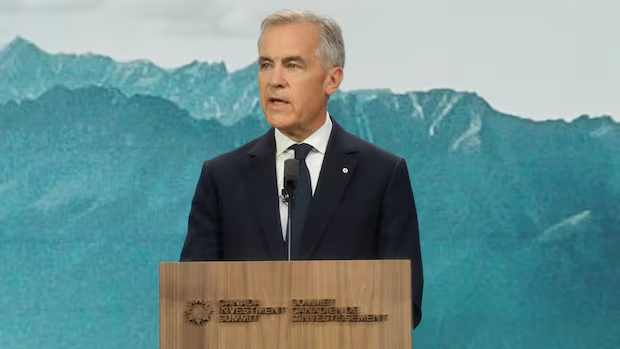
Carney's plan for private investment at airports will squeeze workers, cost passengers more: labour congress
Canada seeking private investment at 4 airports: Carney
Economist Jim Stanford said he thinks Carney's summit should have focused on attracting foreign investment to build new infrastructure here in Canada, rather than selling off ownership of Canadian assets like airports.
"Foreign investment has both costs as well as benefits. It depends what the foreign investment is used for. If it's used to build new capability, that's great," he told CBC News.
"If it's just used to transfer ownership over something we already have, you know, like an airport to take an example, then it adds nothing to our productive capability."
Having lived in Australia, Stanford said he's seen what privatized airports have become there.
"It's a low-risk cash cow, and consumers have paid big time because the airports are now run to maximize profits for those private operators," he said.
Stanford said he thinks the summit was largely to show Trump that Canada "has a lot going for it", but it likely won't make a huge difference.
"What will make the difference is when we start to see investment flowing into new capital projects," he said.
"And this is what I stress: if it's new money on the ground building new stuff, new machinery, new equipment, new technology that adds to our GDP and that creates jobs, that diversifies our economy so that we can withstand Mr. Trump all the better, then that's what we want to see."
In an op-ed published in the Toronto Star and on his foundation's website, environmentalist David Suzuki criticized Carney's investment summit for failing to address climate change, arguing that economic growth is being prioritized over the urgent threat the climate crisis poses to humanity.
"After interviews I have had with Carney, before and after he became a politician, I believe he is very intelligent, understands the gravity of the climate crisis and is committed to reduce the threat," Suzuki wrote.
"But we have run out of time to delay the radical and deep cuts in emissions that are needed to avoid climate chaos."
Suzuki said he understood the urgent need to bolster Canada's economy and reduce our dependence on the U.S., but argued it shouldn't be done at the expense of environmental protections.
He said cancelling a carbon tax and loosening environmental considerations to fast-track development may support economic growth but "reflect the failure to see that the global economy is the driving force of ecological destruction."
"That’s the problem. Our most elementary and essential needs are dictated by our biological makeup, but our legal, economic and political systems are created to shape, guide and constrain human behaviour without regard to nature and so are inevitably destructive," Suzuki wrote.
"If we can’t start with this fundamental agreement, we are bound to quibble over vested interests and fail. Carney’s meeting won’t address climate change that threatens all of humanity."
NDP Leader Avi Lewis has come out swinging against Carney's plan for private investment in airports, saying the proposal "would be a disastrous deal for travellers, workers and the public purse."
"Canadian airports already support hundreds of thousands of jobs, yet workers are already dealing with contract-flipping, insecure employment and staffing shortages. Handing these critical services to profit-driven owners would put even more pressure on working conditions and safety," Lewis said in a statement.
"The alternative to privatizing our airports is very simple: don't do it."
Vancouver International Airport (YVR) says it's open to explore how private investment could support its operations after Carney announced plans to allow privatization in Canada's four largest airports through long-term concession agreements.
YVR president and CEO Tamara Vrooman said in a statement Tuesday that the airport has been in continuing discussions with the federal government for several months, as well as discussions with the Musqueam Nation given the airport's relationship with the nation.
"We look forward to exploring how private investment can continue to drive passenger experience, support our people and community, and ensure YVR delivers long-term economic value for the region and Canada," she said.
YVR says its current operating model, in place since 1992, includes 28,000 people working there every day and supports another 130,000 jobs nationally. It says the airport contributes $16 billion to Canada's GDP.
Musqueam Nation said in a statement that it is reviewing the federal government's plan and looks forward to "meaningfully participating in any change to YVR."
Representatives for the Montreal airport also released a statement saying it recognized the federal government's initiative to look for more investment avenues into Canadian airports and that the airport looks forward to sharing its ideas about what that could look like.
The statement said "the announced collaboration deserves to be highlighted and supported, as it will form the foundation for the success of whatever approach is ultimately adopted."
Toronto released its own statement Tuesday afternoon as well, saying it looks forward to working with the government on next steps.
Manitoba is looking to triple its critical mineral production over the next five years and use the Port of Churchill to ship more of those resources to international markets.
The province announced plans today to fast-track environmental approvals for advanced mining projects, speed up early mineral exploration and make it easier for mining companies to connect to Manitoba's hydroelectric grid.
In a statement, Premier Wab Kinew said he is also pitching the Port of Churchill, along with mining, infrastructure and agriculture projects worth more than $85 billion, to global investors at the summit.
Kinew said earlier Tuesday that the federal government's investment measures, including Carney's new productivity "mega-deduction," could be a major boost for Manitoban productivity.
He said the summit has helped spark the relationships needed to move projects forward, but that "the real test is going to be how do we follow through, how do we actually implement the start of these good relationships in a way that actually creates jobs and opportunities."
Kinew said Manitoba is open to working with other provinces on major projects, including an east-west pipeline.
"We're spending a significant amount of time here pitching Churchill to a very receptive audience."
CBC News Network speaks to Lily Chang about Carney seeking private investment for major airports
Get the latest on CBCNews.ca, the CBC News App, and CBC News Network for breaking news and analysis.
The Canadian Labour Congress is pushing back against the plan to allow private investment in Canada's largest airports.
"Our experience with any time a service or a government-owned commodity has been privatized is that it results in higher costs for the users, that there's always some kind of negative pressure on workers. And then of course there's generally a loss of long-term public value," said Lily Chang, secretary-treasurer of the CLC.
She said private operators would be looking to recoup the billions they invest, potentially increasing costs for everything from airport parking and baggage carts to retail outlets and taxi access.
"All of these added costs will be passed over to the consumer," she said. "It will definitely increase the cost for the person who's travelling."
Chang also warned that private operators could look to cut labour costs to increase profits.
"There's all kinds of ways to squeeze money and workers, as well as safety could be at risk," she said.
Cohere CEO Aidan Gomez says Canada is currently poised as a leader in AI technology, and leveraging outside investments could help it grow.
The Canadian AI startup is valued at more than $6.8 billion, making it a leader in the country and abroad. With the most advanced, so-called frontier AI models in only a handful of other countries, Gomez says a company like his could give Canada a "ticket to the AI race."
"Canada deserves a champion," Gomez said. "We should continue to control its deployment around the world, and I hope the Cohere can contribute to that on Canada's behalf."
He said that outside money is still necessary to make that happen, though.
"We will need to invite the international community to support us building our champions."
Canada seeking private investment for 4 large airports, Carney says
Prime Minister Mark Carney announced a plan Tuesday to seek investment to 'unlock' the value of Canada's four largest airports. Carney, speaking at a major investment summit, provided few specifics but said the government would retain ownership of underlying land and assets.
Conservative Leader Pierre Poilievre says that while Carney is making grand statements about opening Canada up to foreign investment, the cost of living in the country continues to rise.
Poilievre spoke in Vancouver, offering his rebuttal to Carney's investment summit in Toronto.
"What are the results for you? For your life? Those are the questions we're asking," Poilievre said, opening his remarks as usual in French.
He accused Carney of doubling Canada's deficit since taking office after former prime minister Justin Trudeau and said that while Conservatives are "100 per cent" in favour of free trade with Europe, Carney has given few details about how he would increase the already existing trade with the European Union.
Poilievre pointed out that the Conservatives were the ones to initially broker a trade deal with Europe (under Harper, though Poilievre did not mention him by name).
Poilievre also criticized Carney's idea of Canada becoming an associate member of the EU, floated in an exclusive for the Wall Street Journal this week.
"Conservatives don't support Canadians having to pay tax to European governments and follow European laws, or allowing border policies to inundate our immigration system where we already have too many young people who can't find housing," Poilievre said.
The Conservative leader said there are still barriers to investment in Canada and he would instead focus on reducing project approval times and getting rid of the industrial carbon pricing system, which he incorrectly called a carbon tax, and eliminating Canada's capital gains tax.
For Telesat CEO Daniel Goldberg, the two-day summit has been a good opportunity to make connections with investors from around the world.
His company's low Earth orbit satellite network project, which would provide broadband connectivity across the world, was included in the prospectus document ahead of the summit.
While the project is fully funded, Goldberg said the summit is about getting to know international investors so that those relationships are built when it comes time to scale the project in the future.
"We're engaging with investors all the time, but it's different here when they're attracting this many high quality, very senior executives who are at these leading asset management companies," Goldberg said.
He said securing the $7 billion in funding his company needed for the satellite project has been the biggest hurdle. He's glad to see commitments from some of Canada's major banks this week to invest more within the country, but said it can't all come from within the country.
"The government talks about attracting something like $1 trillion of … investment over the next five years. You need to reach out to these deep capital pools around the world" for that, he said.
Related Stories
 Canada
Calgary man charged for alleged YouTube threat to kill Carney, RCMP says
29 minutes ago
 Canada
Carney says Canada will pursue ‘unique economic alliance’ with EU amid US trade spat
29 minutes ago
 Canada
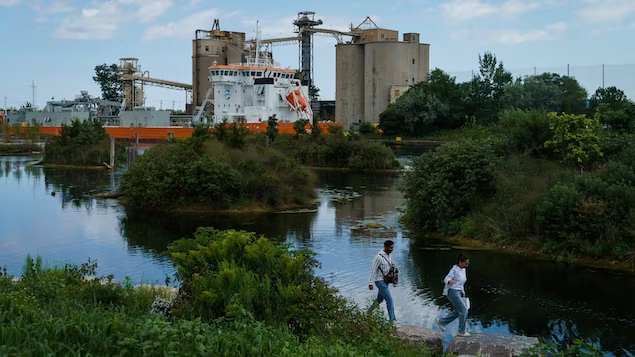
Trump’s latest round of 50% tariffs on Canadian goods now in effect
58 minutes ago
 Canada
Chief says Canada blocking effort to take back control of child and family services
58 minutes ago
 Canada
Zelenskyy’s comparison of Canada to Ukraine is imperfect — but it matters
58 minutes ago
 Canada
TIFF 2026: The latest movie reviews from Toronto
58 minutes ago
 Canada
Davies, Crepeau to miss Canada's World Cup homecoming games in Toronto, Montreal
1 hour ago
 Canada
Alberta referendum pitches more control over immigration. Here's what you need to know
1 hour ago